Self-reported encoding quality promotes lure rejections and false alarms
- 1Department of Psychology, University of North Carolina at Greensboro, Greensboro, North Carolina 27412, USA
- 2Department of Behavioral Sciences, Millikin University, Decatur, Illinois 62522, USA
- 3Department of Psychology, Towson University, Towson, Maryland 21252, USA
- Corresponding author: cnwahlhe{at}uncg.edu
Abstract
The hippocampus supports distinctive encoding, enabling discrimination of perceptions from similar memories. Here, an experimental and individual differences approach examined the role of encoding quality in the classification of similar lures. An object recognition task included thought probes during study and similar lures at test. On-task study reports were associated with lure discrimination in within-subject and between-subjects analyses. Within-subject on-task reports were also associated with false classifications of lures as studied objects. These results are compatible with the view that quality encoding supports memory-based rejection of lures but also engenders false alarms when perceptions and memories are inaccurately compared.
Memory interference may be prevented by hippocampal pattern separation that encodes new events distinctly (Treves and Rolls 1994). Pattern separation has been investigated using a mnemonic similarity task (MST) (Stark et al. 2019). In object-based MSTs, participants study objects and attempt to reject similar but not identical lures. Hippocampal subfields have been implicated in the orthogonalization of inputs, supporting lure discrimination (Yassa and Stark 2011; Hunsaker and Kesner 2013). However, lure discrimination does not purely assay pattern separation, as encoding processes also contribute (Molitor et al. 2014). MSTs can also be modified to differentially recruit pattern separation or completion processes (Liu et al. 2016), with the latter supporting reinstatement of studied objects. Encoding quality may also determine how memory for studied objects is used to reject lures (Norman and O'Reilly 2003; Gallo 2004; Odegard and Lampinen 2005). The present experimental and individual differences study examined the association between self-reported encoding and lure discrimination.
The MST was designed to assay hippocampal function among groups (Stark et al. 2019). Participants studied objects and classified repeated study objects, similar lures, and novel foils as “old,” “similar,” and “new,” respectively. When classifying lures, groups with hippocampal dysfunction associated with aging, clinical disorders, or neurological diseases show fewer correct rejections and more false alarms. This has been assumed to reflect a pattern completion process that reinstates existing memories when pattern separation fails (Toner et al. 2009; Kim and Yassa 2013). However, it is controversial whether pattern separation and completion processes are dependent, as implied by this account, or whether they are independent hippocampal operations (Hunsaker and Kesner 2013). Supporting the latter, Alzheimer's disease and hippocampal damage can reduce lure rejections without increasing false alarms (Kirwan et al. 2012; Ally et al. 2013). Lure rejection is also selectively improved when study conditions promote detailed encoding and item-specific retrieval (Dodson et al. 2000). These findings suggest that pattern separation and completion processes operate independently to support lure discrimination, with pattern completion contributing more when studied objects have been successfully encoded.
Other approaches suggest that encoding quality affects lure classifications in MSTs. For example, pairing studied objects with background scenes and reinstating those scenes with lures has been shown to increase false alarms (Doss et al. 2018; Racsmány et al. 2021). Additionally, computational modeling suggests that reduced encoding of object features accounts for higher lure false alarms in older adults (Huffman and Stark 2017). The role of encoding quality in MST lure classifications has also been examined using eye tracking. In single-item, continuous recognition variants, fewer fixations during study were associated with lure false alarms, suggesting that they result from poorer encoding (Molitor et al. 2014; Bjornn et al. 2022). In contrast, more fixations to one object of a studied pair led to more false alarms to corresponding lures that appeared next to noncorresponding targets on a forced-choice test (Rollins et al. 2019), suggesting that better encoding did not support lure rejection in this context. Despite the differences among approaches, these studies highlight that encoding differences influence both lure rejections and false alarms. However, these tasks were incapable of showing how better encoding quality could simultaneously increase rejections and false alarms, which would support the view that pattern separation and completion operate independently in MSTs.
We overcame this limitation using a thought probe procedure that could show the consequences of variations in encoding quality for lure rejections and false alarms. Encoding quality determines subsequent memory (Jacoby 1991; Long et al. 2018), as when dividing attention during study impairs memory (Craik et al. 1996) by reducing recollection (Gardiner and Parkin 1990) or when focusing attention improves memory (Turk-Browne et al. 2013; Garlitch and Wahlheim 2021). As with attention manipulations, thought probes measuring states of engagement, including mind wandering, assess the memorial consequences of encoding (Smallwood and Schooler 2006). Memory is often better following on-task than off-task study reports (Blondé et al. 2022), especially when the task involves semantic encoding (Maillet and Rajah 2013; Thomson et al. 2014) or interference that can be mitigated by recollection (Garlitch and Wahlheim 2020). Including thought probes in a recognition task enables subsequent memory analyses for all response and item types conditioned on probe reports. Our primary goal was to determine whether both lure rejections and false alarms would be greater when participants reported being on task than off task while studying the corresponding similar objects.
We developed a two-study–test cycle MST with unique objects in each cycle. The task balanced the number of probes with interprobe lag lengths to examine associations between object classifications and self-reported encoding (i.e., on-task reports). Thought probes followed study objects that later appeared as similar lures or studied targets on the recognition test. We could therefore conduct within-subject and between-subjects analyses to assess encoding-related differences in discrimination of lures and recognition of targets. We preregistered hypotheses on the Open Science Framework (OSF; https://osf.io/v7cb4). Based on studies indicating that memory for studied objects supports lure rejection (Stark et al. 2019), we hypothesized that on-task reports would be associated with better lure rejection in both within-subject and between-subjects comparisons. We did not preregister hypotheses for lure false alarms but reasoned that on-task reports would also lead to more false alarms. Our rationale was that lures should be misattributed as studied objects when pattern completion occurred but participants could not distinguish memories from perceptions. Finally, since mind wandering is often associated with impaired episodic memory (Blondé et al. 2022), we hypothesized that on-task reports would be associated with better target recognition in within-subject and between-subjects comparisons.
Three-hundred undergraduate students (222 females, Mage = 19.19; SD = 2.50; range = 18–43) from the University of North Carolina at Greensboro (N = 150; 106 females; Mage = 19.30; SD = 2.31; range = 18–32) and Towson University (N = 150; 116 females; Mage = 19.07; SD = 2.67; range = 18–43) participated for partial course credit.1 We included any undergraduate students eligible to participate in department studies as part of their course requirements. We did not set any specific exclusion criteria. We exceeded our minimum planned sample and had 0.80 power (α = 0.05) to detect a small effect size (r = 0.16) according to G*Power 3.1.9.2 (Faul et al. 2009). Participants were tested individually or in groups up to four.
All stimuli were presented using E-prime 3.0 software (Psychology Software Tools, Inc.). Participants completed two study–test cycles with unique objects and identical procedures. Each cycle included 270 objects (540 total) from the Stark Laboratory's database of MST stimuli (https://faculty.sites.uci.edu/starklab/mnemonic-similarity-task-mst; Stark et al. 2013). A within-subject design included target, lure, and foil test conditions. For counterbalancing, the stimulus set was divided into six 90-object groups with comparable normative lure false alarm rates established by Stark et al. (2013). Groups were then rotated through cycles and test conditions, appearing equally often in six formats across participants. In each cycle, participants viewed 180 objects during study and 270 objects at test. All objects appeared for 3 sec each (1-sec ISI) instead of the standard MST duration of 2.5 sec (0.5-sec ISI). This modification was intended to induce mind wandering and provide ideal time lags between thought probes. Objects appeared in fixed random orders with two stipulations: No more than three objects from the same condition appeared consecutively, and the average serial positions were equated across conditions. Each study phase included 10 thought probes (20 total), with an equal number following each study object type (10 total after target and lure objects). The object lag between probes varied across intervals of 16, 17, 18, 19, or 20 objects, resulting in an average lag interval of 18 objects (SD = 1.41; range = 16–20) and lag duration of 72 sec (SD = 5.96; range = 64–80). Each probe evoked a discrete on-task or off-task judgment. Figure 1 displays a schematic of the procedure.
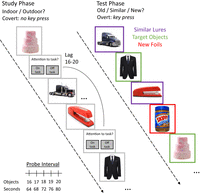
Participants studied pictures of objects and took a modified recognition test in separate phases. They completed two identical study–test procedures with unique objects in each. During study, participants covertly considered whether the object belonged indoors or outdoors. Thought probes appeared pseudorandomly after repeated target and similar lure objects with a lag of 16–20 objects. Probes appeared immediately after objects, and participants indicated being on-task or off-task. At test, participants overtly classified objects as old, similar, or new with a key press.
During study, participants were told to consider whether objects belonged indoors or outdoors and that they would be asked periodically to report whether they were attending to this task. They did not make button presses during study because pilot results suggested that overt judgments sustained ceiling-level task engagement. Participants were told that when probes appeared, they should indicate being “on-task” when thinking about where the objects belonged and “off-task” when thinking about anything else. The instructions are provided in Supplemental Material SM1. Probes appeared after objects but before ISIs to ensure that participants reported current subjective states during object processing. Participants reported by clicking a button on the screen. At test, participants were told to classify repeated study objects, similar lures, and unstudied novel foils as “old,” “similar,” and “new,” by pressing the “v,” “b,” and “n,” keys, respectively. Participants were given up to 3 sec (1-sec ISI) to respond. The study–test cycles appeared in immediate succession. Thought probe responses to studied objects were used to categorize paired test objects as “on-task” or “off-task” in analyses of classification accuracy.
All data preprocessing and statistical tests were performed using R software v. 4.1.0 (https://www.R-project.org). The analysis scripts are on the OSF (https://osf.io/v7cb4). The percentage of participants who reported being on-task was highest for the first probe of each cycle, followed by sharp declines before stabilizing (Fig. 2A). Fewer participants also reported being on-task in the second cycle than the first cycle. This characterization of task engagement is consistent with work showing that people's minds wander more as tasks progress (Teasdale et al. 1995; McVay and Kane 2012). The wide range of on-task percentages across participants (Fig. 2B), was suitable for individual difference analyses of associations with object classifications. Object classifications were also suitable for individual difference analyses because average performance (Table 1) avoided edge effects and varied widely across participants (see Supplemental Fig. S1). Bias-corrected scores for lure discrimination {[p(similar|lure) − p(similar|foil)]; (M = 0.27; 95% CI = [0.25, 0.29])} and traditional recognition {[p(old|target) − p(old|foil)]; (M = 0.56; 95% CI = [0.54, 0.59])} were also suitable for individual difference analyses (also see Supplemental Fig. S1).
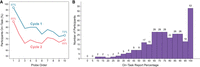
(A) The percentages of participants that reported being on-task conditioned on thought probe order and study–test cycle. (B) The frequency distribution of overall on-task report percentages across participants.
Proportions of test object classifications
We tested hypotheses about encoding quality and object classifications using mixed-effect models with subjects and items as random intercept effects and task report as a fixed effect. We fitted separate logistic models to each response type using the glmer function from the lme4 package v.1.1.27.1 (Bates et al. 2015). We performed pairwise comparisons using the emmeans package v.1.6.1 (https://CRAN.R-project.org/package=emmeans). The significance level was α = 0.05. Effect sizes are odds ratios (OR). We conducted within-subject analyses of encoding separately for lures and targets, including only participants who made at least one of all classification types for an object type (lure n = 234; target n = 219).
For lures (Fig. 3A), on-task reports led to more correct rejections (“similar” response) than off-task reports (z ratio = 3.92; OR = 0.67; P < 0.001). On-task reports also led to more false alarms (“old” response) than off-task reports (z ratio = 3.38; OR = 0.69; P < 0.001); this association did not depend on the perceptual similarity between lures and studied objects [a model including fixed effects of task report and lure bin (see Supplemental Material SM2) indicated no significant interaction; χ2 (2) = 2.53; P = 0.28]. Off-task reports led to more lure incorrect rejections (“new” response) than on-task reports (z ratio = 6.98; OR = 2.21; P < 0.001). Finally, there was a positive between-subjects correlation between on-task report percentage and lure discrimination (r(298) = 0.27; P < 0.001). (Fig. 3C).
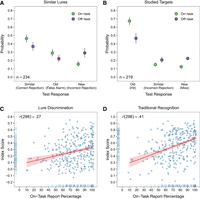
(A,B) Test response classification probabilities for similar lures (A) and studied targets (B) based on whether participants reported being on task or off task after seeing the corresponding object during the study phase. (C,D) Scatter plots depicting associations between the percentages of on-task reports during study and index scores for lure discrimination (similar lures) (C) and traditional recognition (studied targets) (D). Error bars (A,B) and shaded regions (C,D) are 95% confidence intervals. The rugs in C and D indicate the frequency distributions for each measure.
For targets (Fig. 3B), on-task reports also led to more correct recognition hits (“old” response) than off-task reports (z ratio = 7.85; OR = 0.42; P < 0.001). In contrast, off-task reports led to more incorrect target rejections (“similar” response; z ratio = 3.23; OR = 1.48; P = 0.001) and misses (“new” response; z ratio = 5.59; OR = 2.03; P < 0.001) than on-task reports. There was also a positive between-subjects correlation between on-task report percentage and traditional recognition (r(298) = 0.41; P < 0.001). (Fig. 3D). Collectively, these findings suggest that encoding quality engendered lure rejection and false alarms depending on how subsequent memories could be compared with current percepts with similar but not identical features.
The present study addressed a central theoretical issue about the roles of hippocampal pattern separation and completion in mnemonic discrimination tasks (Hunsaker and Kesner 2013). Although pattern separation and completion are posited to be dependent processes (Yassa et al. 2011), independent changes in lure rejections and false alarms challenge this view (Kirwan et al. 2012; Ally et al. 2013). Following prior studies of encoding quality and lure discrimination (Molitor et al. 2014; Rollins et al. 2019; Bjornn et al. 2022), we evaluated the consequences of self-reported encoding for lure rejections and false alarms. On-task reports led to more lure rejections, lure false alarms, and target recognitions and were associated with participant-level differences in bias-corrected lure discrimination and traditional recognition. Encoding quality thus determined the potential for lure rejection, perhaps by supporting memory for studied objects.
The present results join findings from eye-tracking studies in showing that encoding quality differences can be inferred within a task. The current finding that on-task reports led to more lure rejections is consistent with the finding that rejections in single-object MSTs were associated with more study fixations than false alarms (Molitor et al. 2014; Bjornn et al. 2022). Both measures suggested that attention fluctuated during study and that task engagement supported lure discrimination. In contrast, the current finding of more lure false alarms following on-task reports is consistent with the finding in a paired associate object MST that false alarms received more study fixations (Rollins et al. 2019). Both encoding measures suggested that studied objects had to be encoded initially to be mistaken for lures. Supporting this idea, targets and lures were classified as “new” more often after off-task reports, suggesting that those objects were insufficiently encoded for their paired targets and lures to trigger pattern completion at test.
The present result that on-task reports led to more lure rejections and false alarms is consistent with finding that both responses are more associated with subjective recollection of studied objects during lure classification than familiarity (Kim and Yassa 2013). However, this is controversial, as work has shown more lure false alarms associated with recollection and more lure rejections associated with familiarity (Szőllősi et al. 2020). The cause of this inconsistency is unclear, but subjective memory measures could characterize the consequences of encoding quality—from thought probes or eye fixations—for subjective states of studied object retrieval.
To conclude, we evaluated the role of encoding in mnemonic discrimination using subjective reports of task engagement in an MST. Self-reported encoding was associated with lure rejections and false alarms, supporting the view of pattern separation and completion as independent processes. Thought probes uniquely assessed the role of encoding variability in mnemonic discrimination, but this approach is limited by only indexing encoding quality for a subset of stimuli. Future studies could combine this approach with eye tracking and subjective reports of studied object retrieval when classifying lures at test. This would provide converging evidence for the consequences of encoding–retrieval interactions for lure discrimination.
Footnotes
-
[Supplemental material is available for this article.]
-
Article is online at http://www.learnmem.org/cgi/doi/10.1101/lm.053751.123.
-
↵1 We replaced one Towson University participant who had an extreme negative lure discrimination score (−0.30). We did not preregister this as an exclusion criterion.
- Received February 8, 2023.
- Accepted April 17, 2023.
This article is distributed exclusively by Cold Spring Harbor Laboratory Press for the first 12 months after the full-issue publication date (see http://learnmem.cshlp.org/site/misc/terms.xhtml). After 12 months, it is available under a Creative Commons License (Attribution-NonCommercial 4.0 International), as described at http://creativecommons.org/licenses/by-nc/4.0/.