Sensory preconditioning in newborn rabbits: from common to distinct odor memories
- 1Developmental Ethology and Cognitive Psychology Group, Research Center for Taste and Feeding Behaviour, UMR 6265 CNRS, 1324 INRA, Université de Bourgogne, 21000 Dijon, France
- 2Nutrition and Integrative Neurobiology Group, INRA 1286, Bordeaux, France
- 3Université de Bordeaux, 33000 Bordeaux, France
Abstract
This study evaluated whether olfactory preconditioning is functional in newborn rabbits and based on joined or independent memory of odorants. First, after exposure to odorants A+B, the conditioning of A led to high responsiveness to odorant B. Second, responsiveness to B persisted after amnesia of A. Third, preconditioning was also functional with two overlapping pairs of odorants (A+B and B+C) and amnesia of one odorant did not affect memory of the others. Thus, incidental pairing of odorants allows reinforcement of one odorant to implicitly reinforce the others, the bond then vanishes, and the memory of each element becomes independent.
Although the mechanisms of first-order conditioning, based on simple association between conditioned and unconditioned stimuli (CS, US, respectively), are the focus of intense research, much less is known about higher-order conditioning in which a CS2 acquires significance by being paired with another CS (CS1) rather than a US. The CS2 is paired with CS1 before CS1+US association in sensory preconditioning, or after CS1+US association in second-order conditioning (e.g., Brogden 1939; Rescorla and Cunningham 1978; Rescorla 1980; Kehoe et al. 1981).
The effectiveness of second-order conditioning has been shown recently in newborn rabbits. In this species, the mammary pheromone (MP) emitted by lactating females triggers orocephalic movements involved in neonatal localization and oral grasping of the nipples (Coureaud 2001; Schaal et al. 2003). It also promotes first-order conditioning acting as US; after a single and brief pairing with the MP, a novel odorant or mixture of odorants (CS1) becomes able to produce the conditioned grasping response 24–48 h later (Coureaud et al. 2006, 2008; Charra et al. 2013; for review, see Coureaud et al. 2010). Moreover, rabbit pups also learn to respond to CS2 when CS1+MP pairing is followed by CS1+CS2 pairing (Coureaud et al. 2011). In this second-order conditioning, amnesia of CS1 induced after recall of CS1 (by blockade of reconsolidation process) (see Coureaud et al. 2009a) leaves the CS2 memory intact (Coureaud et al. 2011). Thus, response to CS2 seems not to be based on the associative chain CS2 → CS1 → US/response but rather on a direct link CS2 → US/response. This indicates in newborn rabbits that CS2 is independent of CS1 representation after second-order conditioning.
Interestingly, behavioral differences were observed between second-order conditioning and sensory preconditioning in adult mammals. Extinction of CS1 eliminates CS2 in sensory preconditioning only (Rizley and Rescorla 1972), suggesting that this learning process is primarily mediated by associative chains (CS2 → CS1 → response). However, the organization of associative memory in sensory preconditioning could be different in newborns as ontogenetic differences have been reported in rodents and humans, with better abilities in such paradigms in younger organisms (for reviews, see Spear and Kucharski 1984; Rovee-Collier and Giles 2010). Until now, chemosensory preconditioning was demonstrated in newborn rats (Cheslock et al. 2003), but the question of the dependence vs. independence of the induced CSs memories was not evaluated.
We therefore investigated here sensory preconditioning and the subsequent memories of CS1 and CS2 in 182 newborn rabbits (from 91 females). Only two pups per litter were used per experiment (they were included in distinct groups; therefore the pups in a given condition were not littermates). To avoid interference with the pups’ prandial state (Montigny et al. 2006), experiments always occurred at 10:30 a.m., 1 h before the daily nursing (Zarrow et al. 1965).
To determine whether olfactory preconditioning is functional in newborn rabbits, 25 pups were exposed on day 1 to odorants A+B (ethyl isobutyrate+ethyl maltol; Sigma-Aldrich; see Coureaud et al. [2008, 2009b] for concentrations) for 5 min, before MP (2-metylbut-2-enal; Sigma-Aldrich)-induced conditioning to odorant A for 5 min on day 2 (previous description of exposure and conditioning in Coureaud et al. [2006, 2009a, 2011]). On day 3, they were submitted to a behavioral assay during which each pup was immobilized in one hand of the experimenter, its head being left free, and the stimulus was presented for 10 sec with a glass-stick 0.5 cm in front of the nares (e.g., Coureaud et al. 2006, 2008, 2009a,b, 2011). The variable was the proportion of pups responding by specific head-scanning movements followed by labial seizing of the stick; nonresponding pups displayed no response except sniffing. The experimenters did not know the precise groups of each pup during the test. The proportions were compared by the χ2 test of McNemar or of Pearson when the same pups were tested to different stimuli or different pups to the same stimulus, respectively. If necessary, Yates correction was made. Differences were considered significant if P < 0.05 (two-tailed tests). Here, after A+B exposure then A+MP conditioning, the pups strongly responded to A, and interestingly also to B (inter-trial interval, 120 sec; order of presentation, counterbalanced; χ2 < 0.05, P > 0.05) (Fig. 1A). Similar results were observed with odorants C and D (ethyl acetoacetate, Furaneol; Sigma-Aldrich) in 15 newborns exposed to C+ D before MP-induced conditioning to C (Fig. 1B). Moreover, 1-d-old pups (n = 8) exposed to odorants A+B for 2.5 min and, 1 min later, to A+MP for 2.5 min, strongly responded to B in addition to A on day 3 (>87.5%; χ2 < 0.5, P > 0.05; no manipulation on day 2). This demonstrates the effectiveness of olfactory preconditioning in newborn rabbits using two different pairs of odorants, with a short or long delay between preconditioning and conditioning.
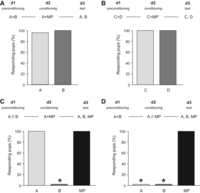
Sensory preconditioning. (A) Case of the AB odor pair. Rabbit pups were exposed to odorants A+B on day 1 (d1), then conditioned to odorant A by association with the mammary pheromone (MP) on day 2. The behavioral response to A and B was tested 24 h later. Sensory preconditioning occurred since pups responded not only to A, but also to B. (B) Case of the CD odor pair. Pups were exposed to odorants C+D and then MP-conditioned to C before testing to C or D. They responded to C but also to D. (C,D) Associative nature of the sensory preconditioning. Pups were separately exposed to odorant A then odorant B, before being MP-conditioned to A (C) or exposed to A+B before being separately stimulated with A then with the MP (D). All of them were finally tested for their response to A, B, and MP. When the association of A and B or A and MP is prevented, respectively on day 1 and on day 2, sensory preconditioning does not occur. (*) P < 0.05.
To evaluate the associative nature of the preconditioning, two groups of six pups were either exposed to odorant A and, 1 min later, to odorant B on day 1 (2.5 min/stimulus) before MP-induced conditioning to odorant A for 5 min on day 2, or simultaneously to A+B for 5 min on day 1 before separate exposure to A and, 1 min later, to MP on day 2 (2.5 min/stimulus). On day 3, all the pups from the first group responded to A and to MP (used as a control) but not to B (B vs. A or MP, χ2 = 4.16, P = 0.04) (Fig. 1C), while pups from the second group responded only to MP (MP vs. A or B, χ2 = 4.16, P = 0.04) (Fig. 1D). Thus, simultaneous presentation of stimuli during pre-exposure (A+B) and conditioning (A+MP) was required to establish a link in memory between the two initially neutral odorants, i.e., for olfactory preconditioning.
Then, we investigated the dependence/independence of the preconditioned CSs after conditioning through disruption of reconsolidation induced by administration of amnesic treatment after reactivation of CS1 (for a similar approach, see Debiec et al. 2006; Coureaud et al. 2009a, 2011). Thus, 27 pups were exposed to odorants A+B on day 1 (5 min), conditioned to A on day 2 (5 min), and reactivated with A on day 3 (2 min) immediately before injection of anisomycin (AN [Sigma-Aldrich], 42 mg/kg i.p., n = 17 pups) or saline (n = 10). As expected, no AN-injected pups responded to odorant A on day 4, contrary to saline-treated pups (χ2 = 19.07, P < 0.001). Saline-treated newborns strongly responded also to odorant B (χ2 < 0.1, P > 0.5) as, interestingly, AN-injected pups did (B vs. A, χ2 = 13.07, P < 0.001; between groups comparisons, χ2 < 0.1, P > 0.05) (Fig. 2A). Like in other studies with other newborn or adult mammals (Davis and Squire 1984; Gruest et al. 2004; Desgranges et al. 2008; Languille et al. 2008; Merhav and Rosenblum 2008) our present and previous results support the fact that the blocking effect of AN in newborn rabbits is a real amnesia and not an aversive effect (Coureaud et al. 2009a, 2011). Thus, the amnesia of odorant A did not appear disruptive to the memory of odorant B. Reciprocally, 15 pups exposed to A+B, conditioned to odorant A, and reactivated with odorant B before injection of AN or saline (n = 10 and 5, respectively) all responded to odorant A (χ2 < 0.1, P > 0.05), whereas only saline-treated pups responded to odorant B (saline- vs. AN-treated pups, χ2 = 10.84, P < 0.001; A vs. B in AN-injected pups, χ2 = 8.1, P = 0.004) (Fig. 2B). Thus, the amnesia of one preconditioned odorant did not affect the memory of the other, suggesting that these memories passed very quickly from a state of dependence to a state of independence, as if the initial and common memory of A and B evolved in distinct representations after reinforcement of one of the odorants.
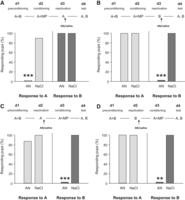
Reactivation of odor memories created by sensory preconditioning using a single pair of odorants. (A,B) Pups were exposed to odorants A+B on day 1 (d1), and conditioned to odorant A by pairing with the MP on day 2. On day 3, they were reactivated by exposure to odorant A (A) or B (B) and injected with anisomycin (AN) or saline. All the pups were tested for their responsiveness to odorants A and B on day 4. Post-reactivation administration of AN impairs only the response to the odorant used as the retrieval cue. (C,D) Pups were exposed to odorants A+B on day 1, reexposed to odorant A (C) or B (D) and injected with AN or saline on day 2, before MP-conditioned to odorant A on day 3. On day 4, they were tested for their responsiveness to odorants A and B. Administration of AN suppresses the initial link created between odorants A and B by sensory preconditioning. (***) P < 0.001, (**) P < 0.01.
To assess that a link was created between odorants A and B before conditioning, pups were made amnesic to A or B after pre-exposure to the pair of odorants, but before and not after the reinforcement of A. Thus, 31 pups were exposed to odorants A+B on day 1 (5 min), injected with AN or saline on day 2 immediately after reexposure to A (2 min, n = 8 and 9) (Fig. 2C) or to B (n = 7 and 7) (Fig. 2D), and conditioned to A on day 3 (5 min). On day 4, AN-injected and saline-treated neonates responded to odorant A (χ2 < 0.4, P > 0.5), but only saline-treated pups responded to odorant B (χ2 > 9.0, P < 0.01) (Fig. 2C,D). Thus, odorants A and B appeared clearly linked after simultaneous pre-exposure and until conditioning.
Finally, to determine whether sensory preconditioning functioned with more complex associations of stimuli, eight pups were exposed to odorants A+B and, 1 min later, to odorants B+C on day 1 (2.5 min/pair), conditioned to odorant A on day 2 (5 min), and reexposed to odorant B on day 3 (2 min) before immediate injection of saline. On day 4, they highly responded to A, as expected, but also to B and C (Fig. 3A). To assess the selectivity of the responsiveness, 10 other 1-d-old pups were exposed to A+B then to the nonoverlapping C+D pair, conditioned to A on day 2, and reactivated to A before injection of saline on day 3. On day 4, they responded to odorants A and B, but not to C and D (A or B vs. C or D, χ2 = 8.1, P < 0.01) (Fig. 3B). Thus, sensory preconditioning functioned with more than one pair of odorants but required overlapping between the pairs. In this A–B–C preconditioned chain, to evaluate whether amnesia of one odorant generalized to the others, 20 pups were exposed to odorants A+B then, 1 min after, to odorants B+C on day 1 (2.5 min/pair), conditioned to A on day 2 (5 min), and reactivated with odorant B or A (n = 12 and 8) immediately before injection of AN on day 3. On day 4, B-reactivated pups did not respond to B, but they all responded to A and C (B vs. A or C, χ2 = 10.08, P < 0.01) (Fig. 3C). Similarly, A-reactivated pups did not respond to A, but they responded to B and C (A vs. B or C, χ2 = 6.1, P < 0.05) (Fig. 3D). To evaluate whether a link existed between odorants A and C before conditioning, which could explain the result of Figure 3C, 11 pups were exposed to A+B then B+C on day 1, but reexposed to odorant B and injected with AN on day 2 before conditioning to odorant A on day 3. On day 4, they strongly responded to A but not to B and C (A vs. B or C, χ2 = 8.1, P < 0.01) (Fig. 3E). Thus, odorants A, B, and C appeared linked during the preconditioning and until MP-induced conditioning to one of them. After conditioning, each odorant became independently represented.
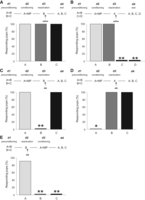
Odor memories created by sensory preconditioning using two pairs of odorants. (A) Case of two overlapping odor pairs. Pups were exposed to odorants A+B then B+C on day 1 (d1), before MP-induced conditioning to A on day 2, and recall of B on day 3 followed by injection of saline. Pups responded to A, B, and C on day 4, indicating sensory preconditioned responses to odorant B and to odorant C. (B) Case of two nonoverlapping odor pairs. Pups were exposed to odorants A+B then C+D, before MP-conditioning to A, and recall of A followed by injection of saline. Pups responded to A and B but not to C and D, indicating that the sensory preconditioned response is selective. (C,D) Pups were exposed to odorants A+B then B+C on day 1, and conditioned to odorant A by pairing with the MP on day 2. On day 3, they were reexposed to odorant B (C) or A (D) and injected with anisomycin (AN). Only the response to the reactivated odorant was impaired on day 4, indicating the rapid independence of the A, B, and C memories after the conditioning. (E) Pups were exposed to odorants A+B and B+C on day 1, reexposed to odorant B and injected with AN on day 2, and MP-conditioned to odorant A on day 3. Pups responded to A but not to B and C on day 4, confirming that an A–B–C chain exists, but only before the conditioning to A. (**) P < 0.01, (*) P < 0.05.
The present study underlines the effectiveness of olfactory preconditioning in newborn rabbits: after incidental pairing of CS1+CS2, the subsequent conditioning of one odorant led to strong and similar responsiveness to the other preconditioned odorant. This sensory preconditioning, contingent on the pairing of CS2 with CS1 then CS1 with MP, is independent of the nature of odorants (here A+B or C+D). Moreover, sensory preconditioning appears functional and selective with two overlapping pairs of odorants (CS1 + CS2 and CS2+CS3), including then direct (CS2) and indirect (CS3) pairing with CS1.
Responsiveness to CS2 after conditioning may be based on two alternatives. CS1 may reactivate CS2 during the conditioning and then CS2 becomes able to produce the response, suggesting independent memory of each element after conditioning. Alternatively, after conditioning of CS1, presentation of CS2 may reactivate CS1 which produces the response, suggesting stimulus–stimulus association (Gewirtz and Davis 2000; Parkes and Westbrook 2011). Our results clearly favor the first alternative. Indeed, when CS1+CS2 pairing was followed by CS1+MP, amnesic treatment administered after CS1 recall abolished CS1 memory but left CS2 memory intact. Reciprocally, amnesia of CS2 did not disrupt the memory of CS1. Thus, CS2 becomes independent of CS1 representation after conditioning. Similarly, in paradigms including overlapping pairs of odorants during preconditioning (CS1+CS2 and CS2+CS3), amnesia of one odorant (CS1 or CS2) after conditioning did not affect the memory of the others. Therefore, direct reinforcement of one element implicitly reinforces the other element(s) and the memory of each element is then represented separately. Importantly, when amnesia of one element happened between preconditioning and conditioning phases, pups responded to the directly reinforced element but not to the other pre-exposed odorant(s), confirming that the odorants are linked after the preconditioning but that this bond vanishes after the conditioning.
How and why do the odor representations become independent after conditioning? Interference and competition between different associative memories have been classically reported (see, for instance, Eisenberg et al. 2003; Suzuki et al. 2004; Bradfield and Balleine 2013). Here, it is likely that the unreinforced association (CS1+CS2) was weaker than the reinforced associations (CS1 + MP and CS2 + MP). Therefore, the stronger reinforced associations may have competed with the weaker unreinforced one after conditioning and have consequently induced its rapid forgetting. From an ecological point of view, it may be important for an organism, even a young one, to efficiently learn elements and/or their associations in odor mixtures (Coureaud et al. 2008, 2009b) and to keep in memory only the most relevant associations (for instance, the most recent or the most repeatedly encountered; Sevelinges et al. 2009; Sinding et al. 2011). Future studies will have to examine this competition assumption.
The present findings suggest that sensory preconditioning in rabbit pups is not based on the associative chain CS2 → CS1 → response but rather on a direct link CS2 → response. This seems in contradiction with studies suggesting that sensory preconditioning is based on stimulus–stimulus association in adult rodents (for reviews, see Gewirtz and Davis 2000; Parkes and Westbrook 2011). For instance, extinction of the first-order CS1 in adult rats eliminated CS2 responding in sensory preconditioning (Rizley and Rescorla 1972). The discrepancy between these and our results may be related to the differences between species (rats vs. rabbits), experimental treatment (extinction vs. reconsolidation blockade), or, more probably, developmental stage (adults vs. newborns). Indeed, it has been shown in rodents and humans that the ability to form simultaneous associations between stimuli in the sensory preconditioning paradigm is different in young and in older organisms (Spear and Kucharski 1984; Rovee-Collier and Giles 2010). For instance, newborns (Cheslock et al. 2003), 8-, 12-, and 15-d-old rat pups perform well in a task consisting in pre-exposure to two different odors, and better than 21- or 60-d-old animals (Spear and Kucharski 1984; Chen et al. 1991). In humans, Boller (1997) found that sensory preconditioning is functional in 6-mo-old infants (pre-exposure to cloth panels). Using a deferred imitation task (slightly different from a traditional preconditioning procedure), other authors have highlighted the ability of infants as young as 3 mo old to spontaneously form associations between stimuli (puppets) during pre-exposure (Campanella and Rovee-Collier 2005). This ability persists in 6- and 9-mo-old children but then significantly decreases in 12- and 15-mo-olds (it reappears however in 18-mo-olds; Barr et al. 2003; Rovee-Collier and Giles 2010). Altogether, these results suggest that newborns and young animals can efficiently integrate different elements during simultaneous unreinforced exposure and memorize them after conditioning in a different way compared to adults. Such capabilities are not prevented by neuromaturational process occurring over development. Moreover, one may note that ontogenetic changes of memory characteristics have been also reported in rodents with procedures other than sensory preconditioning, i.e., for different forms of first-order conditioning (Campbell and Campbell 1962; Feigley and Spear 1970; Coulter et al. 1976; Campbell and Alberts 1979; Sullivan and Wilson 1995; Languille et al. 2010). It is possible that during preconditioning and conditioning, very young organisms select information in different ways than adult organisms due to the ecological challenges posed by their current niche (Spear 1984; Rovee-Collier and Cuevas 2009).
Some of the present results are similar to those obtained by Coureaud et al. (2011) using second-order conditioning in newborn rabbits, which indicated that after paired presentations of CS1+MP followed by CS1+CS2 pairing, CS1 amnesia left the CS2 memory intact. These and the present findings suggest that stimulus–stimulus associations (CS2 → CS1 → response) neither form the basis of sensory preconditioning nor that of second-order conditioning in rabbit pups. Again, a developmental effect could occur. Indeed, these results seem in contradiction with studies in adult rodents suggesting that the stimulus–stimulus associative nature of sensory preconditioning differs from second-order conditioning (for reviews, see Gewirtz and Davis 2000; Parkes and Westbrook 2011; but see Debiec et al. [2006] for demonstration of stimulus–stimulus association in second-order conditioning). One may note that in adult rodents, whereas both paradigms require activation of the glutamatergic NMDA receptors during CS1+CS2 pairing (Parkes and Westbrook 2010), only second-order conditioning requires dopaminergic modulation and basolateral amygdala integrity (Nader and LeDoux 1999; Parkes and Westbrook 2010). It would be interesting to evaluate whether such pharmacological and neurobiological dissociations between the paradigms are absent in newborn rabbits but appear in adults.
In conclusion, the present study illustrates the strong abilities of the neonatal brain, still immature, to perceive, process, and memorize complex information related to behavior, here through chemosensory preconditioning. The results reveal that single and brief incidental exposure of rabbit neonates to one or two overlapping pairs of odorants creates a selective association between these stimuli. Thus, they display cognitive capabilities sufficient to form a link between the odorants in absence of reinforcement. Strikingly, the unreinforced association induced by sensory preconditioning appears transitory, since it splits into independent memories of each stimulus after reinforcement of one element. In the rabbit, sensory preconditioning might be functional during nursing, since the mammary pheromone that promotes conditioning of CS1 or CS2 after CS1+CS2 pairing is produced by lactating females. These preconditioning abilities could be, therefore, extremely adaptive for rabbit pups, as for young mammals in general, all in urgent need of knowledge about their complex environment, permanently subjected to variations.
Acknowledgments
We sincerely thank Valérie Saint-Giorgio, Nicolas Malaty, Florent Costilhes, and all the people from the Centre de Zootechnie (Université de Bourgogne, Dijon) for the care provided to the animals. We also thank two anonymous referees for their generous comments, and Claire Dawson for the English revision of the final text. All experiments were carried out in accordance with ethical rules enforced by French law and were supported by ethical committee authorization number 2406. The work was supported by a Regional Council of Burgundy grant to G.C. and A.T., and the MEMOLAP Grant ANR-2011-JCJC-1410 from Agence National de la Recherche (with the support of Pôle VITAGORA) to G.C. and G.F.
Footnotes
-
↵4 Corresponding author
E-mail gerard.coureaud{at}u-bourgogne.fr
- Received March 7, 2013.
- Accepted July 11, 2013.
- © 2013, Published by Cold Spring Harbor Laboratory Press
This article is distributed exclusively by Cold Spring Harbor Laboratory Press for the first 12 months after the full-issue publication date (see http://learnmem.cshlp.org/site/misc/terms.xhtml). After 12 months, it is available under a Creative Commons License (Attribution-NonCommercial 3.0 Unported), as described at http://creativecommons.org/licenses/by-nc/3.0/.