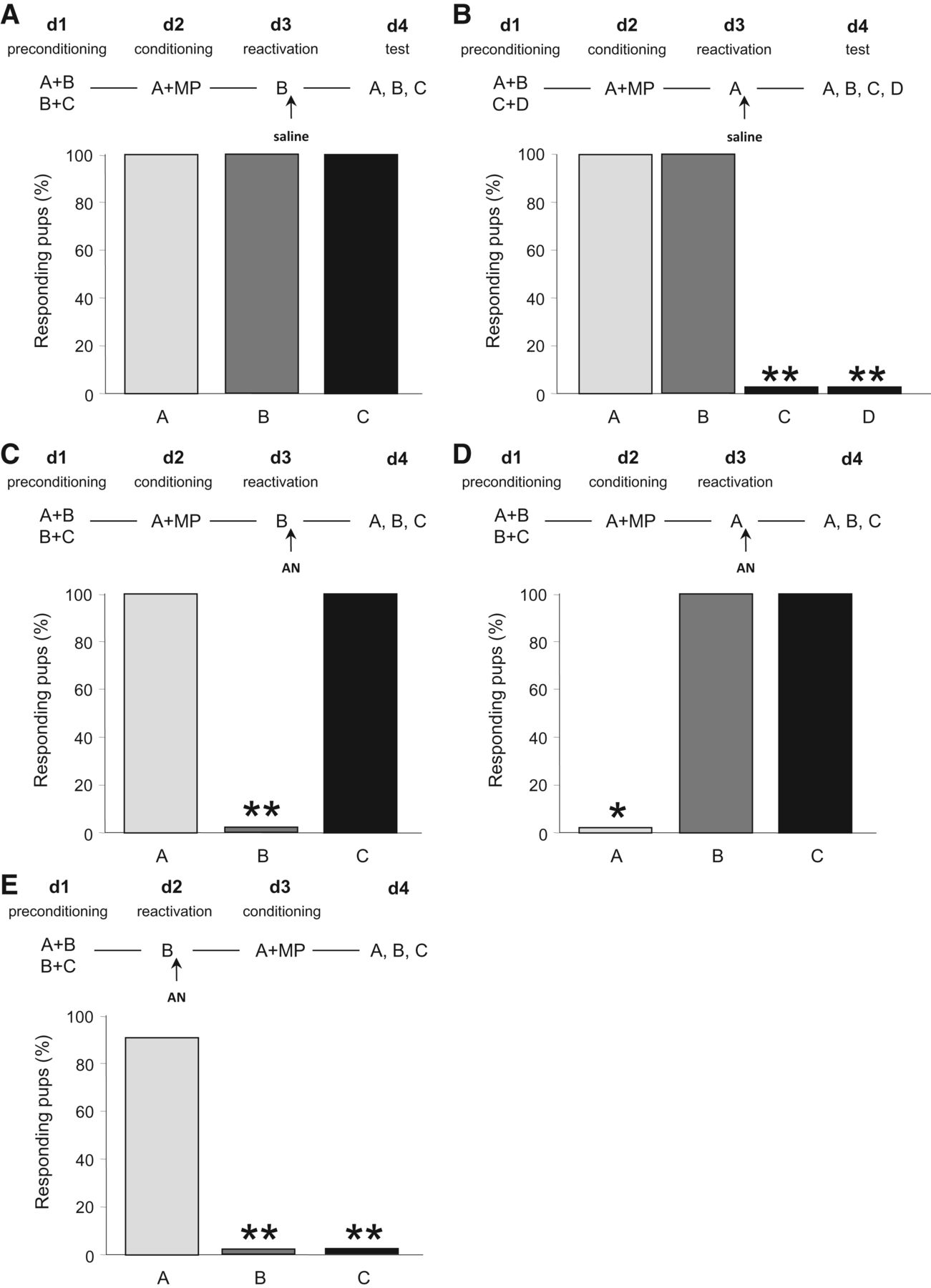
Odor memories created by sensory preconditioning using two pairs of odorants. (A) Case of two overlapping odor pairs. Pups were exposed to odorants A+B then B+C on day 1 (d1), before MP-induced conditioning to A on day 2, and recall of B on day 3 followed by injection of saline. Pups responded to A, B, and C on day 4, indicating sensory preconditioned responses to odorant B and to odorant C. (B) Case of two nonoverlapping odor pairs. Pups were exposed to odorants A+B then C+D, before MP-conditioning to A, and recall of A followed by injection of saline. Pups responded to A and B but not to C and D, indicating that the sensory preconditioned response is selective. (C,D) Pups were exposed to odorants A+B then B+C on day 1, and conditioned to odorant A by pairing with the MP on day 2. On day 3, they were reexposed to odorant B (C) or A (D) and injected with anisomycin (AN). Only the response to the reactivated odorant was impaired on day 4, indicating the rapid independence of the A, B, and C memories after the conditioning. (E) Pups were exposed to odorants A+B and B+C on day 1, reexposed to odorant B and injected with AN on day 2, and MP-conditioned to odorant A on day 3. Pups responded to A but not to B and C on day 4, confirming that an A–B–C chain exists, but only before the conditioning to A. (**) P < 0.01, (*) P < 0.05.