Connecting self-report and instrumental behavior during incubation of food craving in humans
- Corresponding author: nick.ruiz{at}temple.edu
Abstract
Incubation of craving is a phenomenon describing the intensification of craving for a reward over extended periods of abstinence from reinforcement. Animal models use instrumental markers of craving to reward cues to examine incubation, while human paradigms rely on subjective self-reports. Here, we characterize an animal-inspired, novel human paradigm that showed strong positive relationships between self-reports and instrumental markers of craving for favored palatable foods. Further, we found consistent nonlinear relationships with time since last consumption and self-reports, and preliminary patterns between time and instrumental responses. These findings provide a novel approach to establishing an animal-inspired human model of incubation.
Craving has been shown to play a significant role in relapse (Vafaie and Kober 2022). A hallmark of addiction is the incubation of craving, where craving for a reward increases over extended periods of abstinence. Initially reported by Gawin and Kleber (1986), abstinent cocaine users’ self-reported craving escalated over weeks to months when exposed to drug-related cues (i.e., a needle), which had downstream consequences on the probability of relapse. Since this report, the incubation of craving has been replicated in humans and has founded one of the most prominent animal models of addiction across drugs (Neisewander et al. 2000; Grimm et al. 2001; Pickens et al. 2011; Li et al. 2015a) and natural rewards (Aoyama et al. 2014; Grimm 2020).
In animal models of incubation of craving, rodents learn to perform a behavior (e.g., lever press) that is paired with a cue to earn a reward. Craving is later measured by quantifying behavioral responses to the cue in the absence of reinforcement, during extended periods of abstinence. In these models, craving reliably displays an increase over weeks to months (Grimm et al. 2001, 2003; Shalev et al. 2001). While these animal models have provided a foundation for understanding the mechanisms of craving and relapse (Pickens et al. 2011; Venniro et al. 2021), the translational value of rodent models into humans has been limited based on differences in how craving is probed across species (Venniro et al. 2020; Liu et al. 2023).
Human studies of incubation have mainly relied on self-report measures of craving, which represent hedonic feelings toward the prospect of reward rather than motivational vigor (Nava et al. 2006; Bedi et al. 2011; Wang et al. 2013; Li et al. 2016; Parvaz et al. 2016; Coutinho et al. 2018). In animal models, craving is typically queried by lever presses reinforced by cues previously associated with reward, which is thought to more directly represent motivational vigor (Liu et al. 2023). There has been limited translational power across species due to differing underlying mechanisms measured in each population. With animal models assessing craving by measuring the learned behaviors animals perform to seek rewards, human studies leverage human's capacity for experiential reports to measure the desire or urge to seek rewards (Sayette et al. 2000). Therefore, the creation of a task that could better balance elements of the animal literature with the essence of the human literature may help uncover cognitive factors driving incubation (Rosenberg 2009).
The goal of the current project is to validate a novel paradigm in humans that integrates behaviors akin to rodent assays of craving (i.e., instrumental responses) with the subjective human experience (i.e., self-report) in the space of natural rewards: palatable foods. We chose to characterize food craving as food provides a unique opportunity to examine rewarding items with which individuals have an idiosyncratic and rich learning history that could not be easily replicated in the laboratory. We predicted (1) a positive relationship between instrumental responses and subjective self-reports of craving, and (2) that both instrumental responses and self-reports will show a nonlinear relationship with time since last consumption.
The study hypotheses, analyses, and sample size were pre-registered before data collection (AsPredicted #107775). Study 1 included 102 participants and study 2, which was a direct replication of study 1, included 164 participants. Full information about sample size and exclusion criteria is included in the Supplemental Material (see supplemental_sample_size).
Informed consent and stimuli were presented using Inquisit (Grootswagers 2020). Following a few questionnaires, participants listed 10 favorite foods and 10 neutral foods (i.e., neither liked nor disliked) to eat (Fig. 1A). All the stimuli were collected as typed responses and were presented back to the participants exactly as they were typed in. For both lists, participants were told to be specific, providing specific brands, locations to attain the food, or the person who makes it. Next, during a “pre-ratings” phase, participants rated each of the listed foods on how much they liked that item, how much they craved that item, and when they last consumed that item, in a randomized order (Fig. 1B). Liking and craving were measured on a scale from 0 (not at all) to 100 (extremely). For time since last consumption, participants responded on a scale from 0 to 100 that had seven anchors that included “within 10 min,” “within 90 min,” “within 16 h,” “within 7 days,” “within 2 months,” “within 2 years,” and “greater than 2 years ago.” Participants then completed a short distractor task.
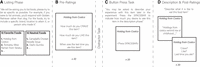
(A) Listing phase. Participants were asked to list 10 of their favorite foods and 10 neutral foods, i.e., food items they neither liked nor disliked. They were instructed to be specific, including brand names, locations to attain the food, or the person who made the food. (B) Pre-ratings. Participants rated each item on a scale from 0 to 100, indicating how much they craved the item, how much they liked the item, and the last time they consumed the item. (C) Button press task. Participants were told they may be given the opportunity to describe an experience with each food item in a later phase of the experiment. They were instructed to press the spacebar to indicate how much they desired to see that item in the later description phase, and that more spacebar presses indicated an increased desire to describe the item. (D) Description and post-ratings. Participants were asked to write at least five sentences describing what it was like to eat each food item. Immediately following their description, they rated that item for craving, liking, and time since last consumption.
Participants next completed an instrumental behavior task (Fig. 1C) and were told that for each food item, they would have an opportunity to describe an experience with that food item later in the experiment. We told participants to press the spacebar to indicate their desire to provide an experience with the item, with more spacebar presses indicating greater desire. We selected instrumental responses to retrieve a memory of the food item as a way to capture a behavior that may be more relevant for human reward craving while still being inspired by the presentation of cues in the absence of reinforcement in rodent incubation paradigms. All 20 items were shown in a randomized order and participants could freely press the spacebar for 10 sec before moving on to the next item. Finally, participants were told to write at least five sentences describing what it is like to eat each food item (Fig. 1D). As the data from the description phase was beyond the scope of the current project, it was not analyzed and will be examined in a subsequent report (AsPredicted #107775).
To examine the relationship between our main variables of interest and our dependent variables (DVs), we used generalized additive models (GAMs) using the “mgcv” package in R (Wood 2017), which extend generalized linear models by allowing nonlinear relationships between dependent and independent variables. Our models included a smooth term for subjective craving or button presses, a linear term for liking score, and included the subject as a random effect to control for intercept. Additionally, we fit linear mixed-effects models and used a model comparison approach to examine the relationship between the variables of craving. Details on model fitting and comparisons can be found in the Supplemental Material. The differences between the current analysis plan and the pre-registered analysis plan are outlined in a supplement which also includes the originally planned analyses (see supplemental_methods).
We first examined the relationship between subjective craving and time since last consumption using the data from the pre-ratings using GAM curves (Fig. 2A). In study 1, the linear effect of liking was significantly related to subjective craving (β = 0.91, P < 0.001, SE = 0.02, t = 58.99). The smooth term for time was significantly related to subjective craving (F = 4.21, edf = 2.65, P = 0.005), implying a significant nonlinear relationship. For study 2 (Fig. 3A), liking was also significantly related to subjective craving (β = 0.89, P < 0.001, SE = 0.01, t = 73.42). The smooth term for time was significantly related to subjective craving (F = 3.98, edf = 4.13, P = 0.001).
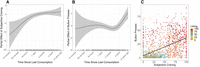
Results from study 1. For the GAM curves, y-axis values are the residual mean subjective craving/button presses where the liking scores are partialed out. 95% confidence intervals are shown in gray. (A) GAM curve for Subjective Craving by Time. Study 1 found a significant nonlinear relationship between time and subjective craving (F = 4.21, edf = 2.65, P = 0.005). (B) GAM curve for Instrumental Behavior by Time. Study 1 found a significant nonlinear relationship between time and instrumental behavior (F = 4.74, edf = 3.72, P < 0.001). (C) The relationship between button presses and self-report of craving. Study 1 found a significant relationship between button presses and self-report of craving (P < 0.001).
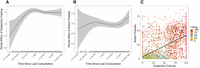
Results from study 2. For the GAM curves, y-axis values are the residual mean subjective craving/button presses where the covariates in each analysis are accounted for. 95% confidence intervals are shown in gray. (A) GAM curve for Subjective Craving by Time. Study 1 found a significant nonlinear relationship between time and subjective craving (F = 3.98, edf = 4.13, P = 0.001). (B) GAM curve for Instrumental Behavior by Time. Study 1 found a significant nonlinear relationship between time and instrumental behavior (F = 1.52, edf = 3.24, P = 0.19). (C) The relationship between button presses and self-report of craving. Study 2 found a significant relationship between button presses and self-report of craving (P < 0.001), replicating study 1.
We next explored the relationship between button presses and time since last consumption using GAM curves (Fig. 2B). In study 1, the linear effect of liking was significantly related to button presses (β = 0.49, P < 0.001, SE = 0.001, t = 47.67). The smooth term for time was significantly related to button presses (F = 4.74, edf = 3.72, P < 0.001), implying a significant nonlinear relationship. In study 2 (Fig. 3B), liking was also significantly related to button presses (β = 0.51, P < 0.001, SE = 0.009, t = 59.11). However, the smooth term for time did not have a significant relationship with button presses (F = 1.52, edf = 3.24, P = 0.19).
Finally, we explored the relationship between self-report of craving and button presses. In study 1 (Fig. 2C), we found that including self-reports of craving in our baseline model significantly increased our model fit when predicting button presses (baseline: presses ∼ liking + [1|subject]; winning model: presses ∼ craving + liking + [1|subject]; model comparison: χ2(1) = 90.05, P < 0.001). The winning model showed that button presses were predicted by both liking [β(2017) = 0.36, P < 0.001, SE = 0.02, t = 22.65) and self-reports of craving [β(1971) = 0.14, P < 0.001, SE = 0.01, t = 9.60]. In study 2 (Fig. 3C), button presses were significantly predicted by liking [β(3264) = 0.34, P < 0.001, SE = 0.02, t = 26.09] and self-reports of craving [β(3201) = 0.19, P < 0.001, SE = 0.01, t = 16.24].
These findings provide a first step to creating a human-based task to probe craving using a paradigm inspired by animal models. First, we found that individuals reported higher subjective craving for items over the duration of time since last consumption. Critically, these findings were specific to cravings and not just general hedonic affect, as we controlled for liking in our analyses. This relationship dovetails with prior human incubation of drug craving (Nava et al. 2006; Bedi et al. 2011; Wang et al. 2013; Li et al. 2015b; Parvaz et al. 2016; Coutinho et al. 2018), extending the literature by replicating this effect in a nonclinical population within the context of a natural reward and providing a path toward the investigation into the heterogeneous systems involved in addiction across species (Kalivas and Volkow 2005).
We found a complicated relationship between time since the last consumption and instrumental button presses to share a memory of the food reward. While study 1 found a significant, nonlinear relationship between subjective craving and instrumental behavior, such that participants performed more button presses to items they had not consumed over longer periods of time, this effect was not replicated in study 2. However, the amount of button presses was positively related to self-reported craving across both studies, implying button presses may be less sensitive to time than self-reports. Previous work has captured objective measures for craving in humans (Ooteman et al. 2006), using physiological (Monti et al. 2000; Liu et al. 2022), behavioral economic (Plebani et al. 2012), and neural markers (Engelmann et al. 2012; Starcke et al. 2018; Garcia-Castro et al. 2023; Koban et al. 2023), but only a select few have examined these measures over varying amounts of time (Parvaz et al. 2016; Zhao et al. 2021). The current study provides an initial step to the creation of a human-based task inspired by animal models that can capture behavioral markers of craving at different time points, but further work is required to understand the true relationship between instrumental responses and time.
One interesting feature of our paradigm, that differs from other assessments of incubation in both the rodent and human literature, is that we probed motivational vigor in response to the opportunity to retrieve a memory about rewards rather than a conditioned cue (i.e., showing a lighter to an individual with nicotine use disorder). This clearly contrasts rodent models of incubation wherein the animals are likely responding habitually and a desire for the lever to work rather than motivated by a desire to think about a rewarding item. However, we believe this design feature more closely mirrors models of craving and relapse that are centered on retrieving prior experiences with a reward, particularly in humans. In line with this decision, there is a growing body of work showing involvement of the hippocampus, a region critical for memory retrieval, in cue-evoked craving. The hippocampus has shown craving-related activation in response to cue-exposure in drugs (Kilts et al. 2001; Schneider et al. 2001; Smolka et al. 2006), and natural rewards (Pelchat et al. 2004; Crockford et al. 2005; Stevenson and Francis 2017). The exact role of the hippocampus in cue-induced craving is unclear, but given its role in the retrieval of autobiographical memories (Maguire 2001; Sheldon and Levine 2016), it is possible representations of previous drug use, or the rewards related to drug use, are brought online during cue-exposure. Due to the episodic nature of these memories (Tulving 1985), the individual may feel as if they are reliving the previous drug-using experience which may lead to drug-seeking behavior. Further, more recent research has shown that autobiographical memory retrieval, albeit not in the context of rewards, is associated with both hedonic and motivational value (Speer et al. 2014; Speer and Delgado 2020).
We chose to assess food craving due to its relative ease to assess along with its features of repeated use/abstinence over extended periods of time paralleling drug use. We propose that individuals may express similar craving behavior, as displayed here, for other positive memories. For instance, individuals report “craving” for travel during periods of which they must abstain from traveling (i.e., COVID-19 pandemic lockdown) (Irimiás and Zoltán Mitev 2023); however, the reported feelings of craving were associated with more complex cognitive-affective states. Thus, it is entirely possible that in some contexts instrumental button presses alone may not fully map onto substance or reward craving. However, food may be more related to drug addiction than other positive events (i.e., travel). Food craving and addiction have overlapping biological and behavioral features with substance abuse (Berridge 2009; Alonso-Alonso et al. 2015; Gearhardt and Schulte 2021), including incubation (Krasnova et al. 2014; Aoyama and Nagano 2020; Grimm 2020; Madangopal et al. 2022). While the food items in this study were not probed for their addictive qualities, they still are rewarding which is one of the inherent properties of addictive substances. Future research can more directly probe the differences between addictive and nonaddictive rewards and can better tease apart the craving shown in the current study by probing cognitive-emotional traits and including them in the analyses.
Additionally, the translation of subjective craving into behaviors to seek reward is not entirely clear. While we were not able to directly assay this in the current study, there is mixed evidence regarding the correlation between subjective craving and relapse. Some research shows a positive relationship between the two (Bottlender and Soyka 2004; Stohs et al. 2019; Vafaie and Kober 2022) while other literature has not (Kranzler et al. 1999; Perkins 2009). These discrepancies necessitate future research discerning what features underlie human craving responses, or how different contextual features influence craving response (McKay 1999; Secades-Villa and Fernández-Hermida 2003). However, paradigms similar to ours, which include self-reports of craving and instrumental button presses, could provide more reliable assays of craving, and be of use in clinical communities.
Acknowledgments
We thank Dr. Emily Cowan for feedback on early versions of the manuscript. We also thank Dr. Lena Skalaban, Ga In Shin, and Virginia Ulichney for their assistance with statistical analysis.
Footnotes
-
[Supplemental material is available for this article.]
-
Article is online at http://www.learnmem.org/cgi/doi/10.1101/lm.053869.123.
- Received August 24, 2023.
- Accepted June 14, 2024.
This article is distributed exclusively by Cold Spring Harbor Laboratory Press for the first 12 months after the full-issue publication date (see http://learnmem.cshlp.org/site/misc/terms.xhtml). After 12 months, it is available under a Creative Commons License (Attribution-NonCommercial 4.0 International), as described at http://creativecommons.org/licenses/by-nc/4.0/.