High and low current perceived stress associated with enhanced emotional mnemonic discrimination
- Rishi Vas1,
- Taylor Phillips1,
- Lorena A. Ferguson1,
- Amritha Harikumar1,
- Madelyn Castro1 and
- Stephanie L. Leal1,2
- 1Department of Psychological Sciences, Rice University, Houston, Texas 77005, USA
- 2Department of Integrative Biology & Physiology, University of California, Los Angeles California 90095, USA
- Corresponding author: stephanieleal{at}ucla.edu
Abstract
Stress can have profound impacts on memory. However, the directionality of stress effects on memory varies widely across studies, some showing enhancement while others showing impairment. This variability has been attributed to the Yerkes-Dodson Law, which proposes a U-shaped pattern such that too little or too much stress may be associated with cognitive dysfunction. The impact of stress on memory may also depend on what aspects of memory are being measured (e.g., emotional content, gist vs. detail) and how stress is measured (e.g., physiological measures, self-report). Here, we aimed to examine how self-reported perceived stress in the current moment was associated with memory performance. We used an emotional memory task designed to tap into potential gist versus detail trade-offs of stress impacting memory (e.g., target recognition, lure discrimination). Participants (ages 18-35) reported their current level of perceived stress. We replicated prior work showing impaired emotional relative to neutral lure discrimination in young adults in support of a gist versus detail trade-off in emotional memory. However, those with low and high current perceived stress showed better emotional lure discrimination compared to those with moderate current perceived stress. These results are in line with the Yerkes-Dodson Law but suggest that the directionality of the impact of stress on memory may depend on the type of memory measured. Low and high current perceived stress was associated with greater detailed memory, especially for emotional information, which may be maladaptive given gist vs. detail trade-offs in emotional memory.
Stress is an inevitable part of life and important for survival under adverse conditions (Cameron and Schoenfeld 2018). However, stress can become detrimental to our health and cognition if too little or too much stress is experienced. Stress is universal, yet responses to stress vary across individuals, cultures, and contexts (Hutmacher 2021). The Yerkes–Dodson Law and Easterbrook's cue-utilization theory have been widely used to explain the inverted-U relationship between emotional arousal and cognitive performance (Yerkes and Dodson 1908; Easterbrook 1959), suggesting that there are optimal levels of arousal to support performance. These approaches state that a moderate amount of stress often helps one prepare for serious experiences, and memory often improves to help one remember important information from that event. Consequently, too much or too little stress can be detrimental. For example, individuals with chronic stress, such as those with depression, have impaired general memory. However, there is an enhancement in remembering negative information (Leal et al. 2014a,b; Dillon and Pizzagalli 2018). While this inverted-U relationship may help explain some of the variability in findings of how stress and arousal impact cognitive function, such as memory, there is more complexity to these interactions that are not captured by a simple inverted-U relationship (Shields et al. 2017). This is likely due to the type of information being measured—gist versus detail information, central versus peripheral information, short-term versus long-term, task difficulty, emotional arousal, etc. (Eysenck 1976; Diamond 2005). There is evidence to suggest a gist versus detail trade-off in emotional memory, where the gist of an emotional experience is preserved at the expense of details (Kensinger 2009; Mather and Sutherland 2011; Leal et al. 2014a,b). Stress further exacerbates this relationship, impairing neutral but enhancing emotional episodic memory (Payne et al. 2006, 2007; Hoscheidt et al. 2013).
When examining these nuanced aspects of memory, one framework that has been instrumental to understanding the mechanisms underlying our memory system has been focused on the hippocampal computations of pattern separation and pattern completion (Leal and Yassa 2018). Pattern separation is a hippocampal computation that processes experiences with overlapping features as distinct from one another and relies on the dentate gyrus (DG) subfield of the hippocampus. Without this computation, we would not be able to disambiguate between overlapping experiences due to interference in our memories. In contrast, pattern completion allows for experiences with overlapping features to be generalized across one another and relies on the CA3 subfield of the hippocampus (Treves and Rolls 1992). The DG and CA3 are especially vulnerable to stress (McEwen 1999), in which chronic stress is associated with CA3 dendritic retraction (McKittrick et al. 2000) as well as reduced DG neurogenesis and associated with impaired performance on hippocampal-dependent tasks (Gould and Tanapat 1999). Mnemonic discrimination tasks have been designed to tax hippocampal pattern separation in humans by including highly similar “lure” stimuli, which are similar but not exactly the same as stimuli shown during encoding (Stark et al. 2013). These tasks have been shown to be sensitive to stress, anxiety, and depressive symptoms (Leal et al. 2014a,b; Balderston et al. 2017; Leal and Yassa 2018; Cunningham et al. 2018; McMakin et al. 2022). A recent study used a mnemonic discrimination task and found a negative relationship between perceived stress over the past month and lure discrimination, where elevated stress was associated with worse task performance in those with low levels of depressive symptoms (Grupe et al. 2022). Another study examined mnemonic discrimination for emotional relative to neutral images, in which half of the participants underwent the Trier social stress test (TSST) to increase stress, as measured by change in cortisol levels from baseline. Those in the stress group showed enhanced negative lure discrimination relative to neutral images and nonstressed controls, as well as an inverted-U relationship between cortisol change and negative mnemonic discrimination, where low and high levels of cortisol were associated with lower negative lure discrimination (Cunningham et al. 2018).
There are many ways to measure stress including self-report, behavioral, psychophysiological, and neuroendocrine approaches (Baum et al. 1982). A combination of these approaches is likely most informative given the large number of individual differences in our stress response, especially within particular contexts. While many studies have manipulated stress levels in participants (e.g., TSST, cold water pressor, etc.), a participant's perceived stress can provide a powerful metric of how stressed a participant believes themselves to be. Upon examination of the predictability of different measures of stress, a subjective stress measure (self-ratings of event stressfulness) and an objective measure of stress (number of stressful events), subjective stress ratings predicted health-related outcomes better than objective measures (Sarason et al. 1978). The Perceived Stress Scale (PSS) (Cohen et al. 1983) is the most widely used scale to assess one's perception of their own stress and measures how one would perceive their own stress over the past month. We modified the PSS to measure current perceived stress, as we hypothesized that natural variations in people's current perceived stress (acute stress) would be a better predictor of memory performance than perceived stress in the past month (chronic stress), which may fluctuate day to day. Previous work has shown that assessing daily stress in the moment is more naturalistic and related to memory failures (Neupert et al. 2006).
In the current study, we aimed to examine how current perceived stress impacted memory on an emotional mnemonic discrimination task. We used a well-validated emotional mnemonic discrimination task that has previously been associated with signals consistent with hippocampal pattern separation (Leal et al. 2014a,b). Participants were shown images ranging across emotional valence (negative, neutral, and positive images) during encoding and rated each image as positive, negative, or neutral. After a short delay, participants were given a surprise memory test. During retrieval, participants were shown images including targets (repeated images), lures (similar images to those shown during encoding), and foils (new images). Participants were asked to determine if an image was exactly the same as seen during encoding or if the image was new or different in some way. We measured target recognition (TR), a standard memory measure for repeated items, and lure discrimination, which measures how well participants discriminate between similar lure images and taxes hippocampal pattern separation (Yassa et al. 2011; Leal et al. 2014a,b). We hypothesized that (1) we may find evidence of a quadratic relationship between current perceived stress and memory in line with the Yerkes–Dodson Law, but that (2) the directionality of these effects would depend on the memory measure, where we predicted that lure discrimination would be more sensitive to effects of current perceived stress relative to TR. We further hypothesized that given gist versus detail trade-offs within emotional memory, (3) we would see larger effects of current perceived stress on emotional relative to neutral memory measures.
Results
Current perceived stress differentially impacts emotional memory
First, we aimed to examine overall performance on the emotional mnemonic discrimination task (Fig. 1). For lure discrimination, we conducted a repeated-measures ANOVA with emotion (negative, neutral, and positive) as the within-subjects factor. We found a significant effect of emotion [F(2,218) = 10.65, P < 0.001, ηp2= 0.09; Fig. 2A], where positive and negative lure discrimination was worse than neutral lure discrimination [F(1,109) = 22.52, P < 0.001, ηp2= 0.17], in line with previous findings (Leal et al. 2014b). Next, we split participants into groups based on their current perceived stress levels and conducted a mixed repeated-measures ANOVA with emotion (negative, neutral, positive) as a within-subjects factor and current perceived stress (low, moderate, high) as a between-subjects factor. We found a significant main effect of emotion [F(2,214) = 9.23, P < 0.001, ηp2= 0.08; Fig. 2B], as expected from our overall ANOVA. There was also a significant effect of current perceived stress [F(2,107) = 3.12, P = 0.049, ηp2= 0.06; Fig. 2B], in which those with low and high current perceived stress had higher lure discrimination performance relative to those with moderate levels of current perceived stress. This effect remained significant (P = 0.048), even when controlling for BDI, BAI, and perceived stress in the past month. There was no interaction between emotion and current perceived stress [F(4,214) = 0.69, P = 0.60, ηp2= 0.02].
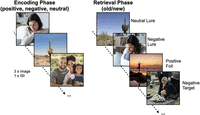
Emotional mnemonic discrimination task. During the encoding phase, participants are shown images and asked to rate them as “positive,” “negative,” or “neutral.” After a 45-min delay, participants were given a recognition test during the retrieval phase, where they were shown repeated images (targets), similar but not identical images (lures), and brand-new images (foils). Participants were asked to rate the images as “old” (image seen before) or “new” (new or different than images seen before). Permission was obtained for the use of all images in this figure, in which the images are licensed by Shutterstock, available at https://www.shutterstock.com/.
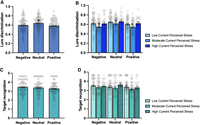
The impacts of current perceived stress on lure discrimination and TR during an emotional mnemonic discrimination task. (A) Lure discrimination performance across negative, neutral, and positive images. (B) Lure discrimination performance in those with low, moderate, or high levels of current perceived stress. (C) TR performance across negative, neutral, and positive images. (D) TR performance in those with low, moderate, or high levels of current perceived stress.
We also examined the relationship between current perceived stress and lure discrimination measures continuously, in which we found significant quadratic relationships between current perceived stress and negative lure discrimination [F(2,107) = 4.82, P = 0.01, r2 = 0.08; Fig. 3A] and positive lure discrimination [F(2,107) = 3.44, P = 0.04, r2 = 0.06; Fig. 3C], but not neutral lure discrimination [F(2,107) = 2.01, P = 0.14, r2= 0.04; Fig. 3B]. Lower and higher levels of current perceived stress were associated with higher emotional (positive and negative) lure discrimination performance, while moderate levels of current perceived stress were associated with reduced emotional lure discrimination.
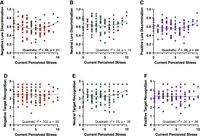
Associations between current perceived stress and memory measures. Relationship between current perceived stress and (A) negative lure discrimination, (B) neutral lure discrimination, and (C) positive lure discrimination; relationship between current perceived stress and (D) negative TR, (E) neutral target recognition, and (F) positive target recognition.
For TR, we conducted a repeated-measures ANOVA with emotion (negative, neutral, positive) as the within-subjects factor. We did not find a significant effect of emotion [F(2,218) = 1.95, P = 0.15, ηp2= 0.02; Fig. 2C], in line with our prior work, which showed preserved emotional memory only at a 24-h delay (Leal et al. 2014b). When conducting a mixed repeated-measures ANOVA with emotion (negative, neutral, positive) as a within-subjects factor and current perceived stress (low, moderate, high) as a between-subjects factor, we did not find any significant effects of emotion (P = 0.13), current perceived stress (P = 0.16), or an interaction between factors (P = 0.63) for TR (Fig. 2D), suggesting lure discrimination may be more sensitive to emotional memory trade-offs when tested immediately and to the impact of current perceived stress. There were no significant relationships between current perceived stress and TR across emotional measures when examined continuously (all P’s > 0.05; Fig. 3D–F).
We also examined the relationship between the standard measure from the PSS, which measures perceived stress in the past month, which was correlated with current perceived stress (r = 0.64, P < 0.001), but found no significant relationships between perceived stress over the past month and any of our memory measures (all P’s > 0.05), suggesting current perceived stress (acute stress) is more sensitive to memory performance relative to general perceived stress measures (chronic stress).
Discussion
The role of stress on cognition and brain function is important to understand, as stress plays a significant part of our day-to-day lives and often increases risk of disease (O'Connor et al. 2021). The hippocampus is especially vulnerable to the effects of stress (McEwen and Sapolsky 1995; Sapolsky 1996; McEwen 1999); however, given the varying impacts that stress can have on cognitive function (Yerkes and Dodson 1908; Teigen 1994; Diamond 2005; Goldfarb 2019), it is important to understand what factors may drive better or worse cognitive function when stressed. We used an emotional mnemonic discrimination task that taxes hippocampal pattern separation and has been shown to be sensitive to conditions of stress (e.g., depression, anxiety) (Leal et al. 2014a,b; Leal and Yassa 2018; Granger et al. 2022). While there are several ways to measure stress, we aimed to investigate how natural variations in current perceived stress impacted performance on the emotional mnemonic discrimination task, which allows us to measure both TR and lure discrimination that may further elucidate stress's role on memory performance.
A quadratic relationship between current perceived stress and emotional lure discrimination
To put the current findings in perspective, it is important to discuss previous results from the emotional mnemonic discrimination task, in which findings were consistent with a gist versus detail trade-off—emotional TR was preserved after 24 h, while emotional lure discrimination was impaired both immediately and 24 h later when compared to memory for neutral images (Leal et al. 2014b). Here, we only tested participants immediately, but replicated these previous findings, suggesting that emotional relative to neutral lure discrimination is impaired in healthy young adults. It may be adaptive to remember the gist of an emotional experience at the expense of emotional details that may not be as important to remember.
When examining the effect of current perceived stress on task performance, we found that low and high levels of current perceived stress were associated with better lure discrimination. When examining these relationships continuously, we found that this quadratic relationship was strongest for positive and negative lure discrimination and current perceived stress, with no significant relationship between the measures for neutral lure discrimination. This quadratic relationship is in line with the Yerkes–Dodson Law, in which greater emotional lure discrimination in those with high and low current perceived stress could be indicative of cognitive dysfunction. In other words, based on prior work and gist versus detail trade-offs for emotional memory, it may be more adaptive to forget emotional details (as observed in the moderate stress group); thus, the observation that high and low current perceived stress is associated with greater memory for emotional details suggests this may be maladaptive. This is consistent with prior work showing enhanced negative lure discrimination in those with greater depressive symptoms (Leal et al. 2014b), induced stress (Cunningham et al. 2018), or in those who are nonresponsive to antidepressants (Phillips et al. 2023). Alternatively, remembering the details of emotional experiences may be beneficial, given other findings suggesting that overgeneralization is maladaptive under stressful conditions (Besnard and Sahay 2016; Dunsmoor et al. 2017). It is interesting that the effects found here apply broadly to all emotional information (positive and negative), rather than a bias toward negative information, suggesting current day-to-day stress could potentially be harnessed to enhance memory for positive experiences. It is important to note that while the negative and positive images included in this task are both significantly more arousing than the neutral images, negative images are rated as more arousing than positive images (Leal et al. 2014b). Thus, it will be important to examine the role of emotional arousal on these effects in a more nuanced way in future studies.
We also found that the effects were similar across both high and low current perceived stress groups. The Yerkes–Dodson Law supports a similar impact of both high and low stress on cognitive performance; however, the mechanisms resulting in these similar cognitive effects in high- and low-stress conditions may manifest differently neurobiologically and would need to be tested further with neuroimaging approaches. For example, levels of circulating stress hormones (i.e., epinephrine, cortisol), and how they impact the brain, are different under low- and high-stress levels (McEwen 1999). Furthermore, high- and low-stress conditions may be characterized by differing cognitive states that drive poor performance. Low-stress conditions may be characterized by low arousal and a lack of motivation and attention, while high-stress conditions may be characterized by high arousal, difficulty focusing, rapid heart rate, and anxiety and worry (Teigen 1994).
It is important to note that we did not find a significant interaction between emotion and perceived stress group in the repeated-measures ANOVA, which does not necessarily align with the continuous analysis showing significant quadratic relationships between perceived stress and emotional memory, but not neutral memory. For the categorical analysis, the trend of high and low versus moderate current perceived stress was similar across emotional categories; thus, collapsing into groups was not as sensitive in picking up on the interaction between emotion and current perceived stress. While we formed the low-, moderate-, and high-stress groups using k-means clustering, suggesting these groups provide meaningful information clustered in this manner based on current perceived stress, there are other ways of examining the data that may preserve the continuous nature of data in a more meaningful way. For the continuous analysis, again here we observed that neutral memory and current perceived stress generally exhibit a similar quadratic pattern to that of the relationships with positive and negative lure discrimination, but the relationship is much weaker and nonsignificant for neutral relative to positive and negative memory performance.
We also examined the relationship between the standard PSS measure of perceived stress over the past month and did not find the same relationships with memory performance. This supports our hypothesis and other work showing that natural variations in people's current perceived stress are a better predictor of memory performance than perceived stress in the past month, which may fluctuate day to day. This suggests that the state one is in while performing a cognitive task from daily variations in stress can impact performance substantially, yet most studies do not typically include measures of current stress. This may be especially impactful if the stimuli or task is emotionally arousing, given the differential effects of current perceived stress on emotional memory.
Potential neurobiological mechanisms underlying the impact of current perceived stress on memory
High-resolution neuroimaging studies during the emotional mnemonic discrimination task used here have found signals consistent with emotional pattern separation in the DG/CA3 subregions of the hippocampus as well as a generalized increase in activity in the amygdala, regardless of memory performance (Leal et al. 2014a, 2016, 2017). In individuals with depressive symptoms, there is evidence of reduced DG/CA3 activity and increased amygdala activity during negative lure discrimination, suggesting enhanced negative lure discrimination may be driven by an overactive amygdala. We hypothesize that we may see similar neurobiological profiles (e.g., reduced DG/CA3 activity and increased amygdala activity) in those with low and high current perceived stress. Alternatively, there may be different underlying neural mechanisms for low versus high current perceived stress, in which increased emotional lure discrimination in those with low levels of current perceived stress could be driven by the reverse neurobiological profile (e.g., increased DG/CA3 activity, decreased amygdala activity) while those with high levels of current perceived stress may exhibit signals more like those with depression. High-resolution neuroimaging would be required to investigate these potential neurobiological profiles.
Others have found that stress can shape representations of memory traces in the amygdala, such that neural representations of central items of a stressful episode are bound together. Amygdala similarity patterns using representational similarity analysis (RSA) display how stress can enhance memory for central information (Bierbrauer et al. 2021). It will be important to conduct similar studies with more complex emotional scenes to better understand gist versus detail emotional memory trade-offs in both the amygdala and hippocampus.
Limitations and future directions
Due to the COVID-19 pandemic, all participants were tested remotely using Zoom's screen share and remote-control features. This could introduce more noise in the data given we could not control their environment (e.g., distractions, computer size, etc.) as much as if the session were conducted in person; however, subjects complied with the study's requirements to engage in the study in a quiet space with stable internet connectivity and to use a computer with a camera. The COVID-19 pandemic also required participants to adopt drastically different lifestyles compared to their normal life (e.g., social isolation) and has been shown to have significant impacts on one's mental health (Campion et al. 2020). Not only could these circumstances impact performance on tasks and questionnaires, especially our measures of interest being stress-related, but they might limit the generalizability of our results to people's lives after the COVID-19 pandemic. It will be important to replicate these findings postpandemic. Future studies would also benefit from including multiple measures of stress (e.g., physiological measures such as cortisol or salivary alpha-amylase) to determine whether they present unique or similar impacts on memory.
Conclusions
The examination of natural variations in people's current perceived stress and its impacts on memory provides important insight into the role of stress on cognition. Further aiming to parse the complex relationships between stress and cognition could provide essential knowledge in which to more selectively enhance or impair memory for certain kinds of information. This could have significant impacts on the development of therapeutic interventions for a host of conditions that share a vulnerability to stress.
Materials and Methods
Participants
Participants ages 18–35 (N = 118) were recruited from Rice University, the Wellbeing and Counseling Center at Rice University, and from the local Houston community through flyers, listserv, and website postings (see Table 1 for full demographics). After removing eight participants due to missing data (N = 3), exposure to stimuli in prior study (N = 1), and below-chance performance (N = 4), we were left with 110 participants. Due to the COVID-19 pandemic, participants completed the study online via Zoom between October 2020 and April 2021. Participants were screened to ensure they had access to a computer with a camera and microphone, stable internet connectivity, and access to a quiet space during the experiment. Participants were compensated with either a $30 Amazon gift card or course credit upon completion of the study. Informed consent was obtained from all participants in accordance with the guidelines approved by the Rice University Institutional Review Board.
Participant demographics and questionnaire results
Questionnaires
Participants completed a demographics form to determine age, sex, race, ethnicity, and highest level of education as well as a Medical Screening Questionnaire. Our primary measure of interest was the PSS (Cohen et al. 1983), a widely used scale to assess one's perception of their own stress within the past month, and includes questions such as “In the last month, how often have you felt that things were going your way?” and “In the last month, how often have you been upset because of something that happened unexpectedly?” We measured perceived stress in the past month as well as created a modified version (PSS-C) to measure current perceived stress. The modified instructions state: “Please answer based on how you are CURRENTLY feeling right now.” Participants were asked to answer “yes” or “no” to questions such as “Are you feeling nervous or stressed?” and “Do you feel you are on top of things?” (see Supplemental Material 1 for the full modified questionnaire).
Participants’ scores on the PSS-C were examined continuously as well as divided into three groups. We examined PSS-C scores both as categorical and continuous variables for a couple of reasons. First, prior work using the emotional mnemonic discrimination task has typically examined performance using a repeated-measures ANOVA to directly compare across emotional conditions (negative, neutral, positive) (Leal et al. 2014b), thus, for consistency across studies in the field and to be able to include this repeated-measures component of the study as a function of perceived stress level, we created high, medium, and low groups to include in the model. However, this method results in some information loss by collapsing into groups—thus, we also examined PSS-C continuously. The limitation with this approach is the correlations are examined independently and not compared to one another in a model such as in the repeated-measures ANOVA. We performed a tertiary split based on a 0–10 scale where 0–3 was considered “low current perceived stress,” 4–6 was considered “moderate current perceived stress,” and 7–10 was considered “high current perceived stress.” This split was also consistent with k-means clustering analysis based on PSS-C score with three clusters (Mucherino et al. 2009). After completing the PSS-C, participants also rated their stress over the past month using the original PSS measuring perceived stress over the past month, rating each question on a scale of 0–4 (total score range 0–40).
In addition to this primary measure of interest, participants also completed an additional battery of questionnaires which included the Beck Depression Inventory-II (BDI-II) (Beck et al. 1996) to measure depressive symptoms over the past 2 weeks (scored 0–63), the Beck Anxiety Inventory (BAI) (Beck et al. 1988) to assess anxiety symptoms for the past month, the Subjective Memory Complaints Questionnaire (SMCQ) (Youn et al. 2009) to measure self-reported memory problems, the Pittsburgh Sleep Quality Index (PSQI) (Buysse et al. 1989) to measure various aspects of sleep, the Lifestyle & Exercise Questionnaire (LEQ) that we created in the laboratory to examine one's diet, cognitive, social, and physical activity levels, and a COVID-19 questionnaire that we created to determine experiences with the COVID-19 pandemic (e.g., stress levels due to pandemic, prior COVID diagnosis, etc.). After they completed the memory task, we administered the Suicide Ideation Screening Questionnaire (SISQ) if participants indicated at least a 1 on Question 9 of the BDI-II to ensure they were not actively suicidal and gave them resources to seek help. These additional measures were not central to our hypotheses but are reported in Supplemental Material 2 for completeness.
Emotional mnemonic discrimination task
Participants completed a well-validated emotional mnemonic discrimination task, which has been shown to tax hippocampal pattern separation, over Zoom in which the experimenter used an Apple MacBook using PsychoPy (version 3.2.4) to present the task (Fig. 1; Leal et al. 2014a,b). Participants were shown 148 images ranging across emotional valence (negative, neutral, and positive images) during encoding (3000 msec each, with a 1000 msec fixation display between each image) and rated each image as positive, negative, or neutral. Participants moved a sliding scale at the bottom of each image that stated “negative,” “neutral,” or “positive” while the image was still on the screen to indicate their response. Following the battery of questionnaires discussed above, the participants were given a surprise memory test. During retrieval, 290 images were shown, including targets (repeated images), lures (similar images to those shown during encoding), and foils (new images). Trial types were evenly distributed. Participants were asked to determine if a scene was exactly the same as one seen during encoding (Old) or if a scene was either new or different in some way (New/Different). Retrieval was split into two parts to minimize fatigue (7 min each). For a full breakdown of number of stimuli, arousal, and valence ratings across trial types, see Supplemental Material 3.
Our two main measures of interest were TR and lure discrimination index (LDI). TR is a standard memory measure calculated using a discriminability index, d’ = z (Hits) – z (False Alarms). Hits were the number of targets (old items) that were correctly recognized as “Old.” False alarms refer to the incorrect recognition of foils as “Old” and were subtracted to correct for response bias. LDI measures how well participants discriminate between similar lures and taxes hippocampal pattern separation, which was calculated as LDI = p(“New”|Lure) − p(“New”|Target) and corrects for response bias (Yassa et al. 2011; Leal et al. 2014b). For a full breakdown of behavioral responses by trial type, see Supplemental Material 4.
Statistical analyses
All data were analyzed using SPSS v. 28 (IBM Corp., Armonk, NY). Repeated-measures ANOVAs and t-tests (two-tailed) were used for planned comparisons. Post hoc statistical tests for ANOVAs were corrected for multiple comparisons with Scheffe's method. Linear and nonlinear regression was conducted for continuous variables. Kolmogorov–Smirnov tests were used to investigate normality assumptions, and none of the distributions investigated significantly deviated from the normal distribution. The Greenhouse–Geisser correction corrected for error nonsphericity in repeated-measure tests. This paper reported effect sizes (η2 and Cohen's d) when relevant. Statistical values at a final corrected α level of 0.05, which appropriately controls for type I error, were considered significant. The data generated in the current study are available in a GitHub repository: https://github.com/lealmemorylab/currentperceivedstress.
We conducted post hoc G*Power 3.1.9.7 (Faul et al. 2007) power sensitivity analyses with an α = 0.05 and power of 0.80. For repeated-measures ANOVAs, a sample size of 110 (low PSS-C: N = 48, medium PSS-C: N = 40, and high PSS-C: N = 22) could detect a within-subjects F effect size of up 0.12 (small effect size) (Cohen 1992) and a between-subjects F effect size of up to 0.24 (small to medium effect size). Within-between interactions for repeated-measures ANOVAs could detect effect size up to 0.13 (small effect size). Multiple regression with one predictor (PSS-C) could detect an f2 size of up to 0.07 (small effect size).
Acknowledgments
This work is supported by a NARSAD Young Investigator Grant from the Brain & Behavior Research Foundation (30897). These data have been presented as a poster at The Society for Neuroscience conference, the UTHealth McGovern Neuroscience Presentation, and the Rice Undergraduate Research Symposium. We would also like to acknowledge the Rice Wellbeing and Counseling Center for help with participant recruitment.
Author contributions: R.V. informed the design of the experiment, performed data collection and analyses, interpreted the results, and drafted the manuscript. T.P. performed data collection. A.H. and L.A.F. were involved with recruitment of participants. M.C. assisted in data analysis. S.L.L. informed the design of the experiment, performed data analysis, interpreted the results, and wrote the manuscript.
Footnotes
-
[Supplemental material is available for this article.]
-
Article is online at http://www.learnmem.org/cgi/doi/10.1101/lm.053989.124.
-
Freely available online through the Learning & Memory Open Access option.
- Received April 10, 2024.
- Accepted July 17, 2024.
This article, published in Learning & Memory, is available under a Creative Commons License (Attribution-NonCommercial 4.0 International), as described at http://creativecommons.org/licenses/by-nc/4.0/.