Emotional intensity produces a linear relationship on conditioned learning but an inverted U-shaped effect on episodic memory
- 1Department of Psychiatry and Behavioral Sciences, University of Texas at Austin, Austin, Texas 78712, USA
- 2Department of Psychology, University of Texas at Austin, Austin, Texas 78712, USA
- 3Department of Neuroscience, University of Texas at Austin, Austin, Texas 78712, USA
- Corresponding author: joseph.dunsmoor{at}austin.utexas.edu
Abstract
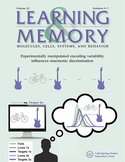
Emotional intensity can produce both optimal and suboptimal effects on learning and memory. While emotional events tend to be better remembered, memory performance can follow an inverted U-shaped curve with increasing intensity. The strength of Pavlovian conditioning tends to increase linearly with the intensity of the aversive outcome, but leads to greater stimulus generalization. Here, we combined elements of episodic memory and Pavlovian conditioning into a single paradigm to investigate the effects of varying outcome intensities on conditioned fear responses and episodic memory. Participants encoded trial-unique images from two semantic categories as conditioned stimuli (CS+ and CS−) before (preconditioning), during, and after (extinction) acquisition. We systematically varied the intensity of the unconditioned stimulus (US) during acquisition between-groups as a nonaversive tone, a low-intensity electrical shock, or a high-intensity electrical shock paired with a loud static noise. Results showed that conditioned skin conductance responses scaled linearly with US intensity during acquisition, with a high-intensity US leading to greater resistance to extinction and stronger 24 h fear recovery. However, 24 h recognition memory produced an inverted U-shaped relationship, with better recognition memory for CSs encoded before (retroactive), during, and following conditioning using a low-intensity US. These findings suggest a dissociation between optimal levels of emotional intensity on explicit and implicit learning and memory performance.
Footnotes
-
[Supplemental material is available for this article.]
-
Article is online at http://www.learnmem.org/cgi/doi/10.1101/lm.053982.124.
- Received June 3, 2024.
- Accepted September 24, 2024.
This article is distributed exclusively by Cold Spring Harbor Laboratory Press for the first 12 months after the full-issue publication date (see http://learnmem.cshlp.org/site/misc/terms.xhtml). After 12 months, it is available under a Creative Commons License (Attribution-NonCommercial 4.0 International), as described at http://creativecommons.org/licenses/by-nc/4.0/.