Shaping behaviors through social experience and their proposed sensitivity to stress
- Center for Neurobiology of Stress Resilience and Psychiatric Disorders, Chicago Medical School, Rosalind Franklin University of Medicine and Science, North Chicago, Illinois 60064, USA
- Corresponding author: jeremy.rosenkranz{at}rosalindfranklin.edu
Abstract
Mammals have evolved with a range of innate drives, such as thirst and hunger, that promote motivated behaviors to ensure survival. A drive for social engagement promotes social interaction and bond formation. While a stable social environment maintains the opportunity for resource sharing and protection, an additional benefit is provided by the social transmission of information. Social experiences, and information obtained from conspecifics, can be used to learn about threats and opportunities in the environment. This review examines the primary forms of social learning and how they can shape behavior. Additionally, while there is much known about the effects of stress on learning and memory, there is much less known about its effects on social learning and memory. This review will therefore dissect the major factors that contribute to social learning and propose how stress may impact these factors. This may serve as a way to formulate new hypotheses about how stress might impact social learning and the effects of social experiences on behavior.
Social engagement can be fun and provides opportunities for rewarding outcomes. Across the animal kingdom, social competency can promote survival by providing safety and facilitating reproduction and food acquisition (Alexander 1974). However, the social environment can be among the most common sources of stress (Almeida 2005). Maintaining hierarchal position, defending territory, and cooperating with conspecifics promote survival and reproductive fitness, but also present ongoing challenges that must be faced across mammals. Humans are not immune to these challenges, and social stressors ranging from interpersonal violence and bullying to a difficult boss and moody children are among the most common causes of stress in adults. While mammals have evolved to either eliminate or cope with periodic stress, unrelenting social stress has a negative impact on human physical and mental health (McEwen 1998). These effects have been examined across humans and other primates and rodents, and include effects on learning and memory (Giovanniello et al. 2023; Sep et al. 2023). Learning from conspecifics, or social learning, provides a safe opportunity to gain important knowledge. But one area that has been much less explored is how stress impacts elements of social cognition and how this may influence social learning. This review will focus on the major forms of social experience-dependent alterations of behavior and social learning in rodents. This review will then dissect what is known about effects of stress on specific elements of social function that may impact social learning.
A framework for social experience-dependent learning
When interacting with a conspecific, there is an ongoing dynamic bidirectional process that occurs. In the simplest recipe for social interaction, there must be a social target, and there must be the ability to perceive and interpret social behavior (Frith and Frith 2007; Redcay and Schilbach 2019; De Felice et al. 2023). But this is heavily modified by other intrinsic and extrinsic factors. Social motivation, a drive to engage in social behavior or form social bonds, plays a significant role in social opportunity and receptivity, for instance, by facilitating approaching to a social situation and attention to a conspecific (Tamir and Hughes 2018; Lee and Beery 2022). Social motivation is in flux across development and can rapidly change in response to social experiences (Kennedy et al. 2014; Kilford et al. 2016). In the extreme, abusive or violent social interactions are expected to reduce motivation to engage in social interactions and can bias social perception. On the other hand, positive social experiences can increase subsequent motivation to engage in social opportunities. These simple shifts of social motivation can then guide subsequent social behavior. This is important because social motivation, and its sensitivity, is at the core of mammalian ability to gain information from the social environment and to subsequently adapt behavior.
There are several categories of information gained by social experience, which can then be used to guide behavior (Fig. 1). This can include a range of social experience-dependent changes in behavior, from social recognition and hierarchy assembly, to social transmission of food preference and avoidance of threats. While, presumably some of these forms of learning would be expected to follow explicit learning rules that underlie recognition, or implicit learning rules that underlie operant or associative rules, this might not always be the case, and there are a rich multitude of factors that continuously influence the formation and adaptation of these behaviors (Kendal et al. 2018). To attempt to accurately dissect some of these factors, it is helpful to delineate the boundaries of social experiences from nonsocial experiences. In addition to sensitivity to intrinsic social motivation, we will use the requirements that (1) there must be a social source (usually a conspecific), and (2) there must be some awareness of the social source. Clear awareness of the social source is often not directly measured in social behavior assays, but it is usually assumed based on attention and interaction with a conspecific. These criteria separate social learning from some reflexive responses that might not require awareness of a social source, and from some forms of learning that might utilize a discrete social cue in isolation. Experiences with these social sources can lead to social experience-dependent adoption of behaviors, affect, and rules or strategies (Fig. 1).
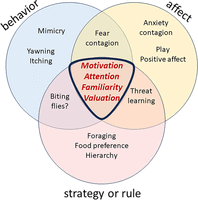
Venn diagram of transmission and adoption during social experiences. There are three broad categories of what is most commonly gained by an observer during a social experience: (1) a behavior, (2) an affective state, and (3) a rule or strategy. Specific social experiences are expected to be associated with one or more of these categories. A behavior may be adopted during contagious yawning/scratching and mimicry, without transmission of any specific affective state or rule/strategy. An affective state might be adopted during contagious anxiety (when no specific threat is present), play, and other positive states, without the adoption of a specific behavior or strategy. A specific behavior and affective state might be adopted during contagious fear (threat is present). Specific rules might be learned by observing foraging, social food preference, and the formation of a hierarchy. A rule and an affective state might be adopted during social threat learning, while a rule and a behavior might be adopted when observing a conspecific meet a specific challenge, such as biting flies. All of these social experiences are sensitive to factors (highlighted in red in the middle of the diagram), such as social motivation, attention/vigilance, valuation/interpretation of social information, and familiarity of the social source.
The basics: contagious yawning, biting flies, and strategies
Some of the most basic forms of social experience-dependent changes in behavior require social receptivity, but modify a reflexive behavior. A category of unlearned behaviors is proposed to be so fundamental to survival that the behaviors have evolved without the necessity for decision-making. This includes behaviors with clear biological importance, such as breathing, as well as behaviors that are believed to help maintain homeostatic balance or response to toxins, such as yawning, shivering, and vomiting. These behaviors can occur without any social context, but yawning, shivering, and disgust can also be facilitated by social transmission in a process described as social contagion (de Waal and Preston 2017; Palagi et al. 2020; Gan et al. 2022; Kavaliers et al. 2022). Social contagion has also been observed for itch, laughing, and for broad emotional states (Schut et al. 2015; Palagi et al. 2022; Puścian et al. 2022). Contagious itch and contagious yawning have been tested and documented across a wide range of mammals, from humans to rodents. The social parameters that underlie contagious itch and yawning are not clear. This form of learning requires at least a minimal degree of attention toward the yawner or scratcher, but it is not fully established whether these behaviors fit better under a label of reflexive imitation or if they require awareness that the performer is a source of social information. The difference would come down to whether the contagious behavior is triggered by an observed noise or motion irrespective of the source, or whether this information needs to originate from a social source. Some evidence suggests that this form of transmission emerges most robustly if the conspecifics are familiar to each other (Norscia and Palagi 2011; Madsen et al. 2013; Romero et al. 2013, 2014; Pedruzzi et al. 2022; Gallup and Wozny 2023) and if they have recently experienced itchy or hyperthermic conditions (Gallup and Eldakar 2011). This suggests that there may be an element of social processing, such as recognition of the state of the animal, that facilitates contagion. Furthermore, human conditions associated with lower empathy tend to show lower contagious yawn (Gallup et al. 2021; Helt et al. 2021).
In further support of social transmission of a simple behavior, and not just reflexive imitation, studies using biting flies have demonstrated that a rodent can observe conspecific escape behavior from biting flies, and will adopt a similar escape strategy and conditioned analgesia when exposed to nonbiting flies (same species with biting mouthparts removed) a day later, in the absence of the demonstrator (Kavaliers et al. 2001, 2003). This favors the interpretation that social transmission has been received and adopted. However, the form of learning that underlies this experience-dependent behavioral change is not clear from these studies. On one extreme, it is possible that the rodent has learned a conspecific stimulus-response progression and was able to make a transitive leap and apply this to itself. It is more parsimonious, however, that the rodent acquired a simpler association between flies and an aversive outcome or state, which was adopted when directly exposed to flies for the first time.
There is mixed evidence about whether a rodent can learn more complex information solely by observation. Rodents are fairly adept at spatial learning of reward location by observation (Brown et al. 2007, 2008; Doublet et al. 2022). In contrast, the ability for rodents to learn a strategy or operant task by observation is more tenuous (Doublet et al. 2022), but there are hints that it can occur (Weigl and Hanson 1980; Heyes and Dawson 1990; Heyes et al. 1994; Ray and Heyes 2002). However, it has been found that observation of either an expert conspecific performing an operant behavior, or a beginner conspecific learning an operant behavior, increases the rate of learning on the same task (Zentall and Levine 1972; Huang et al. 1983; Collins 1988; Laland and Plotkin 1992; Carlier and Jamon 2006; Takano et al. 2017; Yamada and Sakurai 2018; Keshen et al. 2023; Rautio et al. 2024). This suggests that rodents can gain substantially from social observation, and may even be able to use conspecific behavior to refine a spatial or foraging task, but it cannot replace direct experience in these tasks.
Social predictors: contagious emotion and socially learned threat
The ability to detect a conspecific negative state, and then either adopt a similar state (emotional contagion), or use this as a component of associative learning has been demonstrated with several approaches. This is distinct from mimicry, in which an animal might adopt an observed behavior without adopting the affective state. Mimicry is seen abundantly throughout mammalian species, and can even be used as a strategy adopted from a different species for an advantage. Behavioral mimicry occurs substantially throughout social interactions. Although it can occur without awareness or specific goal, in the context of social learning, behavioral mimicry can also be a building block of learning complex behaviors by observation. The main difference, in a practical sense, is that a mimicked behavior will mirror the demonstrator action, while a contagious state might or might not mirror the behavior. This is because there may be alternative advantageous behaviors that may be appropriate in response to an affective state, whether or not it is acquired by contagion. In the most basic form of contagion, a rodent undergoes an aversive experience while observed by a conspecific. The observer will typically display progressive distress behaviors that are tied to the distress demonstrated by the demonstrator (Church 1959; Lucke and Baton 1980; Jeon et al. 2010; Kim et al. 2010; Atsak et al. 2011; Han et al. 2019). There is still debate about the nature of negative emotional contagion, and what is socially transmitted. On one hand, components of the demonstrator's negative affective response (vocalizations, stress pheromones) may be intrinsically aversive to the observer. This would suggest that the stimulus, uncoupled from the social source, is sufficient to produce a negative affective state. This would not require recognition of the conspecific affective state. Although subtly different, this might be best described as an instance where the social cue itself is an unconditioned stimulus, and the negative affect of the demonstrator is not the key for contagion. However, there are hints that recognition of affective state can contribute. For instance, the degree and type of demonstrator distress behavior dictates the type of observer response (Knapska et al. 2006; Langford et al. 2006; Smith et al. 2016; Li et al. 2018; Han et al. 2019; Andraka et al. 2021), and this emotional contagion is strongest with same-strain rodents that are familiar with each other (Langford et al. 2006; Jeon et al. 2010; Knapska et al. 2010).
While emotional contagion has been strongly demonstrated with negative emotions, it may also apply to the contagion of positive emotions in rodents. Rodents show preference for others that are displaying positive affective behaviors (Ferretti et al. 2019; Scheggia et al. 2020), display similar responses as demonstrators when they observe tickling (Kaufmann et al. 2022), demonstrate a positive bias toward ambiguous cues when they hear positive vocalization (50 kHz), and will increase play behavior to match a conspecific (Pellis and McKenna 1992; Varlinskaya et al. 1999).
Emotional contagion can serve to prepare rodents to respond to a threat or opportunity. But there is now strong evidence that rodents can further utilize conspecific affective responses, and use them as the basis for associations to contextual or discrete cues. This has been most clearly demonstrated with social fear conditioning, where the demonstrator receives foot shocks, and an observer will not only adopt the affective state of the demonstrator, but will also learn that the context or cues that predict conspecific foot shock are potential sources of threat (Jeon and Shin 2011; Jones et al. 2014, 2018; Twining et al. 2017). So, in contrast to operant tasks described above, observation alone is sufficient to acquire these associative forms of memory. The nature of the association is still not clear. The most commonly proposed options include (a) the conspecific negative affective behavior is used as a cue that predicts a potential threat to the observer, and this is associated with the context or cue (selfish rats; Keysers and Gazzola 2023); (b) a context or cue predicts conspecific negative affective behaviors, and these conspecific behaviors are aversive to the observer; and (c) a context or cue predicts an aversive event to a conspecific, and harm to a conspecific is innately aversive to the observer (selfless rat). While some evidence supports that harm to conspecifics is aversive and conspecific negative affective behaviors are aversive, social transmission can even facilitate fear learning when the observer never witnesses the demonstrator receiving a US, or never witnesses the demonstrator in the context or with cues that predict a US (Knapska et al. 2010; Jones et al. 2018). This might weaken the supposition that the rodent acts selfishly in this situation because there is no obvious threat. Indeed, whether rodents can be motivated to act out of empathy toward conspecifics is gaining support with studies that demonstrate behaviors that benefit conspecifics without obvious immediate self-benefit (Hernandez-Lallement et al. 2014; Wood et al. 2016; Li and Wood 2017), but see Kentrop et al. (2020). In addition, rats will learn to lever press to free or reduce distress to conspecific (Rice and Gainer 1962; Greene 1969), although the motivation for this freeing behavior, whether prosocial motivation aimed at conspecific distress or selfish motivation to gain social interaction, is still unclear (Silberberg et al. 2014; Bartal et al. 2016; Hiura et al. 2018; Carvalheiro et al. 2019; Cox and Reichel 2020; Schulingkamp et al. 2023) as rodents will also learn operant behaviors just for access to social interaction (Angermeier 1960; Evans et al. 1994; Hachiga et al. 2018; Venniro et al. 2018; Hackenberg et al. 2021; Chow et al. 2022; Schulingkamp et al. 2023). However, some rats will even sacrifice the opportunity for a reward if that will prevent conspecific distress (Hess et al. 2023). In many conditions, it may be more nuanced, and a rodent will act altruistically if the cost is not too high (Schneeberger et al. 2012; Hernandez-Lallement et al. 2020). Although the motivation for these behaviors can still be debated, it requires recognition and the motivating properties of a social stimulus.
You smell safe, I'll have what you're having
Familiarity between conspecifics facilitates many types of social experience-dependent changes in behavior (Camacho-Alpízar and Guillette 2023). Social recognition memory forms the basis of familiarity. During a first interaction between rodents, there are typically risk assessment behaviors intermingled with social investigation. Although not studied in depth, initial social investigations in many rodents tend to be cautious (Rex et al. 2004; Reeb and Tang 2005; Cavigelli et al. 2007, 2011; Loh et al. 2023), with sniffing and interactive behaviors from a position of relative safety, with limited flank and underside exposure (Blanchard et al. 1977; Pellis and Pellis 1987; Pellis and Bell 2011). As rodents gain experience with the same conspecific, they learn to recognize the conspecific based on olfactory cues (Brennan and Kendrick 2006). Similar to other forms of recognition memory, there is initial encoding, short-term recognition memory, a protein synthesis-dependent consolidation, and long-term recognition memory (Thor et al. 1982; Engelmann et al. 1995; Everts and Koolhaas 1997; Kogan et al. 2000; Ferguson et al. 2002; Winslow 2003; Richter et al. 2005; Camats Perna and Engelmann 2017). During the process of familiarization, rodents can also learn whether a same-sex conspecific is a source of threat based partly on olfactory cues and on whether the conspecific initiates aggressive behavior. Studies using social defeat demonstrate that rodents can reliably identify a conspecific that was previously aggressive, and modify behavior accordingly (Crestani et al. 2018). Furthermore, based on social interaction experience, rodents form stable hierarchies that require the formation of recognition memory (Adams and Boice 1983).
Can all rodents form social bonds? While social recognition is a reliable ability across most rodents studied, the evidence for stable adult social bonds tends to be more selective to some rodent species. Rodent maternal-infant behaviors imply that bonding is possible in many rodent species (Numan and Young 2016). Rodent pups rely on and orient strongly toward their mother, and mothers expend significant efforts, at personal cost, toward nurturing and protecting their pups. Both pups and mother display distress at separation (Herman and Panksepp 1978; Insel et al. 1989; Pawluski et al. 2009). Evidence for social bonds between adult rodents has been more challenging to demonstrate widely across rodent species. Most famously, select species of vole form long-lasting pair bonds that include selective mating (Insel and Shapiro 1992), but there is less evidence in rats and mice (Brunner et al. 2016; Schweinfurth et al. 2017a). However, there are some hints that social bonds may form. Rats and mice will form preferences for specific conspecifics (Proops et al. 2021), and some females will even engage in mate-guarding behavior after copulation (Holley et al. 2014). In addition, unstable social housing is a stressor (Henry et al. 1993; McCormick et al. 2007; Green et al. 2013), and even the removal of individual cage mates can be enough to produce changes indicative of social stress (Burman et al. 2008; Ferland and Schrader 2011). However, there are alternative explanations for these effects aside from social bonds.
If social bonds are not a major factor in most rodent social behaviors, what is the basis for the strong effects of familiarity in social learning? Some hints are derived from the social transmission of food preference. Food preference is among the simpler forms of social experience-dependent changes. Based on olfactory cues, rodents will prefer foods that were recently consumed by a conspecific (Galef and Kennett 1987; Valsecchi et al. 1996; Forestier et al. 2018). This preference is replicable, but surprisingly, food safety can be learned, but food aversion is not formed by food-related illness in conspecifics (Galef et al. 1983; Galef 1986; Galef and Whiskin 2000; Jing et al. 2014). Several studies aimed to test whether the reliability of the information from the conspecific is a factor in successful social transmission. Reliability, manipulated as conspecific that previously consumed an available food (i.e., history of providing useful information) or food that made the rodent ill, did not bias subsequent social transmission of food preference (Agee and Monfils 2018; Kitchenham et al. 2019). However, there is some evidence that the trustworthiness of the conspecific as a cooperating partner can impact other behavior. Rodents may be sensitive to unfairness (Oberliessen et al. 2016), and shift their behavior in response to whether conspecifics reciprocate sharing and grooming, or cooperate in mutual reward tasks (Rutte and Taborsky 2007; Schneeberger et al. 2012; Dolivo and Taborsky 2015; Schweinfurth et al. 2017b; Schweinfurth and Taborsky 2018). Familiar rodents may already have a history of reciprocity, but it is not known if this factor might shift social learning.
Simpler alternatives for the strong effects of familiarity might lie in whether the observer recognizes important behavioral changes. A range of behavioral changes contribute to the social cues that underlie social responses and learning (Pereira et al. 2012; Márquez et al. 2015; Cruz et al. 2020; Ebbesen and Froemke 2021; Gachomba et al. 2022). It is expected that individual familiarity may extend to recognizing typical individual behavior patterns. This would lead to enhanced recognition of a change in conspecific behavior that could serve as a cue for social learning. Also tied to predictability and safety, an unfamiliar conspecific may produce anxiety states that interfere with social learning (Forestier et al. 2018).
Is the demonstrator a teacher?
While substantial evidence confirms social learning in rodents, it is not known whether there is intentional demonstration, or teaching. There is evidence for intentional teaching in nonhuman primates and some other mammals (Thornton and McAuliffe 2006; Musgrave et al. 2016; Mikeliban et al. 2021), but this has not yet been demonstrated in rodents. However, rodents do alter their vocalizations during aversive and appetite conditions depending on social context and the observing conspecific (Wright et al. 2010; Atsak et al. 2011; Chabout et al. 2012; Willey and Spear 2012; Kisko et al. 2015a,b; Seagraves et al. 2016; Burke et al. 2017, 2022; Seidisarouei et al. 2021). In addition, they can alter their behavior during social learning if an observer is present (Atsak et al. 2011). While this alone is not sufficient evidence of teaching, it implies that awareness of an observer can change what is demonstrated.
There are two hypothesized prerequisites for teaching, cooperation and joint attention (Thornton and Raihani 2010). Cooperation in rats has been observed in the context of working together to obtain rewards (Viana et al. 2010; Łopuch and Popik 2011). In contrast, there is not substantial evidence for joint attention, often assessed as gaze-following in rodents, although it has been found in several other nonhuman primate and mammalian species (Shepherd and Platt 2008; Shepherd 2010; Range and Virányi 2011; Bettle and Rosati 2019; Johnson et al. 2022). However, it is not clear that gaze-following, a vision-dependent behavior, would be the preferred modality for rodent joint attention. Although rodents can use visual cues to detect threat to a conspecific (Hong and Choi 2018), there is evidence that rodents may rely on auditory, body movement, or olfactory cues in a manner that could be a prelude to joint attention (Pereira et al. 2012; Márquez et al. 2015; Cruz et al. 2020; Gerber et al. 2020; Ebbesen and Froemke 2021; Gachomba et al. 2022). So, although it is possible, there is no strong evidence yet for or against teaching behaviors in rodents.
Stress and the processes of social learning
There is now substantial information about the impacts of different types of stressors on explicit and implicit learning processes, in humans and rodents (Moreira et al. 2016; Rocha et al. 2021; Sep et al. 2023; Plas et al. 2024). There is much less known about the effects of stress on social learning. However, by breaking down the components of social learning, we may be able to predict the effects of stress. The component processes can differ depending on the type of social learning, but there are several expected shared components across different types of social learning.
Attention is a key requirement for many forms of learning, and attention to a conspecific is associated with better acquisition of social learning (Yusufishaq and Rosenkranz 2013; Hong and Choi 2018; Weil et al. 2022; Agee et al. 2023; Troha et al. 2023). Stress increases risk assessment behaviors, including vigilance (Zalaquett and Thiessen 1991; Krebs et al. 1997; Nelson et al. 2010; Choy et al. 2012; Liesenjohann et al. 2013), and can increase social vigilance (Duque-Wilckens et al. 2018). However, if sufficient attention is already directed at conspecific, enough to permit acquisition of all needed information to produce social learning, higher vigilance is not expected to lead to better learning. A small amount of evidence might be gained from studies that tested contagious yawn and itch, whose requirements are limited primarily to attention. Stress and potential threats decrease contagious yawn (Miller et al. 2012; Moyaho et al. 2017) and have no impact on contagious itch (Shayan et al. 2024). Furthermore, contagious yawn and itch are greater between familiar conspecifics, despite higher attention toward an unfamiliar conspecific (Thor et al. 1982; Dantzer et al. 1987; Engelmann et al. 1995; Cirulli et al. 1996; Popik and van Ree 1998; Winslow 2003; Moy et al. 2004; Markham and Juraska 2007; Shayan et al. 2024). So, increased vigilance caused by stress might not enhance social learning.
Social interaction can be another significant factor in social learning because it provides opportunity for relaying important olfactory cues. A number of studies have found decreased social interaction, or even social avoidance after stress (Von Frijtag et al. 2000; Berton et al. 2006; Burgado et al. 2014; Hodges et al. 2017; Wendelmuth et al. 2020; Schaack et al. 2021; da Costa et al. 2023). However, even physically separated rodents can learn from observation, so it is not clear if this would be a key factor that might impact social learning after stress.
Social familiarity strongly enhances social learning, as described above. There are several studies that indicate decreased recognition memory after stress (Wagner et al. 2013; de Lima et al. 2017; Duque et al. 2017; Wendelmuth et al. 2020; da Costa et al. 2023; Liu et al. 2024) and decreased social recognition memory (Von Frijtag et al. 2000; Franklin et al. 2011; Eagle et al. 2013; Hodges et al. 2017; Schaack et al. 2021). This would be expected to significantly diminish the enhancing effects of familiarity on social learning. However, social recognition tests are usually performed in a manner that relies on stable social novelty preference, and may produce null results even when there is other evidence of social memory (D'Amato 1997; Penka et al. 2004; Shahar-Gold et al. 2013; Ferrara et al. 2022). So, if stress produces neophobia, as found in some studies (Dess 1992; Job and Barnes 1995; Green et al. 2006; Wisłowska-Stanek et al. 2016), this might be enough to produce a change in social recognition task performance despite fully intact social recognition memory. In fact, there is evidence that stress may increase social recognition memory. For example, stress facilitates memory for previously established hierarchy (Cordero and Sandi 2007), which would rely on social recognition (van der Kooij and Sandi 2012). So, it is not likely that stress will impact social recognition in a manner to prevent social learning.
A final important factor in social experience-dependent changes is related to the ability to appropriately interpret and process social stimuli. It is expected that disruption in the value of social cues, or in the ability to interpret social cues, would impair social learning (Koban and Pourtois 2014; Lockwood 2016; Webb et al. 2017; DeMayo et al. 2019; Vázquez et al. 2022). There has been minimal examination of the effects of stress on these processes in rodents. However, we might extrapolate from the effects of post-weaning social isolation. It is during the post-weaning period that rodents are believed to learn appropriate reciprocation of social behaviors, develop the ability to interpret the valence of conspecific behavior, and learn to modify their own behavior in response to a conspecific. This is believed to be achieved partly through play behavior (Pellis et al. 1997; van den Berg et al. 1999; Pellis and Pellis 2017; Li et al. 2021; Cooper et al. 2023), during which rodents can learn that vocalizations and responses of a conspecific mirror their own vocalizations and responses, perhaps via auto-conditioning (Parsana et al. 2012; Cruz et al. 2020; Packheiser et al. 2023). Post-weaning social isolation prevents this opportunity and leads to reduced social motivation (Hol et al. 1999; Okada et al. 2015; Kinley et al. 2021; Caruso et al. 2022), impaired social recognition (Kercmar et al. 2011; Liu et al. 2019), abnormal sexual behaviors (Gerall et al. 1967; Duffy and Hendricks 1973; Cooke et al. 2000; Kercmar et al. 2014; Liu et al. 2019) and impaired ability to deescalate aggressive encounters and aggressive responses to nonthreats (Wongwitdecha and Marsden 1996; Tóth et al. 2008; Seffer et al. 2015) along with abnormal vocalizations (Von Frijtag et al. 2002). These may indicate impaired interpretation of and responses to social stimuli. In parallel, post-weaning social isolation disrupts social learning (Yusufishaq and Rosenkranz 2013; Panksepp and Lahvis 2016; Dawud et al. 2021). If stress can produce similar effects as deprived rearing, it would be expected to significantly impair social learning.
Conclusions
Social engagement is a significant element in mammalian life. The opportunity to share experiences and learn from conspecifics is among the many benefits of a social environment. These experiences incorporate processes from relatively simple recognition to potentially complex behavioral strategies. There are still many factors that are not known, including whether social learning represents a subtype of other well-studied forms of implicit and explicit memory formation, or whether it is a specialized form that utilizes unique rules and contingencies. Studies over the past decade point to unique substrates and disassociation of social learning from other forms of learning. In addition, while stress is ubiquitous in daily life, there is little direct experimental evidence that tests the effects of stress on rodent social learning. While we can speculate that the effects of stress on social memory may be similar to nonsocial memory, many social factors that contribute to social experiences are themselves sensitive to stress. It is important to begin to test these questions in order to develop a better understanding of social experience-dependent behaviors and disorders that disrupt these processes.
Acknowledgments
The author thanks Dr. Nicole Ferrara for useful discussions. Funding was provided by the National Institutes of Health (MH118237).
Footnotes
-
Article is online at http://www.learnmem.org/cgi/doi/10.1101/lm.053926.124.
- Received July 15, 2024.
- Accepted September 9, 2024.
This article is distributed exclusively by Cold Spring Harbor Laboratory Press for the first 12 months after the full-issue publication date (see http://learnmem.cshlp.org/site/misc/terms.xhtml). After 12 months, it is available under a Creative Commons License (Attribution-NonCommercial 4.0 International), as described at http://creativecommons.org/licenses/by-nc/4.0/.
References
- ↵
- ↵
- ↵
- ↵
- ↵
- ↵
- ↵
- ↵
- ↵
- ↵
- ↵
- ↵
- ↵
- ↵
- ↵
- ↵
- ↵
- ↵
- ↵
- ↵
- ↵
- ↵
- ↵
- ↵
- ↵
- ↵
- ↵
- ↵
- ↵
- ↵
- ↵
- ↵
- ↵
- ↵
- ↵
- ↵
- ↵
- ↵
- ↵
- ↵
- ↵
- ↵
- ↵
- ↵
- ↵
- ↵
- ↵
- ↵
- ↵
- ↵
- ↵
- ↵
- ↵
- ↵
- ↵
- ↵
- ↵
- ↵
- ↵
- ↵
- ↵
- ↵
- ↵
- ↵
- ↵
- ↵
- ↵
- ↵
- ↵
- ↵
- ↵
- ↵
- ↵
- ↵
- ↵
- ↵
- ↵
- ↵
- ↵
- ↵
- ↵
- ↵
- ↵
- ↵
- ↵
- ↵
- ↵
- ↵
- ↵
- ↵
- ↵
- ↵
- ↵
- ↵
- ↵
- ↵
- ↵
- ↵
- ↵
- ↵
- ↵
- ↵
- ↵
- ↵
- ↵
- ↵
- ↵
- ↵
- ↵
- ↵
- ↵
- ↵
- ↵
- ↵
- ↵
- ↵
- ↵
- ↵
- ↵
- ↵
- ↵
- ↵
- ↵
- ↵
- ↵
- ↵
- ↵
- ↵
- ↵
- ↵
- ↵
- ↵
- ↵
- ↵
- ↵
- ↵
- ↵
- ↵
- ↵
- ↵
- ↵
- ↵
- ↵
- ↵
- ↵
- ↵
- ↵
- ↵
- ↵
- ↵
- ↵
- ↵
- ↵
- ↵
- ↵
- ↵
- ↵
- ↵
- ↵
- ↵
- ↵
- ↵
- ↵
- ↵
- ↵
- ↵
- ↵
- ↵
- ↵
- ↵
- ↵
- ↵
- ↵
- ↵
- ↵
- ↵
- ↵
- ↵
- ↵
- ↵
- ↵
- ↵
- ↵
- ↵
- ↵
- ↵
- ↵
- ↵
- ↵
- ↵
- ↵
- ↵
- ↵
- ↵
- ↵
- ↵
- ↵
- ↵
- ↵
- ↵
- ↵
- ↵
- ↵
- ↵
- ↵
- ↵
- ↵
- ↵
- ↵
- ↵
- ↵
- ↵
- ↵
- ↵
- ↵
- ↵
- ↵
- ↵
- ↵
- ↵
- ↵
- ↵
- ↵
- ↵
- ↵
- ↵
- ↵
- ↵
- ↵
- ↵
- ↵
- ↵
- ↵
- ↵
- ↵
- ↵
- ↵