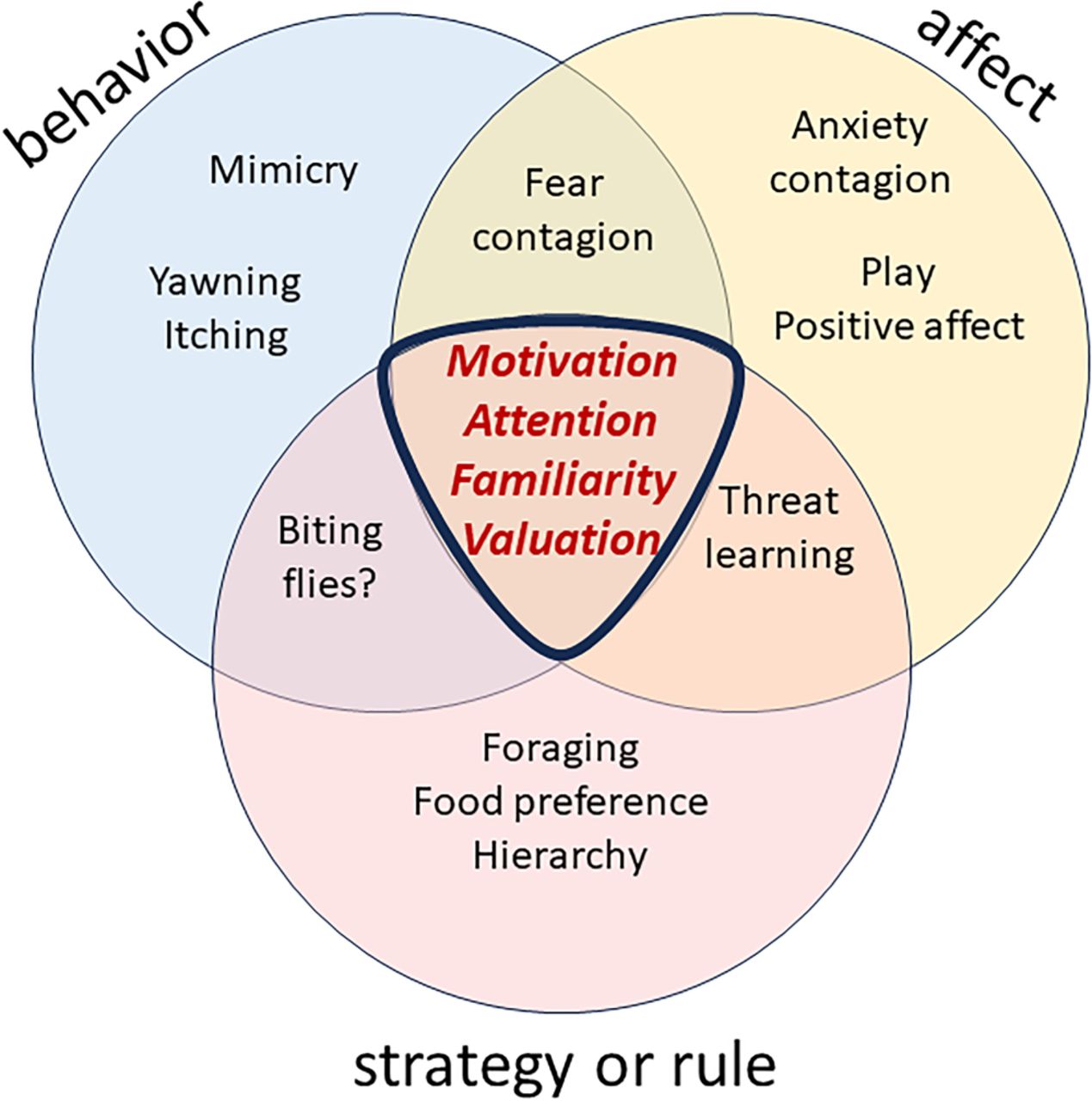
Venn diagram of transmission and adoption during social experiences. There are three broad categories of what is most commonly gained by an observer during a social experience: (1) a behavior, (2) an affective state, and (3) a rule or strategy. Specific social experiences are expected to be associated with one or more of these categories. A behavior may be adopted during contagious yawning/scratching and mimicry, without transmission of any specific affective state or rule/strategy. An affective state might be adopted during contagious anxiety (when no specific threat is present), play, and other positive states, without the adoption of a specific behavior or strategy. A specific behavior and affective state might be adopted during contagious fear (threat is present). Specific rules might be learned by observing foraging, social food preference, and the formation of a hierarchy. A rule and an affective state might be adopted during social threat learning, while a rule and a behavior might be adopted when observing a conspecific meet a specific challenge, such as biting flies. All of these social experiences are sensitive to factors (highlighted in red in the middle of the diagram), such as social motivation, attention/vigilance, valuation/interpretation of social information, and familiarity of the social source.