Evidence for novelty reward cross-cueing in the odor span task in rats: implications for odor-based reward-motivated tasks
- Department of Anatomy, Physiology, and Pharmacology, University of Saskatchewan, Saskatoon, Saskatchewan S7N 5E5, Canada
- Corresponding author: john.howland{at}usask.ca
-
↵1 These authors contributed equally to this work.
Abstract
The odor span task (OST) infers working memory capacity (WMC) by requiring rodents to discriminate between previously presented and session-novel odors to obtain a hidden food reward. Here, rats’ responses to session-novel odors and food rewards were assessed to determine whether rats use mitigating strategies in the OST. Rats accurately responded to session-novel odors but also reliably responded to the food reward alone and performed at chance when both a session-novel odor and food reward were presented in separate locations. The inclusion of unscented sand in the cups holding the food reward significantly reduced the rats’ responses to the food reward alone. Collectively, these results demonstrate the need for rigorous tests of potential mitigating strategies and hold wide implications for rodent odor discrimination-based behavioral tasks.
As olfaction is the primary sensory modality of rodents, numerous odor-guided behavioral tasks have been designed to investigate rodent cognition (Slotnick 2001). For example, popular tasks such as olfactory operant conditioning, odor discrimination, and the odor span task (OST) all share a common feature of olfactory-guided behavior that is reinforced by food rewards (Eichenbaum and Otto 1993; Galizio 2016). Because performance of these tasks is partly motivated by the food reward itself, rodents may acquire mitigating strategies that optimize the attainment of the food reward but may not engage the intended cognitive processes being studied. Therefore, rigorous tests of potential mitigating strategies are crucial for upholding the face validity of odor discrimination-based tasks and of behavioral tasks more broadly.
The OST is used to assess nonspatial working memory capacity (WMC) that relies on rodents’ ability to discriminate between and remember distinct odors to locate a hidden food reward (Dudchenko et al. 2000; Young et al. 2007). It uses an incrementally modified serial delayed nonmatch to sample procedure in which a session-novel odor is rewarded, and odors presented in preceding trials are not. Thus, after each successive correct trial, the memory load increases, and trials will be serially conducted until an incorrect selection is made. To prevent potential mitigating strategies, studies using the OST typically use hidden food rewards beneath scented sand or wood chips, requiring the rat to perform a conditioned digging response for collection (Dudchenko et al. 2000; Young et al. 2007; Davies et al. 2013a,b), or a lid-flipping variant, where a food reward is hidden under a scented lid of a plastic portion cup in unscented sand (MacQueen et al. 2011; Galizio et al. 2013; Scott et al. 2020). To ensure that rats respond to session novelty in the absence of a food reward during the OST, existing studies using the OST typically conduct a simple probe experiment where rats are required to respond to session novelty in the absence of a food reward (Dudchenko et al. 2000; MacQueen et al. 2011; Davies et al. 2013b). While this design investigates responding to session novelty alone, it fails to fully address the possibility of food odor-guided mitigating strategies within the task. Such mitigating strategies may be especially probable in the context of the OST given the variability of food rewards that have been historically used for reinforcement (e.g., Froot Loops, sucrose pellets, and dustless pellets) (Dudchenko et al. 2000; Young et al. 2007; Davies et al. 2013b; Mathews et al. 2018). To address this problem and rigorously assess cue-related responding in the OST in rats, we designed a four-stage expanded probe experiment that tests rats’ responses to (1) a standard pairing of a session-novel odor with a food reward, (2) a session-novel odor alone (i.e., a no-bait condition with the food reward absent), (3) a food reward paired with a previously presented odor (i.e., no session-novel odor present), and (4) a cross condition in which the session-novel odor and food reward are presented simultaneously, but the food reward is located in a previously presented stimulus. In addition, we tested separate groups of rats using stimulus cups that either did or did not contain sand to assess whether this additional component of the stimuli would affect performance.
Adult Long-Evans rats (male, n = 9; female, n = 3) were used. Rats were housed individually or pair-housed in standard ventilated cages and kept on a 12-h light/dark cycle (lights on at 7:00 a.m.). Rats were tested at the same time each day during the light phase. While being trained and tested on the OST and expanded probe, rats were maintained at 85%–90% of their free-feeding weight with water available ad libitum. The first cohort of rats (male, n = 6; Charles River Laboratories) was sourced from a separate experiment in which subjects were bilaterally implanted with cannulae to allow chemical inactivation of the nucleus accumbens core using muscimol and baclofen (Onofrychuk et al. 2024). These rats were used in the no-sand masking condition. The second cohort of rats (male, n = 3; female, n = 3) consisted of transgenic PV-Cre rats [National Institute of Drug Abuse Intramural Research Program Transgenic Rat Project LE-Tg(Pvalb-iCre)2Ottc strain received from the Rat Research and Resource Center] sourced from a separate experiment. These rats were tested in the sand masking condition on the probe trial prior to any chemical or surgical manipulation. Rats were only tested in one condition (i.e., no sand or sand), as the condition in which they were trained on the OST would be expected to influence their performance during the expanded probe session. All experiments were approved by the University of Saskatchewan Animal Research Ethics Board and conformed to the guidelines of the Canadian Council on Animal Care.
Following procedures previously described by our laboratory (Scott et al. 2020), rats were first trained on the OST using 45 mg of dustless precision pellets (Bio-Serv F0021). We used a square table (91.5 cm × 91.5 cm) with 24 holes (5.5-cm diameter) located 3.5 cm from the table edge and 7.5 cm from one another for all training and testing (for additional details, see Fig. 1; Scott et al. 2020). During OST training, rats acquired several important associations for task performance. Specifically, rats were trained to perform a conditioned lid-flipping response with a nonmatch to sample rule in which a session-novel odor was rewarded by two hidden food pellets. Lids were scented with odors for a minimum of 24 h by storing them in sealed containers containing various spices (sage, cocoa, basil, clove, lemon, allspice, paprika, thyme, garlic, celery, fennel, marjoram, cumin, dill, cinnamon, oregano, onion, anise, caraway, coffee, mustard, nutmeg, and ginger) purchased from a local grocery store (Scott et al. 2020). Lids were reused during OST training, but the same lid was never used twice on the same testing day. The mastery criterion for this experiment and others was defined as an odor span of eight across three consecutive training days. Upon demonstration of OST mastery, rats were tested once on the expanded probe trial, which is visualized and described in Figure 1B. Six trials were completed within each stage to measure rats’ responses to different conditions across multiple trials. On average, trials were separated by a delay of 1 min, and stages were separated by a delay of 3 min. Within the probe experiment, only trials where the session-novel odor or stimulus containing a food reward was encountered prior to making a choice were considered in the final analysis, as these trials represent responding upon, or after, exposure to the reward-predicting stimuli.
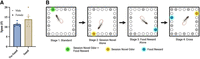
(A) Performance of rats across three consecutive training sessions on the odor span task in the no-sand and sand masking conditions before probe testing. (B) The four stages of the expanded probe experiment, with the maximum number of stimuli possible visualized in each stage. The target locations are highlighted for each stage, while other, incorrect stimuli are represented by gray shaded circles. Locations left white would have no stimulus at that location for that given trial. Locations of stimuli were randomized for each trial. Stage 1 consisted of a standard pairing of a session-novel odor with food reward. Starting with an empty table, six incremental trials were run at this stage with the addition of a novel odor paired with food reward on each trial. Six odors were on the table at the end of this stage, and all odors were removed by the experimenter at the end of this stage. Stage 2 consisted of a session-novel odor without food reward. Starting with an empty table, six incremental trials were run at this stage with the addition of a novel odor without food reward on each trial. If rats flipped a correct lid, they were quickly rewarded with food provided by the experimenter. Six odors were on the table at the end of this stage, and they were used by the experimenter for stage 3. Stage 3 used a previously presented odor paired with a food reward. Using the same previously presented odors from stage 2, one odor at a time was baited for six nonincremental trials. Six odors were on the table at the end of this stage, and they were used by the experimenter for stage 4. Stage 4 used a cross condition in which a previously presented odor paired with a food reward and a session-novel odor without a food reward were both presented. Six incremental trials were run in this stage, with 12 odors on the table at the end of the session.
To assess the sensitivity of the expanded probe experiment to potential mitigating strategies, rats were separated by cohort into two conditions: one in which the food reward was masked with unscented sand and a no-sand condition in which reward pellets were presented within a plastic portion cup under a scented lid. One aspect of this experiment that differs from existing work is that after an incorrect response, defined as removing the lid of a previously seen cup–lid combination in the presence of a session-novel stimulus, a session-novel odor was still introduced in the subsequent trial if the rat interacted with the previous session-novel odor. This decision was made based on the premise that if the rat was exposed to a session-novel odor, even if it did not remove the lid, the rat would still have a memory of that odor. This premise is supported by our general observation that rats that made an incorrect response after contact with the session-novel stimulus did not treat that stimulus as novel on subsequent trials.
Probe sessions were recorded using an overhead video camera and were manually scored by an experienced behaviorist. Behavioral measures of choice latency, interaction bout count, and accuracy were calculated for each rat in each stage. As choice latency is partially confounded by the number of stimuli present within a given trial, we calculated a second measure, termed searching vigor, which was derived by normalizing choice latency to the number of interaction bouts within a given trial (Onofrychuk et al. 2024). Simply put, searching vigor is the mean interval between interaction bouts within a given trial. For stages of the probe experiment in which a session-novel stimulus was incrementally presented (stages 1, 2, and 4), accuracy was defined as flipping the lid of the session-novel stimulus. For stage 3, in which a food reward was randomly placed under a previously presented odor, accuracy was defined as flipping the lid of the food pellet-containing portion cup. To investigate the effect of masking condition on performance, we conducted a series of 2 × 4 mixed ANOVAs with factors of masking condition (sand and no sand) and stage (stages 1–4). Multiple comparisons were completed using Sidak's multiple comparisons test between stages within each condition. For all statistical analyses, significance was set as P < 0.05.
The baseline odor spans of rats in the sand and no-sand conditions were similar prior to probe testing (t(10) = 1.54, P = 0.15) (Fig. 1A). The first stage of the probe test involved a standard pairing of a session-novel odor with a hidden food reward, while the second stage aimed to determine whether rats respond to the session-novel odor in the absence of a food reward. Within both masking conditions, rats responded to session novelty in the absence or presence of a food reward with similar accuracy (Fig. 2A), latency (Fig. 2C), and search vigor (Fig. 2D). Choice accuracy showed no main effect of masking condition (F(1,10) = 2.05, P = 0.18) (Fig. 2A) but did show a main effect of stage (F(3,30) = 15.74, P < 0.0001) and an interaction effect (F(3,30) = 8.14, P = 0.0004). Notably, within the sand masking condition, accuracy was significantly decreased in stage 3 when a food reward was presented in the absence of a session-novel stimulus (P < 0.0001) but was not significantly decreased in the no-sand condition (P = 0.76). Within the no-sand condition, rats located the food reward under a previously presented familiar odor with accuracy (Fig. 2A), latency (Fig. 2C), and searching vigor (Fig. 2D) similar to those of the previous two stages. In both the no-sand (P = 0.0024) and sand (P = 0.023) conditions within stage 4, accuracy was also significantly decreased when cues (session novelty and food pellet) were presented simultaneously but in separate locations.
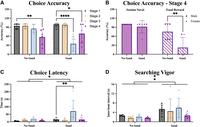
Behavioral measures for both odor-masking conditions in each stage of the expanded probe experiment. (A) Choice accuracy (percentage). (B) Choice accuracy for stage 4 split by whether the initial approach was to the session-novel odor or hidden food reward. (C) Choice latency. (D) Searching vigor. Significant differences between conditions are noted with asterisks. See the text for all statistics.
As our data show that rats consistently respond to a food reward in the absence of session novelty (stage 3), and the cross condition (stage 4) involved the presentation of both session novelty and the food reward in spatially distinct locations, we chose to separately analyze trials in which the rat encountered the session-novel odor or the food reward first (Fig. 2B). A 2 × 2 ANOVA with factors of masking condition (sand and no sand) and initial approach (novel and familiar) revealed a main effect of masking condition (F(1,10) = 8.01, P = 0.018), a main effect of initial approach (F(1,10) = 28.06, P = 0.0003), and an interaction effect (F(1,10) = 6.21, P = 0.032). Interestingly, we found that if rats approached the session-novel stimulus first, they would subsequently remove the lid of the session-novel odor consistently in both masking conditions. The critical difference between masking conditions was seen in responding following the initial approach to the previously presented scented cup–lid pairing containing a food reward. In the no-sand condition, rats that encountered the food reward first subsequently responded to the stimulus containing the food reward with high accuracy, while those in the sand condition responded to the same condition with significantly lower accuracy (P = 0.0024). When sand was used, rats were less likely to detect the hidden food reward regardless of whether they encountered it initially, as shown by a decreased likelihood of flipping the lid of the previously encountered odor hiding the reward. Inspection of individual data points revealed that half of the rats in the no-sand condition responded to the food reward 100% of the time when they initially approached the food reward, and the other half responded to the food reward at chance (50%). Additionally, in the sand condition, two of the six rats responded to the food reward two-thirds of the time, while the remaining four rats did not respond to the food reward at all. These results suggest that the use of sand significantly reduced food odor-guided mitigating strategies but did not completely abolish the role of these mitigating strategies on foraging.
For latency to make a choice (Fig. 2C), a main effect of both masking condition (F(1,10) = 5.82, P = 0.037) and stage (F(3,30) = 4.59, P = 0.0092) was observed but with no interaction effect (F(3,30) = 2.27, P = 0.10). Within the sand masking condition, latency in stage 3 was significantly higher than in stage 1 (P = 0.0044). Analysis of searching vigor revealed a main effect of masking condition (F(1,10) = 18.79, P = 0.0015) (Fig. 2D) but not stage (F(3,30) = 1.48, P = 0.24) or interaction (F(3,30) = 0.58, P = 0.63), and no significant differences between stages within each masking condition were observed. Within the sand masking condition, rats showed a significantly increased latency (Fig. 2C) with similar search vigor (Fig. 2D) to make significantly less accurate decisions (Fig. 2A). This effect can be interpreted as the rat remaining on the table for a longer period and continually moving from odor to odor searching for a session-novel odor or the food reward.
Taken together, these data demonstrate the general ability of rats to respond to a food reward cue alone, and the individual differences in the reliance on these cues, in the OST. We conclude that the use of unscented sand blocked two-thirds of the reward-guided mitigating strategies on a population level, but there was still evidence of such strategies using unscented sand and reward pellets in some rats (Fig. 2B). Although this reward-guided behavior in the OST is concerning given that rats may use reward cues as well as novelty cues in performing the task, it is important to note that previous studies by our laboratory and others overwhelmingly support that the OST requires novelty discrimination and short-term memory (Dudchenko et al. 2000; April et al. 2013; Davies et al. 2013a; Galizio et al. 2016; De Falco et al. 2019; Scott et al. 2020). For this reason, it appears that rats may use reward cues in conjunction with session-novel cues, but the use of the food reward alone is not sufficient to achieve a high odor span. While the present study does not investigate reward delivery techniques directly, several techniques used in existing studies may be more effective in preventing the observed mitigating strategies. For example, Young et al. (2007) used similar pellets as a food reward but added crushed reward pellets to the masking sand so each stimulus carried the odor of the reward, thus limiting the ability of rodents to distinguish between reward-containing and non-reward-containing stimuli. Peña et al. (2006) also used “double-bait” controls, where both session-novel and previously presented odors were rewarded in a generalized matching procedure. Previous work in our laboratory has used a sand-digging variant of the OST, which is likely more resistant to the presently described mitigating strategies, since the food reward is buried in sand that is strongly scented with spices (Davies et al. 2013a,b; De Falco et al. 2019). Galizio and colleagues (Peña et al. 2006) have also partially addressed the concern of behavior guided by the odor of a sucrose pellet by determining the ratio of spices to sand required to effectively mask the odor of a food reward in untrained rats; however, this does not fully address the concern, as repeated training with food rewards may increase acuity to such rewards, and there is not a standardized food reward used in the OST. Finally, a novel, automated version of the OST has been developed that mitigates concerns of odor–reward cross-cuing by involving the presentation of one odor at a time in an operant conditioning chamber (Wagner et al. 2022).
Odor-based tasks are commonly used to assess olfactory memory, behavioral and cognitive flexibility, and odor–reward association memory and are potentially vulnerable to similar food odor-guided strategies. These tasks often require rodents to retrieve a hidden food reward from a scented digging medium such as sand or bedding (Mandairon et al. 2008; Kesner et al. 2011; Morris et al. 2013; Dhawan et al. 2019; Sey et al. 2019) or a small depression in a sponge (Lee et al. 2013; Portero-Tresserra et al. 2013; Rojic-Becker et al. 2021). Food rewards vary from pellets similar to those used here (Lee et al. 2013; Décarie-Spain et al. 2022) to cereals such as Froot Loops or Honey Nut Loops (Mandairon et al. 2008; Kesner et al. 2011; Morris et al. 2013; Portero-Tresserra et al. 2013; Dhawan et al. 2019; Sey et al. 2019; Rojic-Becker et al. 2021) to other sugary treats such as biscuits (Ahnaou et al. 2021). Thus, the careful design of appropriate behavioral controls, such as the expanded probe described in the present study, is crucial for maintaining the face validity of behavioral tasks in neuroscience.
Acknowledgments
We thank Ilne L. Barnard for assistance with statistical analysis. This research was supported by a Natural Sciences and Engineering Research Council of Canada (NSERC) Discovery Grant to J.G.H., and T.J.O. was supported by scholarship funding from NSERC. A.E.G. and T.J.O. were supported by scholarship funding from the College of Medicine at the University of Saskatchewan.
Footnotes
-
Article is online at http://www.learnmem.org/cgi/doi/10.1101/lm.053871.123.
- Received August 17, 2023.
- Accepted December 22, 2023.
This article is distributed exclusively by Cold Spring Harbor Laboratory Press for the first 12 months after the full-issue publication date (see http://learnmem.cshlp.org/site/misc/terms.xhtml). After 12 months, it is available under a Creative Commons License (Attribution-NonCommercial 4.0 International), as described at http://creativecommons.org/licenses/by-nc/4.0/.