Dorsal hippocampus function in learning and expressing a spatial discrimination
Abstract
Learning to discriminate between spatial locations defined by two adjacent arms of a radial maze in the conditioned cue preference paradigm requires two kinds of information: latent spatial learning when the rats explore the maze with no food available, and learning about food availability in two spatial locations when the rats are then confined in one arm with food and the other with no food. Previous research showed that a functional dorsal hippocampus is not required for latent learning. The present experiments show that it is required for learning about food availability, and during retrieval of both types of information.
True spatial navigation requires the ability to discriminate among locations that are not identifiable by any single stimulus, but only by using information about the relationship of the locations to more than one stimulus or cue in the environment (O’Keefe and Nadel 1978). One model for studying spatial discriminations utilizes the conditioned cue preference (CCP) paradigm on an eight-arm radial maze. Rats are required to discriminate between spatial locations defined by two adjacent arms on the maze. Since virtually all of the extra-maze cues can be seen from both arms, they cannot be used individually to discriminate between the locations. Rather, rats must learn the relationships of the cues to each other and the relationships of each of the arm locations to the cues.
The CCP paradigm has three phases. Phase 1 is pre-exposure, in which rats explore a standard eight-arm radial maze (center platform diameter = 15 cm; arm dimensions = 5 × 60 cm; see Chai and White [2004 for detailed description) with no food available for 10 min per day on three consecutive days. Phase 2 is training, in which rats are confined for 30 min in the end of one arm with a supply of food and, on alternate days, in an adjacent arm with no food. Each rat is assigned a unique pair of arms, and the order of food–no-food presentation is counterbalanced within groups. Four such 2-d training trials are given. Phase 3 is the test in which the rats are placed on the maze for 20 min with no food and allowed to move freely. Normal rats spend more time in the food-paired than in the unpaired arm, indicating that they have learned to discriminate between the spatial locations defined by the two arms.
Chai and White (2004) found that both the pre-exposure and training phases are required for learning the adjacent arms discrimination. Since there is no reinforcement on the maze during pre-exposure, the rats cannot acquire any reinforced or conditioned responses. However, they can acquire information about the relationships among the extra-maze cues and about the locations of the arms with respect to those cues, a form of spatial learning. Since the acquisition of this information has no specific, immediate effect on behavior it has been called latent learning (Blodgett 1929; Tolman and Honzik 1930). During training the rats are confined on the ends of the maze arms. This limits their ability to add to the spatial map, but allows them to acquire information about the availability of food in the spatial locations defined by the maze arms.
Chai and White (2004) found that lesions of the dorsal hippocampus impair adjacent arms discrimination learning. This shows that a functional dorsal hippocampus is required for the adjacent arms discrimination, but provides no information about its specific importance in the two learning phases and the retrieval phase of the CCP task. This issue can be addressed by temporary inactivation of the dorsal hippocampus during each of the three phases, leaving the structure in a normal state during the other phases.
Gaskin et al. (2005) found that dorsal hippocampus injections of muscimol, an inhibitory GABA receptor agonist that blocks neural activity for 3–4 h (DeFeudis 1982; Majchrzak and Di Scala 2000), prior to the pre-exposure trials had no effect on adjacent arms discrimination learning, even though identical injections impaired win-shift performance in a radial maze in the same rats in a subsequent test. This finding is consistent with other reports of a similar lack of effect of hippocampal lesions in other unreinforced (latent) learning situations (Kimble and BreMiller 1981; Coutureau et al. 1999, 2000; White and Wallet 2000; Ward-Robinson et al. 2001; White et al. 2003).
The purpose of the present study was to examine the effects of temporary inactivation of the dorsal hippocampus with muscimol during the training and test trials on learning about the availability of food in the spatial locations defined by adjacent radial maze arms, and on using the information acquired during both training and testing to express a discrimination between the locations. Thirty male Long-Evans rats (Charles River Laboratories) weighing 300–400 g at the beginning of the experiment were used. Using standard stereotaxic techniques under sodium pentobarbital (65 mgl/kg, ip) anesthesia, stainless steel guide cannulas (23 gauge, 10-mm long) were implanted bilaterally into the dorsal hippocampus at 3.8 mm posterior and 2.5 mm lateral to bregma, and 3.3 mm below the surface of the skull (Paxinos and Watson 2005). The cannulas were blocked with stylet needles (10-mm long) cemented into place. Immediately following surgery, all rats received injections of the analgesic Dipyrone (50% solution [0.11 mL, IP]) and the antibiotic Tribissen (24% solution [0.1 mL SC]). All rats recovered from surgery for 7 d and were then handled and adapted to food-deprivation and Kellogg’s Froot Loops cereal for 4 d, after which they were maintained at 80%–85% of their initial weights. The behavioral testing procedure was as described above. During training, a supply of Froot Loops was available on each rat’s food-paired arm; its unpaired arm was empty. On the test trial the times at which each rat entered and exited the arms were recorded. A rat was considered to be in an arm or to have left the arm if its front feet crossed the threshold between the arm and the center platform. The total time spent in each arm was calculated.
Two groups of rats received bilateral intra-hippocampal injections of either muscimol or saline before all training trials; two other groups received similar injections before the test trial. Following the injections the rats were returned to their home cages for 30 min and were then placed on the maze for training or testing. The stylet needles were removed and the injections were made with 30-gauge cannulas 11-mm long that protruded 1 mm beyond the ends of the guide cannulas. Rats in the muscimol groups received injections of 0.5 μL of muscimol hydrobromide (1 μg/μL dissolved in 0.9% sterile saline) at the rate of 0.30 μL/min. Saline injections consisted of the 0.9% sterile saline vehicle injected using the same parameters. The stylet needles were replaced after each injection.
The results for the pre-training injection groups are shown in Figure 1A. Rats that received saline injections preferred their food-paired arms, but rats trained with hippocampal inactivation did not exhibit a CCP. A two-way ANOVA with Groups as a main effect and Arm Choice as a repeated measure was calculated. There was a significant interaction between the two factors (F[1,14] = 5.89, P < 0.03). Planned comparisons showed that there were significant differences in time spent in the food-paired and unpaired arms for the Saline (F[1,14] = 9.48, P < 0.01), but not for the Muscimol group (F[1,14] = 0.61). Overall activity levels, estimated from the total numbers of entries into the food-paired and unpaired arms, were similar in the rats injected with muscimol and saline (mean total arm entries, muscimol group: 17.4; saline group: 16.3; t(14) = 0.307).
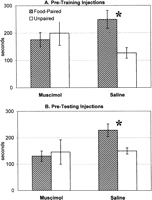
Mean times (SEM) spent in the paired and unpaired arms during the test trial. (A) Pre-training intrahippocampal injections of muscimol or saline. (B) Pre-testing intrahippocampal injections of muscimol or saline. *P < 0.02.
The results for the pre-testing injection groups are shown in Figure 1B. Rats that received saline injections exhibited a preference for their food-paired arms, but the group tested with hippocampal inactivation did not exhibit a CCP. The ANOVA revealed a significant interaction between Groups and Arm Choice (F[1,15] = 4.66, P < 0.05). Planned comparisons showed that there was a significant preference for the food-paired arm in the group that received pre-testing saline injections (F[1,15] = 7.89, P < 0.02), but no significant preference in the group that received muscimol (F[1,15] = 0.65). Activity levels were similar in the two groups (mean total arm entries, muscimol group: 20.1; saline group: 22.1; t(15) = 0.402). These data show that a functional dorsal hippocampus is required both to acquire information about the availability of food in the arm locations and to express the adjacent arms CCP.
Starting 3 d after the CCP test, the rats in the pre-training muscimol and saline groups were tested on the win-shift task (Olton and Samuelson 1976) using a second radial maze identical in size and shape to the maze used for the CCP experiment. This maze was located in a different room with different extra-maze cues. At the start of each daily trial, a rat’s access to four randomly selected arms was blocked. When the rat had obtained the food (1/4 piece of a Froot Loop) from the four open arms, access to all eight arms was allowed. The number of entries made to previously entered arms while retrieving all eight pieces of food was recorded as errors.
Rats were tested daily until the group made an average of <2 errors (nine trials). Thirty minutes before testing on the next day, all rats received bilateral injections of muscimol or saline into the dorsal hippocampus. These injections were identical to those they had received in the CCP task. One additional test with no injections was given on the following day.
The results for the win-shift testing are shown in Figure 2. A two-way, repeated measures ANOVA on the mean errors for days 1–9 revealed significant effects of Group (F[1,13] = 9.172, P < 0.011) and Trial (F[8,104] = 6.367, P < 0.001), but no significant interaction (F[8,104] = 1.446). Post hoc LSD tests showed that the difference between the means for the muscimol and saline groups was significantly different only on Trial 1 (P < 0.01), although the difference was also marginally significant on Trial 7 (P < 0.051). These findings suggest the possibility of a minor impairment in hippocampal function due to repeated muscimol injections prior to the training trials. As seen in Figure 2, however, any such effect did not seriously impair the rats’ ability to learn or perform the win-shift task.
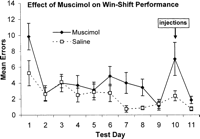
Effects of pre-training muscimol and saline injections on win-shift performance for rats in the pre-training groups. Rats were tested daily (see text for details) on a maze in a different room from the one used for the discrimination test. On Trial 10 they were given muscimol or saline injections identical to those they received during discrimination training.
The effects of the muscimol injections were examined with an ANOVA on the means for days 9–11. There were significant effects of Group (F[1,13] = 7.727, P < 0.016) and Trials (F[2,26] = 8.090, P < 0.002), but no significant interaction (F[2,26] = 3.291). LSD tests revealed significant differences between the means for the muscimol and saline groups on Trial 10 (P < 0.001), but not on Trials 9 (P < 0.843) or 11 (P < 0.035). The means for the muscimol group were significantly different for Trials 9 and 10 (P < 0.001), and for Trials 10 and 11 (P < 0.621). These results show that the rats’ performance on the win-shift task was primarily dependent on a functional dorsal hippocampus.
Taken together, the win-shift findings suggest the likelihood that sufficient dorsal hippocampal function remained after the training trials to perform the adjacent arms CCP. The absence of a CCP in those rats can therefore be attributed to their failure to acquire the necessary information about the difference in food availability in the maze arms while their hippocampal function was blocked during the training trials.
After all behavioral testing was complete, the rats were euthanized with a lethal dose of 30% chloral hydrate. Methylene blue (0.5 μL) was injected through the same guide and inner cannulas used for the infusions of muscimol or saline. The rats’ brains were then removed and prepared for histological examination using standard techniques. The locations of the cannula tips in several representative rats are shown in Figure 3. In a study (Martin 1991) using 2-deoxyglucose uptake as a measure of neural activity following similar injections of muscimol into the cerebral cortex, it was estimated that a volume of tissue with a radius of ∼1 mm was inactivated. Applying this conclusion to the present injections suggests that they inactivated most of the dorsal hippocampus with the possibility of some spread to surrounding structures.
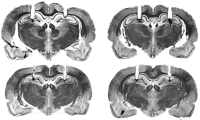
Photomicrographs of four sections from the brains of rats with cannulas in the dorsal hippcampus, representative of the injection sites in the present experiment.
Together with our previous report (Gaskin et al. 2005) that inactivation of the dorsal hippocampus during pre-exposure has no effect on adjacent arms discrimination learning, the present findings that a functional dorsal hippocampus is required for both acquisition of information about the availability of food and for expression of the spatial preference for a location that formerly contained food, complete the analysis of the impairing effects of dorsal hippocampus lesions (Chai and White 2004) on adjacent arms discrimination learning in the CCP paradigm. The findings reveal that discriminating between adjacent arms of an eight-arm radial maze requires two different kinds of information: pure spatial information about the maze environment that is not dependent on the dorsal hippocampus, and information about the availability of food that is hippocampus-dependent. In most spatial learning tasks these kinds of information are acquired simultaneously, making them difficult to distinguish.
The information acquired by these two processes must be combined in some way to produce behavior that results in the discrimination. The present findings suggest that this could occur during the training trials, on the test trial, or both. Information acquired during pre-exposure could be retrieved during training, altered by the addition of information about the availability of food, and re-stored by a hippocampus-based process, as has been suggested by several authors (Nadel and Moscovitch 1997; Moscovitch and Nadel 1998; Sara 2000; Nader 2003; Dudai 2004). If this hypothesis is correct, inactivation of the dorsal hippocampus during the training trials would block this process. Elimination of the discrimination by inactivation during the test trial could be due to impaired retrieval of a spatial map that includes information about the availability of food at the two locations to be discriminated.
Alternatively, information acquired during training could be stored, at least temporarily, in the hippocampus itself, and combined with the non-hippocampal spatial information during the post-training period or during the test. This would also be consistent with the impairment of the discrimination by inactivation during both training and testing in the present experiment. These alternative implications of the suggestion that spatial learning involves two different kinds of information acquired by different brain systems remain to be investigated.
Acknowledgments
We thank Maliha Naeem for assistance with behavioral testing and Melissa Latourelle for assistance with surgery and histology. This research was supported by a grant from the Institute of Neurosciences, Mental Health and Addiction, Canadian Institutes of Health Research.
Footnotes
- 1
↵1 Corresponding author.
↵1 E-mail norman.white{at}mcgill.ca; fax (514) 398-4896.
-
Article and publication are at http://www.learnmem.org/cgi/doi/10.1101/lm.138806
-
- Received November 10, 2005.
- Accepted January 17, 2006.
- Cold Spring Harbor Laboratory Press