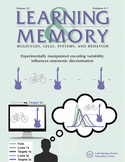
Experimentally induced encoding variability influences mnemonic discrimination: evidence from human behavioral data and global matching models
- Derek J. Huffman1,
- Leslie Rollins2,
- Morgan Carter2,
- Chayse A. Cotton2,
- Katelyn B. Cockrell2,
- Elena Rezac2 and
- Mai Khanh Tran1
- 1Department of Psychology, Colby College, Waterville, Maine 04901, USA
- 2Department of Psychology, Christopher Newport University, Newport News, Virginia 23606, USA
- Corresponding author: derek.huffman{at}colby.edu
Abstract
Computational models and neurobehavioral data suggest that encoding variability affects forced-choice mnemonic discrimination. Here, we experimentally manipulated encoding variability on the forced-choice Mnemonic Similarity Task by varying stimulus repetitions during encoding. We first generated predictions from a global matching model. Behavioral data supported all predictions. Across most conditions, repetitions consistently enhanced mnemonic discrimination; however, when encoding variability was induced by 3-repetitions of the original version of the noncorresponding lure and 1-repetition of the target during learning, individuals exhibited increased interference. These findings provide further insight into theories of human memory, especially the effect of stimulus repetition on mnemonic discrimination.
Footnotes
-
[Supplemental material is available for this article.]
-
Article is online at http://www.learnmem.org/cgi/doi/10.1101/lm.054218.126.
- Received February 11, 2026.
- Accepted June 7, 2026.