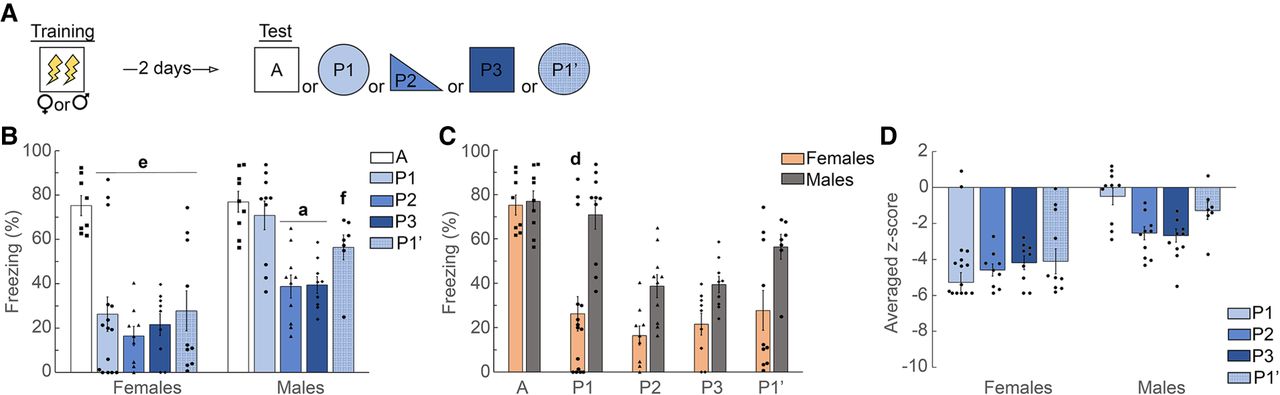
Contextual discrimination of female and male rats trained in a fear conditioning task and tested 2 days later. (A) Experimental protocol: all subjects were trained in Context A and subsequently tested either in A, P1, P2, P3, or P1′ 2 days after training (P1′ being a slight modification of context P1). (B) Histogram showing mean ± SEM of the % freezing time in each context grouped by sex, with individual dots overlaid representing individual animals. (C) Same data (and statistical analysis) grouped by context. (B,C) Data analyzed by independent two-way ANOVA followed by Tukey post hoc test: a (different from A/P1), P < 0.0055; f (different from P2/P3), P < 0.032; d (females differ from males tested in the same context), P < 0.0001; and e (all groups differ from A), P < 0.0001. (D) Individual (and the average) Z-scores for contexts P1, P2, P3, and P1′ (standard deviations, all compared to A).