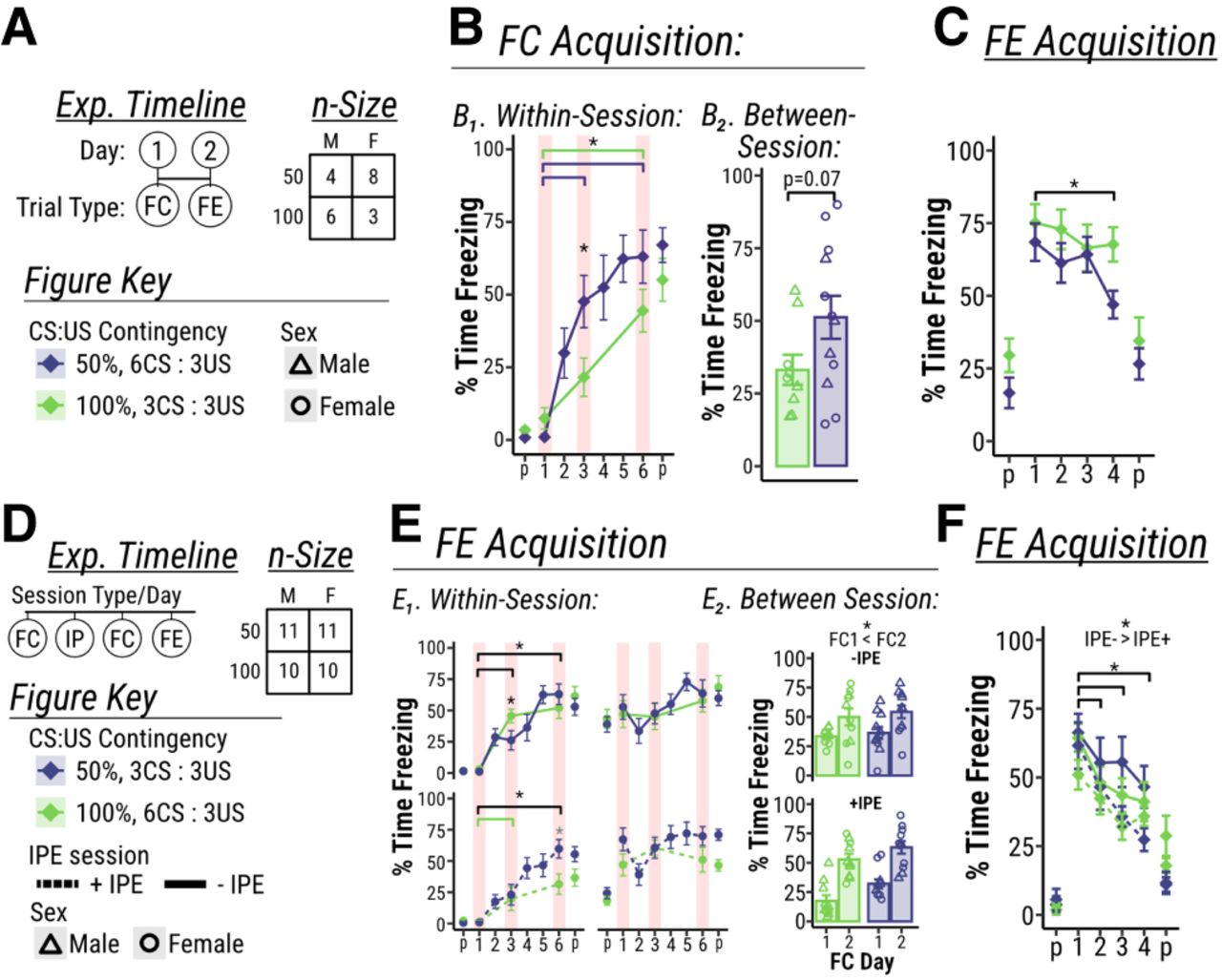
Less FC training and blocks of nonreinforcement do not result in PREE. (A) Mice were FC in context A for one trial, during which they received consistent reinforcement (100%; 3CS:3US) or partial reinforcement (50%; 6CS:3US). They underwent one FE trial in context B on the following day, where they were exposed to 12 unreinforced CS presentations. (B1) The effect of partial reinforcement on within-session 1-day FC acquisition. The consistently reinforced (100%) group demonstrated higher levels of freezing to CS3 than CS1 (P = 0.004). The partially reinforced (50%) group displayed greater freezing to reinforced CS2 (P < 0.001) and CS3 (P < 0.001) relative to CS1. (B2) No overall effect of reinforcement contingency on overall FC session freezing (P > 0.05). (C) No effect of reinforcement contingency on FE acquisition (P > 0.05). (D) Mice experienced 2 days of FC in context A; one group received consistent reinforcement and the other received partial reinforcement (see above). In addition, some mice received a session of 20 unreinforced CS exposures in context A interpolated (+IPE) between FC day 1 and FC day 2. The control group (−IPE) was placed in context A for the same amount of time without any CS exposures. Twenty-four hours after FC day 2, one FE trial was conducted in context B, consisting of 12 unreinforced CS. (E1) The effect of partial reinforcement on within-session FC acquisition ± interpolated extinction (IPE). During FC1, freezing increased across the trial in both contingency groups (P < 0.001), with an interaction between contingency and CS (P = 0.009). There was no effect of reinforcement contingency on freezing during FC2 (P > 0.05). (E2) No effect of partial reinforcement or IPE on between-session FC acquisition (P > 0.05). Freezing increased from FC1 to FC2 regardless of group (P < 0.001). (F) The effect of partial reinforcement and IPE on FE acquisition. +IPE groups demonstrated attenuated freezing overall (P = 0.033), but contingency had no effect (P > 0.05). P along the x-axis represents pretone and posttone periods, respectively. Error bars represent ± SEM. Red shaded regions represent CS–US pairings.