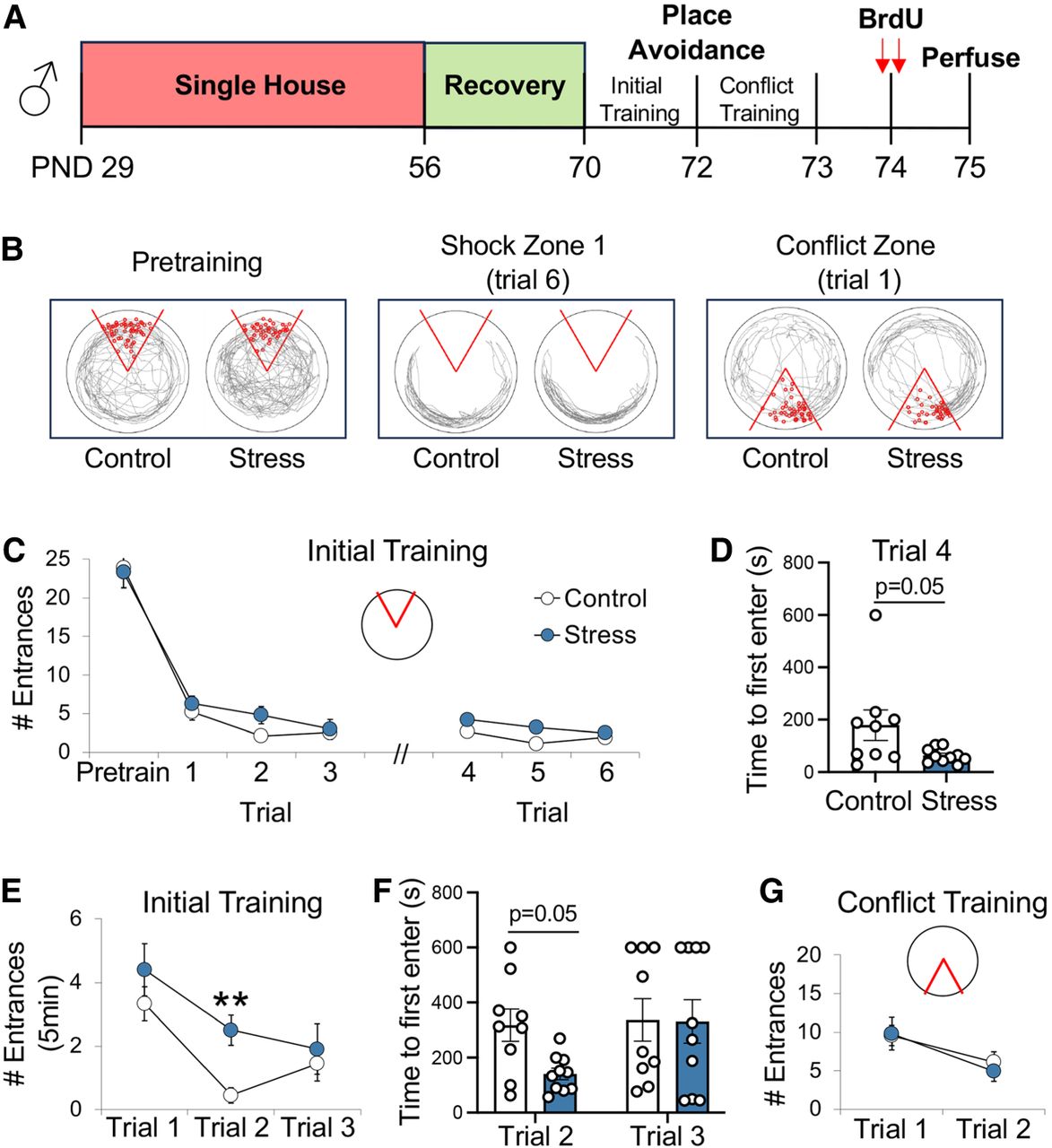
Social isolation during adolescence leads to a modest impairment in spatial learning in males. (A) Experimental time line. (B) Tracked behavior (gray) of a representative control and stressed male mouse before the shock was turned on (pretraining), during the last trial of initial training (trial 6), and during the first trial of conflict training. With the exception of pretraining, red circles indicate where the animal was shocked during each trial. (C) Social isolation did not affect the total number of times male mice entered the shock zone during pretraining or initial training. (D) The latency to first enter the shock zone after 24 h of retention was lower in stressed males than controls. (E) During initial training, stressed males entered the shock zone more than controls during the first 5 min of trial 2 and (F) entered the shock zone faster than controls on trial 2. (G) There were no group differences in the number of times males entered the new shock zone during conflict training. n = 9 control males; n = 10 stress males. Data are represented as mean ± SEM. (**) P < 0.01 versus trial 2 controls.