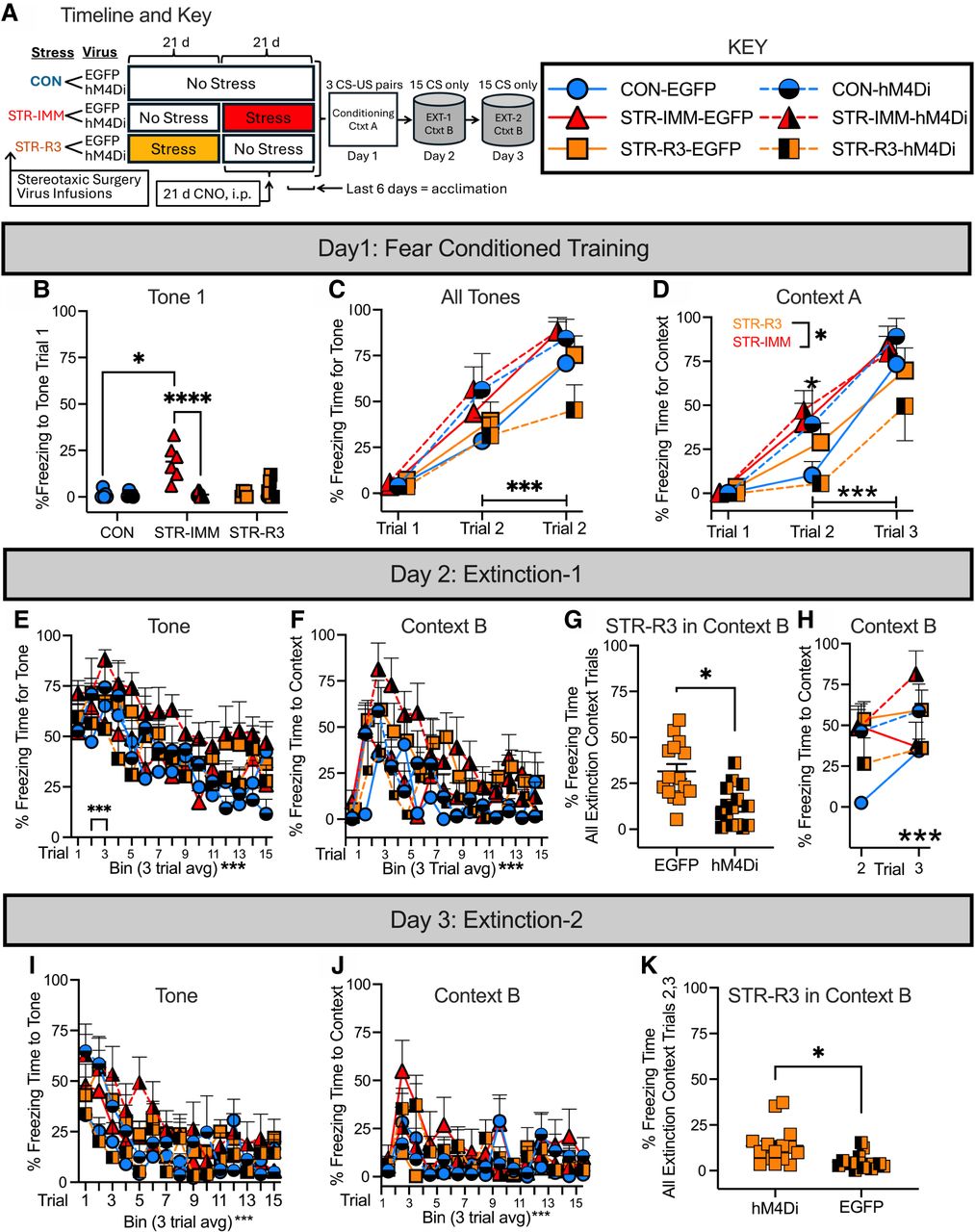
Fear conditioning and extinction. (A) Time line and key are illustrated to the groups, stress manipulations and fear conditioning timing. (B) For freezing to the first tone, the STR-IMM-EGFP group froze more than STR-IMM-hM4Di and CON-EGFP. (C) Freezing to tone increased from trial 2 to trial 3, with similar levels of freezing to tone on trial 3. No statistical group differences were detected. (D) Freezing to context A increased across the session, and the rats in the STR-R3 (EGFP and hM4Di) group froze less to context than the rats in the STR-IMM (EGFP and hM4Di) group. (E) During the first extinction session of 15 CS-only trials, all groups decreased their freezing to tone (E) and context B (F) across the session. (G) For the STR-R3 group, freezing to context B was higher across the extinction session for rats in the EGFP condition than for rats in the hM4Di condition. (H) Analysis of trials 2 and 3, after the tone had been introduced to context B, revealed that freezing to context initially increased, before decreasing later in the session (as seen in F). (I) During the second extinction session of 15 CS-only trials, freezing decreased to tone (I) and context (J). (K) Within the STR-R3 group, rats in the hM4Di condition froze less to context during trials 2 and 3 than those in the EGFP condition. (CON) Blue circles, (STR-IMM) red triangles, (STR-R3) orange squares. EGFP are shown in full color for the respective symbols, and hM4Di are shown by symbols that are blocked in half by color and black. Data are reported as means ± SEM. (*) P < 0.05, (***) P < 0.001, (****) P < 0.0001.