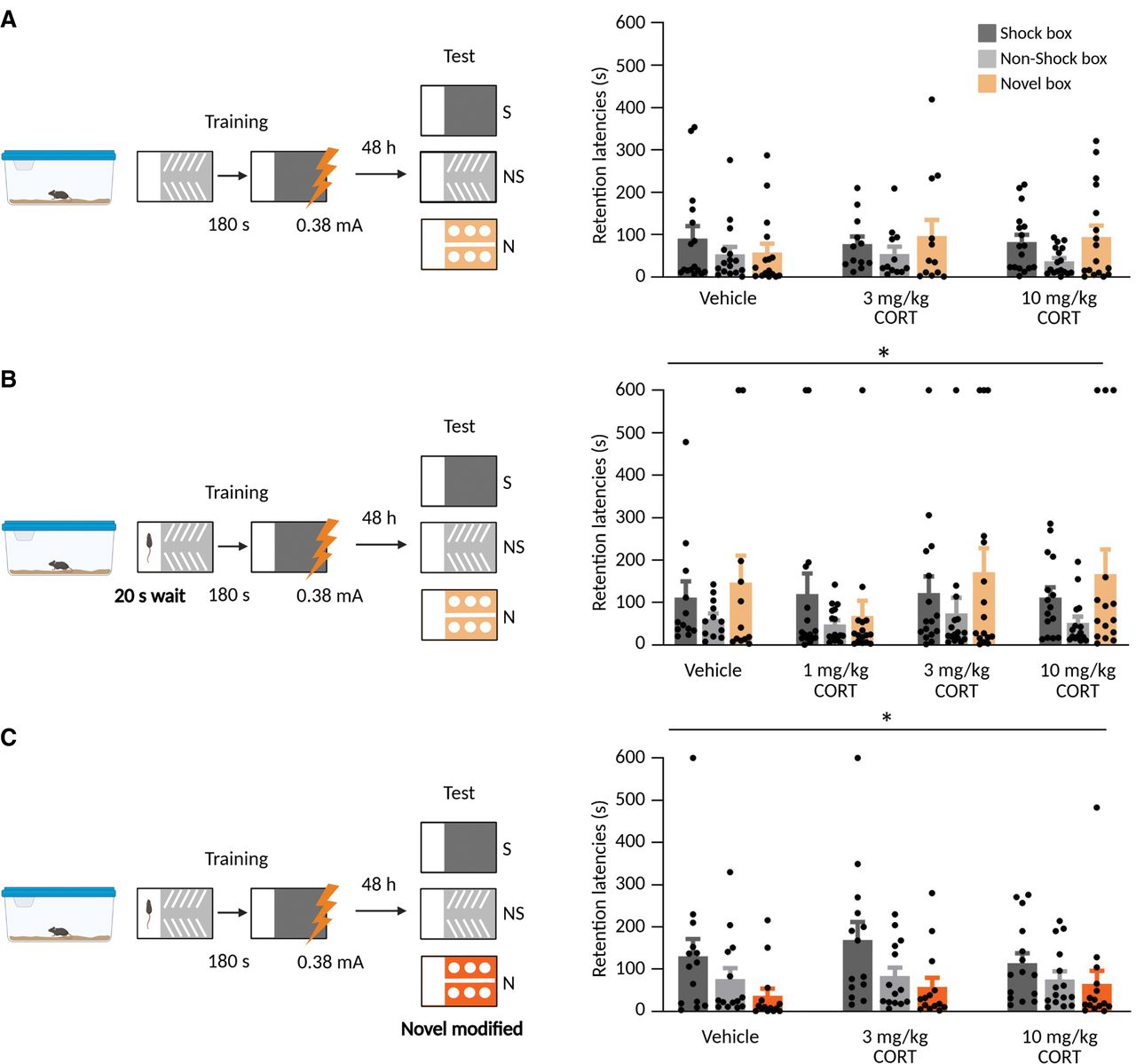
Effect of corticosterone treatment on strength and specificity of memory in the dual-event inhibitory avoidance task in mice. (A) Shock intensity was slightly decreased (0.38 mA) compared to prior settings to facilitate the detection of a memory-enhancing effect of corticosterone, yet all other experimental settings remained the same. No effect of corticosterone treatment or test context was found (vehicle: n = 16, corticosterone 3 mg/kg: n = 12, corticosterone 10 mg/kg: n = 17). (B) To facilitate discrimination of the different training contexts, a 20 sec waiting time in the starting compartment of both inhibitory avoidance boxes during the training session was included. This resulted in a main effect of test context, but no main effect of corticosterone treatment or corticosterone treatment × test context interaction. Instead, long retention latencies were found in the Novel box (vehicle: n = 12, corticosterone 1 mg/kg: n = 16, corticosterone 3 mg/kg: n = 16, corticosterone 10 mg/kg: n = 16). (C) To also facilitate discrimination of the Novel box, we added extra tactile information (sandpaper) to the Novel box. This resulted in a main effect of test context, but no main effect of corticosterone treatment or corticosterone treatment × test context interaction effect (vehicle: n = 15, corticosterone 3 mg/kg: n = 14, corticosterone 10 mg/kg: n = 15). Task parameters changed relative to the prior task conditions are depicted in bold. Data represent mean + SEM. Dots indicate individual data points. (*) P < 0.05: main effect of test context.