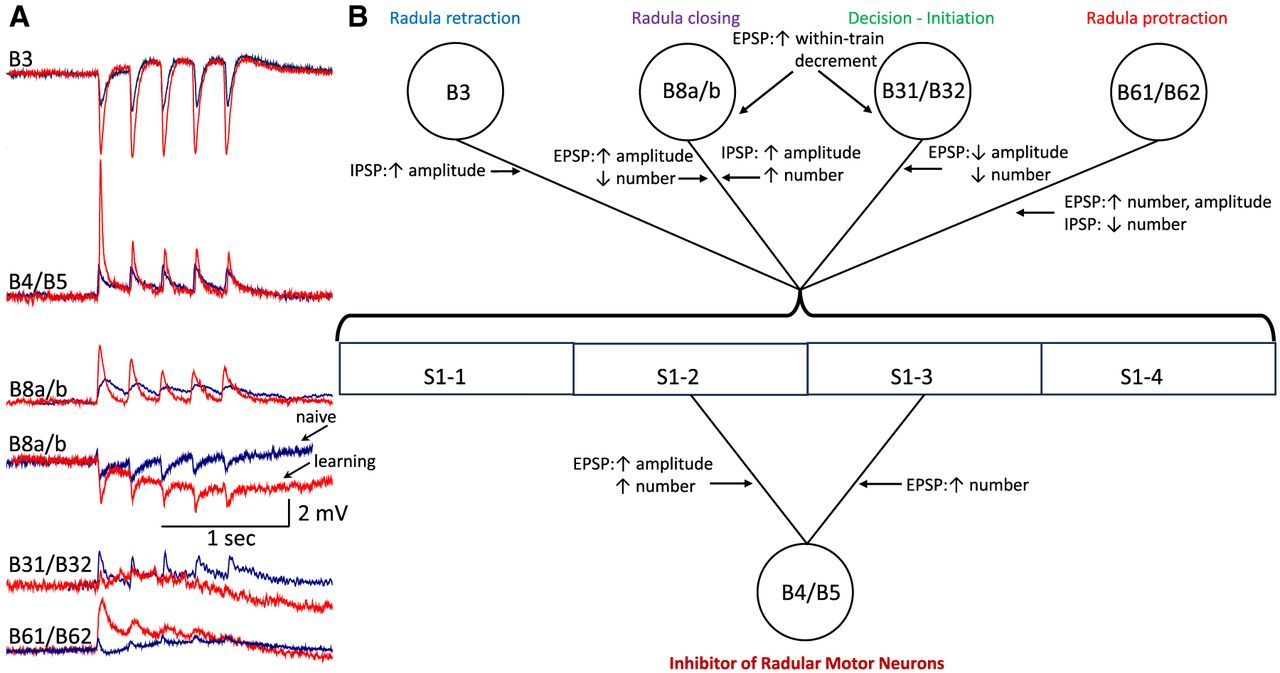
Summary of significant changes in fast connectivity from the S1 cells to the five followers. (A) Examples of recordings from preparations from naive animals (blue) and from animals that had learned (red). Note that fast EPSPs from B4/B5 and from B61/B62 increase in amplitude, and that fast EPSPs from B31/B32 decrease in amplitude. Fast IPSPs from B3 increase in amplitude. Both fast EPSPs and fast IPSPs in B8a/b increase in amplitude, and therefore recordings showing both effects are shown. (B) General summary. When there are no differences in connectivity from the four subareas of the S1 cluster, the connecting line from each of the followers is from the center of the bracket connecting the four subareas. Connecting lines to B4/B5 are shown below the bars depicting the four subareas of the S1 cluster, to illustrate the separate effects of learning from the different subareas. The function of each follower is shown above or below its name. Arrows pointing to a connecting line show the direction of change in a connection. Changes in EPSP or IPSP amplitude, or in the number of connections, are shown when these connections are significant. Note that changes in the amplitude of IPSPs in B3 and of the EPSPs in B31/B32 were found only for the last stimulus in the train of stimuli of the S1 neurons.