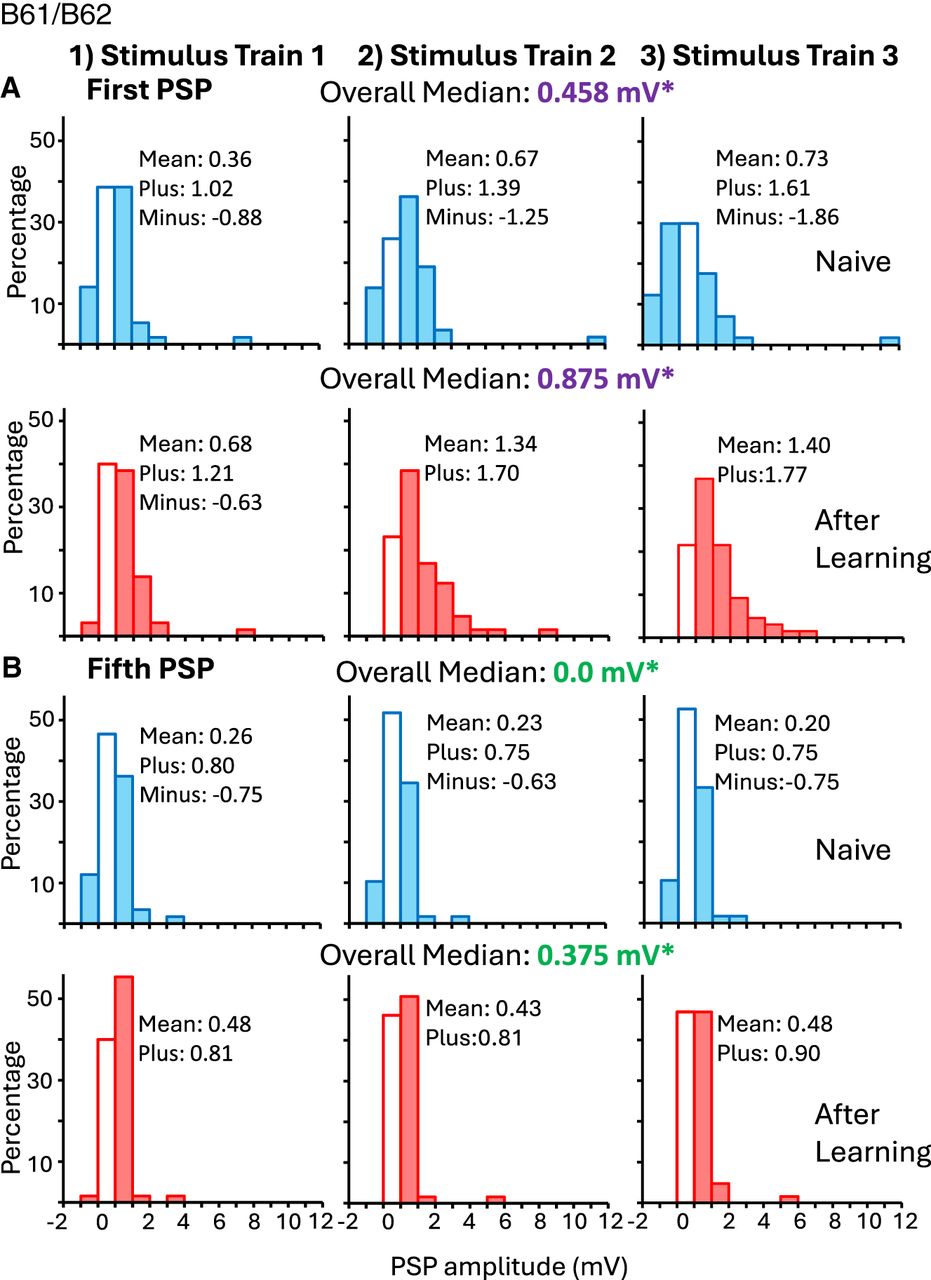
Distribution of fast PSP amplitudes in B61/B62 from S1 neurons. Both EPSPs and IPSPs are produced. Net excitation is increased, in part because there are few IPSPs after learning. Conventions within the figure are as those in Figures 1, 2, 4, and 5. Data are shown separately for the three stimulus trains of five spikes each and for the first (A) and fifth (B) PSP in a stimulus train. Color-coded asterisks show significant effects between naive animals and animals that had learned (see statistics in the text). The overall medians shown are the median amplitudes derived from averaging all three measurements for the first or the fifth PSP elicited by a stimulus train. N = 58 connections were sampled in eight preparations from naive animals, and N = 65 connections were sampled in eight preparations from animals that had learned.