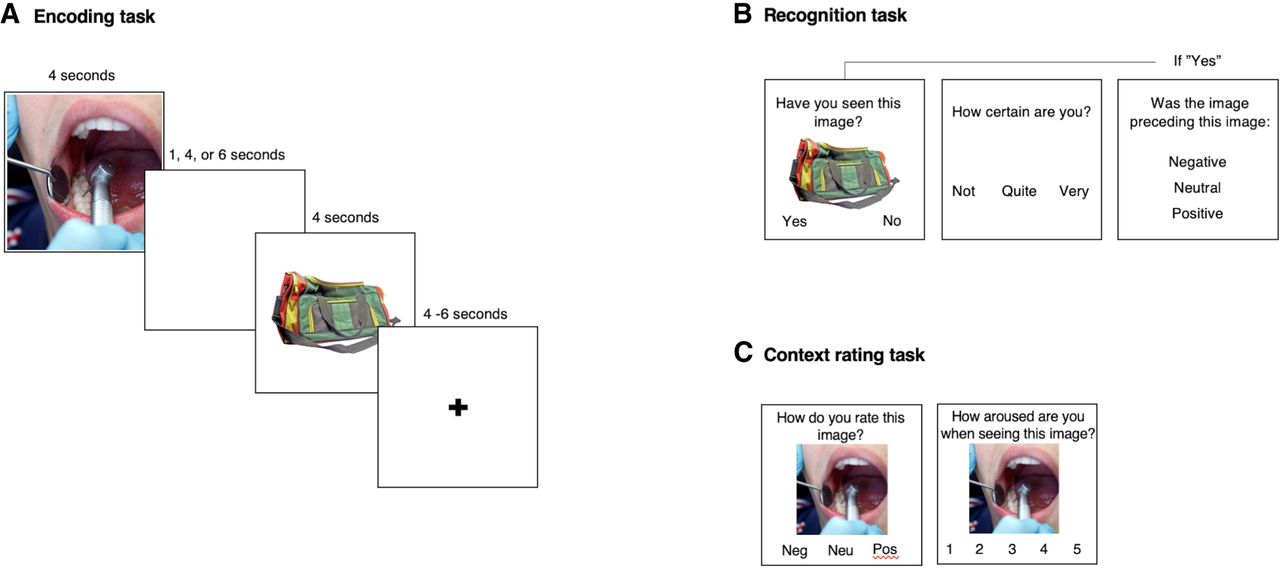
(A) Experimental design and exemplar trial from the encoding task. During incidental encoding, participants were presented with 72 trials consisting of an emotional context image shown for 4 sec, followed by a blank screen shown for 1, 4, or 6 sec, and a neutral everyday object image shown for 4 sec. At the end of each trial, a fixation cross was shown before the next emotional context image was presented. Participants were told to pay attention to all images presented on the screen. (B) Exemplar trial from the recognition task. The surprise memory task was conducted 6 h after the encoding task and consisted of 144 trials (72 old items and 72 foils). Participants were asked to indicate whether they had seen an item image at encoding or not via a button press. Further, they were asked to indicate how confident they were with their response. If participants answered with “yes,” they were prompted to indicate the context valence preceding the item image at encoding. (C) Exemplar trial from the context rating task. After the recognition task, participants were shown all 72 context images again and asked to rate each one on emotional valence and arousal.