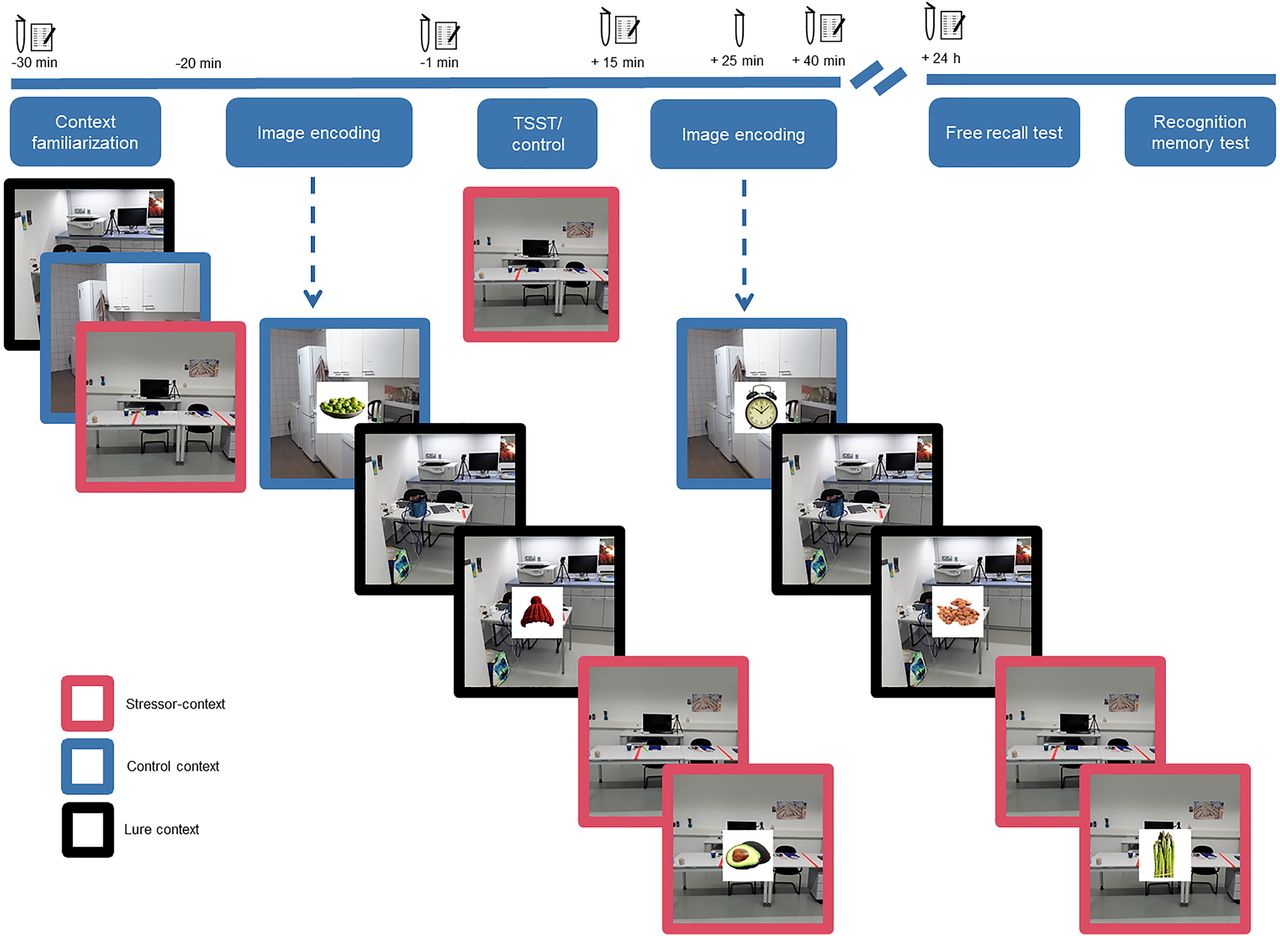
Experimental procedure. On day 1, participants first saw images of several rooms that would later be cued as contexts in the image encoding task. Participants then completed an image encoding task before and after a stressful encounter, or a control treatment. In the image encoding tasks, we first cued a context that was either the same room where the stressful encounter took place (stressor context), a lure context that looked similar to the stressor context, or an unrelated control room (e.g., a kitchen); indicated with colored frames for illustrative purposes. The participants were presented with 320 images in total (160 before the stressor and 160 thereafter). We also collected questionnaires and salivary cortisol throughout day 1 to track subjective and physiological stress responses. On day 2, 24 h later, participants completed free recall and recognition memory tasks for the encoded images as well as the stressful/control encounter.