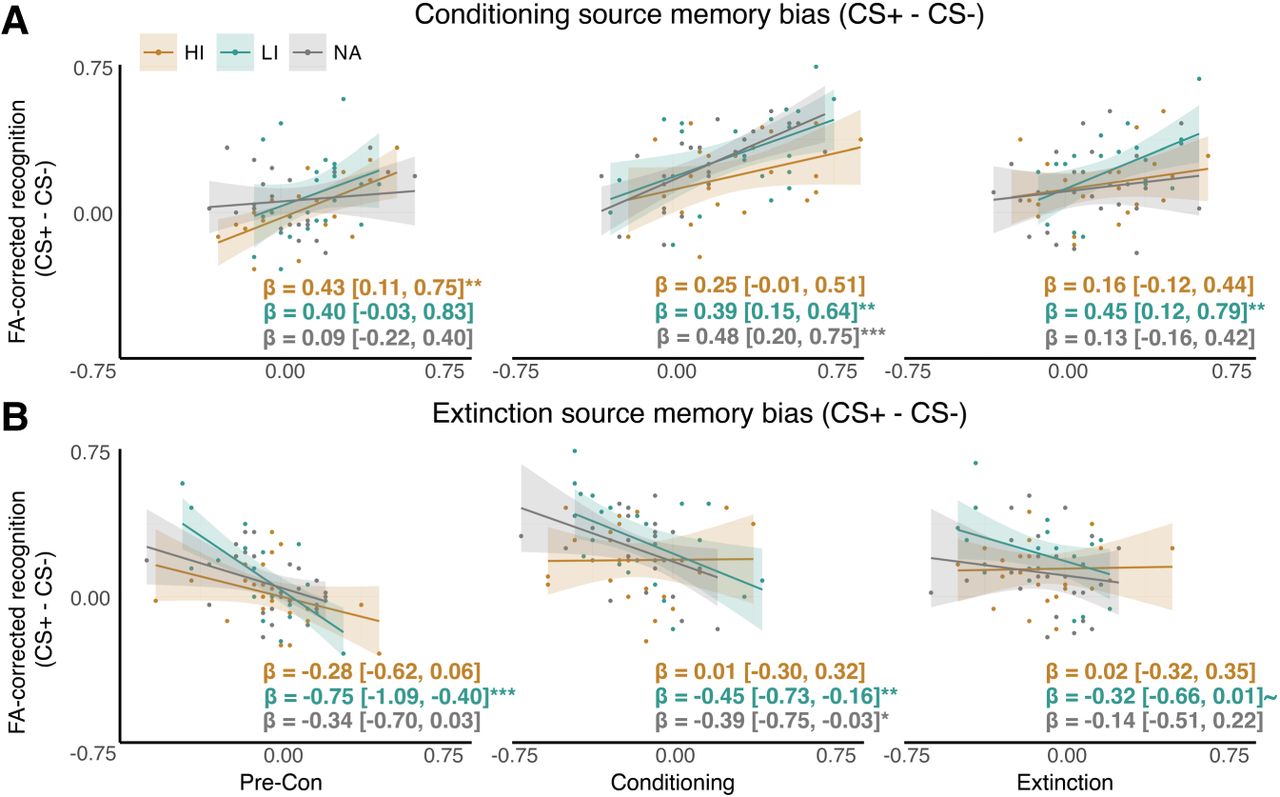
Correlation between differential source memory and differential corrected recognition. (HI) High intensity, (LI) low intensity, (NA) nonaversive. (A) Differential conditioning source memory bias is positively related to differential corrected recognition in selected phases: HI: Pre-Con, LI: conditioning and extinction, NA: conditioning. (B) Differential extinction source memory bias is negatively related to corrected recognition in selected phases: LI: Pre-Con and conditioning, NA: conditioning. Points denote trial-averaged subject data. A simple linear regression was fit within each phase to demonstrate trend. Shaded region denotes 95% CI of the simple regression. Estimated marginal means of coefficients from the model are presented alongside the figure. (*) P < 0.05, (**) P < 0.01, (***) P < 0.001, (∼) P = 0.056.