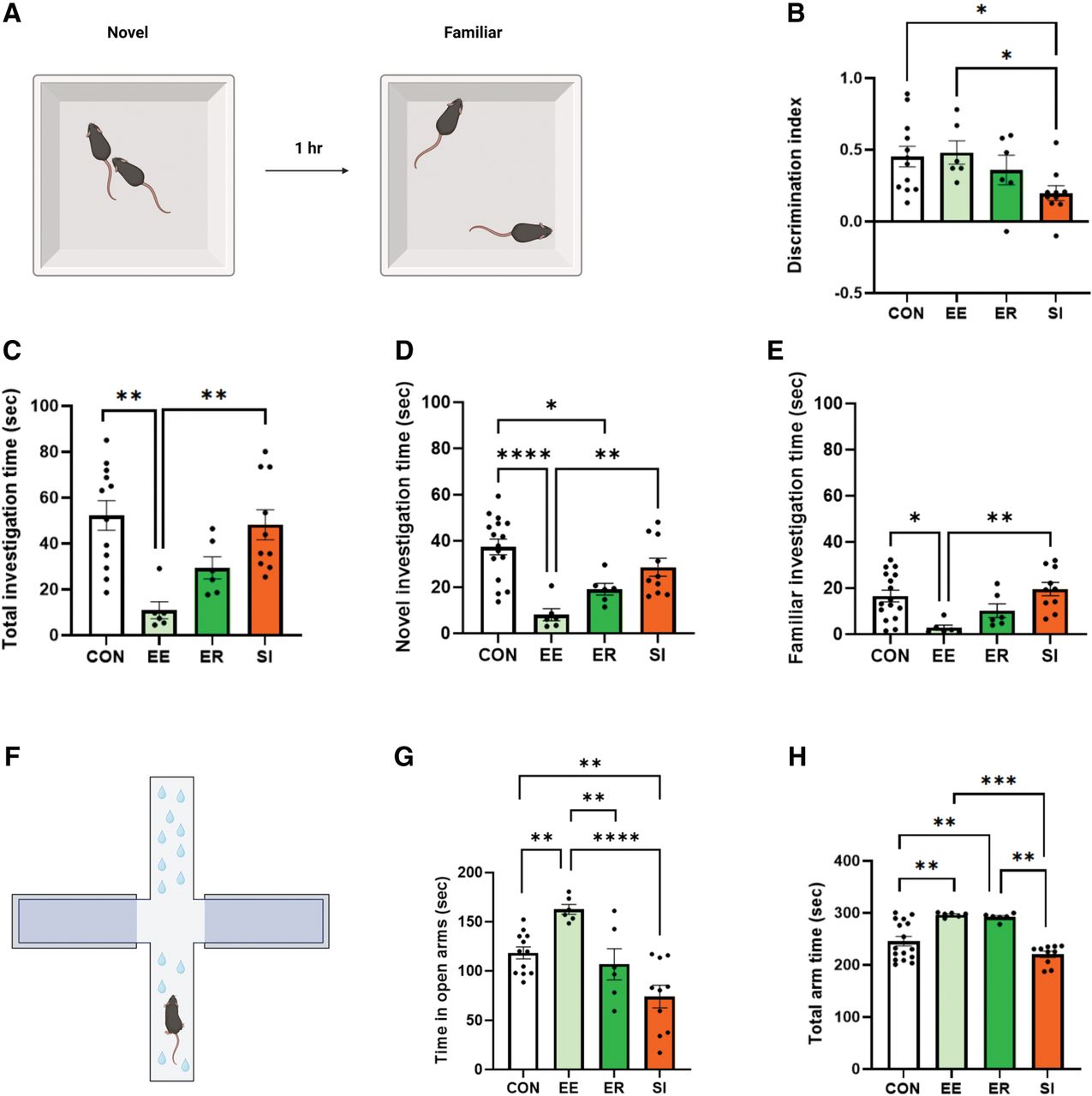
Social, but not nonsocial, loss impairs social recognition and increases avoidance behavior. (A) Schematic of direct social interaction test. (B) SI mice have a significantly lower discrimination index compared to CON, while no differences are observed in ER mice compared to controls. (C) Overall social investigation times across all groups. EE mice exhibited the lowest social investigation times yet retained the ability to discriminate between novel and familiar mice. ER mice showed intermediate investigation times positioned between CON and EE groups, while SI mice showed investigation times comparable to CON. (D) Novel social investigation times across all groups. EE and ER mice showed lower novel interaction times compared to CON, while SI mice showed novel investigation times comparable to CON. (E) Familiar social investigation times across all groups. EE mice exhibit lowest familiar investigation times, while ER and SI mice are comparable to CON. (F) Schematic of EPM test. (G) Time spent in the open arms is significantly higher in the EE group compared to the CON group, while the SI group spent significantly less time in the open arms compared to the CON group. No significant differences were observed between the ER and CON groups. (H) EE and ER mice spent more time in the arms (open + closed) compared to CON. No significant differences were observed between CON and SI mice. Data are presented as mean ± SEM (CON n = 12, EE n = 6, ER n = 6, SI n = 10). Significance is denoted as adjusted P-values after FDR post hoc tests: (*) P < 0.05, (**) P < 0.01, (***) P < 0.001. See Table 1 for complete statistics. (CON) Control, (EE) environmental enrichment, (ER) enrichment removal, (SI) social isolation. Images in A and F were created using BioRender.com and are published under a CC BY-NC-ND 4.0.