The influence of categorical stimuli on relational memory binding
- 1Department of Psychology, University of Nebraska-Lincoln, Lincoln, Nebraska 68588, USA
- 2Center for Brain, Biology, and Behavior, University of Nebraska-Lincoln, Lincoln, Nebraska 68588, USA
- 3Department of Psychology, Binghamton University, Binghamton, New York 13902, USA
- 4Department of Psychology, University of Illinois at Urbana-Champaign, Champaign, Illinois 61820, USA
- 5Carle Illinois College of Medicine, University of Illinois at Urbana-Champaign, Champaign, Illinois 61820, USA
- Corresponding author: hschwarb2{at}unl.edu
Abstract
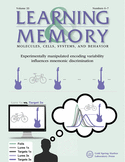
Binding of arbitrary information into distinct memory representations that can be used to guide behavior is a hallmark of relational memory. What is and is not bound into a memory representation and how those things influence the organization of that representation remain topics of interest. While some information is intentionally and effortfully bound—often the information that is consistent with task goals or expectations about what information may be required later—other information appears to be bound automatically. The present set of experiments sought to investigate whether spatial memory would be systematically influenced by the presence and absence of distinct categories of stimuli on a spatial reconstruction task. In this task, participants must learn multiple item-location bindings and place each item back in its studied location after a short delay. Across three experiments, participants made significantly more within-category errors (i.e., misassigning one item to the location of a different item from the same category) than between-category errors (i.e., misassigning one item to the location of an item from a different category) when categories were perceptually or semantically distinct. These data reveal that category information contributed to the organization of the memory representation and influenced spatial reconstruction performance. Together, these results suggest that categorical information can influence memory organization, and not always to the benefit of overall task performance.
Footnotes
-
Article is online at http://www.learnmem.org/cgi/doi/10.1101/lm.054006.124.
- Received March 11, 2024.
- Revision received September 24, 2024.
- Accepted October 1, 2024.
This article is distributed exclusively by Cold Spring Harbor Laboratory Press for the first 12 months after the full-issue publication date (see http://learnmem.cshlp.org/site/misc/terms.xhtml). After 12 months, it is available under a Creative Commons License (Attribution-NonCommercial 4.0 International), as described at http://creativecommons.org/licenses/by-nc/4.0/.