Retrograde amnesia for the stress-induced impairment of extinction: time-dependent and not so forgotten
- Corresponding author: briggsj{at}susqu.edu
Abstract
We investigated whether retrograde amnesia for the stress-induced impairment of extinction retrieval shares similar characteristics with original acquisition memories. The first experiment demonstrated that cycloheximide administered shortly after a single restraint stress session alleviated the impairment of extinction retrieval but not when administered following a longer delay (i.e., the amnesia for stress is time-dependent). A second experiment showed that the retrograde amnesia for stress could be alleviated by a second brief exposure to the stressor. These results demonstrating that amnesia for stress shares characteristics similar to original memories are explained using a retrieval-based memory integration model of retrograde amnesia.
Anxiety disorders are among the most common mental health conditions, with a prevalence rate of ∼33% for adults in the United States (Kessler et al. 2012). Exposure therapy, an effective way to treat anxiety disorders, is based on the principles of experimental extinction (Telch et al. 2014). Extinction is a process involving the presentation of cues or stimuli (conditioned stimuli [CSs]) that have been previously paired with a biologically relevant reinforcer (unconditioned stimulus [UCS]) without the reinforcement. The unreinforced cue exposure produces a reduction in the learned response (conditioned response [CR]).
Although extinction produces a reduction in the CR, it is known that the process does not result in unlearning or a breakdown of the initial association but involves new learning. Evidence for new (competing) learning comes from various behavioral processes following extinction, including the extinguished response spontaneously recovering over time, being renewed if extinction occurs in a different context than original learning, or being reinstated by re-exposure to the reinforcer (Bouton 2004). That the extinguished response returns is problematic for exposure-based therapies.
Another challenge for exposure therapies, as with extinction learning, is that extinction has been shown to be disrupted by various stressors, including elevated platform stress (Akirav and Maroun 2007; Ganon-Elazar and Akirav 2009), forced swim (Izquierdo et al. 2006), chronic restraint stress (Miracle et al. 2006), acute restraint (Briggs and McMullen 2020), and the single prolonged stress (SPS) protocol that involves three distinctive stressors (Knox et al. 2012; for review of SPS, see Lisieski et al. 2018). Much of the research investigating the stress-induced impairment of extinction has been done using rodent subjects; however, the effect has also been demonstrated in human subjects (Raio et al. 2014; Klinke et al. 2020; see also Maren and Holmes 2016). Although the exact mechanisms of stress-induced impairment of extinction are not entirely understood, the physiological effects of stress have been shown to impair areas important to learning and memory, including the hippocampus (Leuner and Shors 2013), the amygdala (Vyas et al. 2002), and the prefrontal cortex (Akirav and Maroun 2007; Maren and Holmes 2016). Recently, Maren and colleagues (Giustino et al. 2020) proposed a mechanism explaining the immediate extinction deficit (IED) effect, in which stress activation of the basolateral amygdala inhibits activity of the infralimbic subdivision of the medial prefrontal cortex, which is a critical region for extinction learning (see also Maren 2022). This stress-induced impairment of extinction is problematic for exposure-based therapy because stress before cue exposure appears to negatively impact the learning or expression of extinction.
Evaluating whether stress effects on extinction are vulnerable to disruption, Briggs and McMullen (2020) recently demonstrated that retrograde amnesia for an acute restraint stress alleviated the stress-induced impairment of extinction, suggesting a vulnerability of a memory for the stress. After first replicating the stress-induced impairment of extinction using a passive avoidance task, a group of rats was injected with a protein synthesis inhibitor immediately following a 1-h restraint session. When later tested for avoidance following extinction learning, the animals that received the amnestic agent appeared to show retrograde amnesia for the stress (i.e., they expressed extinction) compared with a stressed saline control group that showed impaired extinction retrieval. This demonstrated that acute restraint stress was susceptible to disruption by a protein synthesis inhibitor, suggesting that the memory for stress may be similar to other memories. In an attempt to rule out the restraint stress enhancing fear conditioning (making it harder to extinguish), a separate experiment was conducted in which separate groups of stressed rats received incremental amounts of extinction (10, 15, or 20 min). If stress enhanced fear conditioning, the impairment of extinction should be weakened by increasing the cue exposure; however, this was not observed. The stress-induced impairment was observed for all durations of extinction. From these results, it was postulated that the stress-induced impairment of extinction resulted from stress blocking extinction retrieval rather than enhancing fear conditioning. Moreover, the amnesia for the stress effects on extinction appeared to be caused by forgetting the stress-induced inhibition of extinction retrieval. However, it is not known to what extent the retrograde amnesia for acute stress shares characteristics similar to amnesia for original acquisition memories.
Thus, one aim of the current studies was to investigate whether impaired memory for stress follows a time-dependent characteristic of retrograde amnesia (i.e., temporal gradient), in which memory loss is inversely related to the time between original learning and the amnestic treatment (Duncan 1949; Riccio et al. 1968). A second aim was to determine whether the amnesia for acute stress could be alleviated (i.e., recovery of the stress memory) by re-exposure to the stressor.
Experiment 1 involved replicating amnesia for stress-induced impairment of extinction as well as assessing a temporal gradient of retrograde amnesia by incorporating various delays of the amnestic treatment administration following restraint stress. The experimental procedures were similar to earlier studies demonstrating amnesia for the stress-induced impairment of extinction (Briggs and McMullen 2020). Female Long-Evans rats were randomly assigned to one of six groups (see Table 1) before four groups received a single restraint stress session. Stress consisted of restraining each rat in a plastic DecapiCone (Braintree Scientific, Inc.) so that they were immobile for 60 min. Two nonstress control groups remained in their home cages undisturbed. At the 1-h restraint mark, before the animals were removed from the cone, a control group (0-saline) received an i.p. injection of 1 mg/kg physiological saline (0.9%), and an experimental group (0-CHX) received an i.p. injection of 1 mg/kg cycloheximide (premixed concentration 0.1%; Oxoid Ltd.) to replicate whether the memory for acute stress was susceptible to disruption, which would alleviate the stress-induced impairment of extinction. To assess the temporal gradient of retrograde amnesia for the stress, the two other stress groups were removed from the cone after 1 h and returned to their home cages. One of the groups (60-CHX) received an injection of cycloheximide 60 min after being removed from the cone, and the other group (120-CHX) was injected with cycloheximide 120 min after being removed from the cone.
Experimental design for experiment 1
Training, extinction, and testing were conducted in a two-compartment black–white passive avoidance chamber (Ugo Basile model 7551). Forty-eight hours after stress, all rats were trained to fear the black compartment. Training involved placing each rat in the white side of the apparatus with the door closed, and then after 15 sec the door opened, allowing the animal to cross to the black side. A control unit timed the latency to cross (in seconds) into the black compartment. Once the rat entered the black side, the door was automatically closed and a single inescapable footshock (0.8 mA for 1 sec) was delivered. The footshock was administered 3 sec after the door closed and the animal was removed 12 sec after the footshock. Mean cross latencies for the six groups at training ranged from 12.5 to 16.3 sec. An ANOVA revealed no differences among the six group's cross latencies at training (F(5,42) = 0.232, P = 0.946).
Twenty-four hours after training, five groups received a single extinction trial. The extinction session started with a 1-min probe trial to assess avoidance before being exposed to the black compartment. For the extinction session, each rat was placed in the white compartment for 15 sec before the door opened, allowing the animals to cross to the black side. The door remained open for 1 min. No animals crossed during the avoidance probe trial. After 1 min, the rat was removed from the white compartment and placed in the black compartment for 10 min. The door remained closed so that the rats were confined to the black side and not able to cross between compartments during the extinction session. A nonextinction control group (No Ext) did not receive the probe or extinction session but was later tested to assess the level of fear without the extinction treatment.
Twenty-four hours after extinction, all rats underwent passive avoidance testing. Test trials were conducted identically to training with the rat being placed in the white compartment except that no shocks were delivered upon entering the black side. After crossing to the black side, the door automatically closed and the animal was removed. If the animal did not cross, it was removed from the white compartment. Testing lasted for 5 min, and the latency to cross to the black compartment (in seconds) was recorded as the dependent measure.
Figure 1 shows the mean cross latencies for the six groups at test. An ANOVA revealed a significant difference among the groups (F(5,42) = 9.020, P < 0.001). Tukey HSD multiple comparison tests were used to evaluate group differences. As can be seen, the No Ext, 0-saline, 60-CHX, and 120-CHX groups all had longer cross latencies. There were no significant differences among those four groups (Ps > 0.084). The extinction (Ext) group showed shorter latencies (less fear) than the No Ext, 0-saline, 60-CHX, and 120-CHX groups, demonstrating that the 10-min exposure was sufficient to produce extinction. The Ext group was significantly different from the No Ext, 0-saline, and 120-CHX groups (Ps < 0.008) but was not significantly different from the 0-CHX (P = 0.996) and 60-CHX (P = 0.093) groups. The nonstressed Ext group being significantly different (P = 0.007) from the stressed 0-saline extinction group suggests that the restraint stress prior to training disrupted extinction retrieval, replicating our earlier findings, which are consistent with the stress-induced impairment of extinction. Moreover, the 0-CHX group showing significantly shorter cross latencies than the 0-saline and 120-CHX groups (Ps < 0.029) replicates our findings of retrograde amnesia for the stress-induced impairment of extinction (Briggs and McMullen 2020). Importantly, the 120-CHX group showed longer cross latencies, albeit not significantly different from the 60-CHX group (P = 0.795) but different than the 0-CHX group (P = 0.014), suggesting a temporal gradient of amnesia for restraint stress. (The 60-CHX group was not significantly different from the 0-CHX group at P = 0.255.)
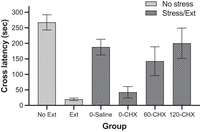
Mean (±SEM) latency (in seconds) to cross to the black side of the black–white shuttle box for all groups in experiment 1. Open bars represent the no stress control groups. Darker slashed bars represent the stressed experimental groups. Long latency scores for the No Ext, 0-saline, and 120-CHX groups represent significant fear. Decreased latency scores for the group that did not receive stress before training and extinction (Ext) represent significantly less avoidance (i.e., reduction of fear). Increased latency scores for the group that received stress 48 h before training (0-saline) compared with the no stress extinction group (Ext) represent the stress-induced impairment of extinction. The 0-CHX group's short latencies replicate retrograde amnesia for the stress-induced impairment of extinction. Significantly longer latencies for the group that received cycloheximide 2 h after stress (120-CHX) compared with the shorter latencies for the group that received cycloheximide immediately after stress (0-CHX) represent a temporal gradient of amnesia.
These results show that administering the amnestic agent cycloheximide immediately after acute restraint stress alleviates the stress-induced impairment of extinction. However, when the protein synthesis inhibitor was administered following a delay, the impairment remained, allowing stress to block extinction. Thus, these results demonstrate that retrograde amnesia for acute restraint stress is time-dependent, suggesting that memory for stress shares characteristics with other memories.
These findings of a temporal gradient can be explained using a retrieval-based state-dependent account of retrograde amnesia (Millin et al. 2001; Riccio et al. 2006; Gisquet-Verrier et al. 2015; Gisquet-Verrier and Riccio 2019). This hypothesis posits that retrograde amnesia produced by treatments administered after a target event produces an internal state that is integrated with the memory. Here, during stress and for a short time after restraint, the memory for stress is in an active state while being encoded. Administering the protein synthesis inhibitor during this process could have provided a “drug” state. In fact, research has shown that cycloheximide can cause sickness and weight loss in rodents, as well as state-dependent effects (Nakajima 1974; Briggs and Olson 2013; Gisquet-Verrier et al. 2015). Thus, the memory for stress would be formed while the animal is in an altered state. When later trained and during extinction learning, when no drug is administered, the lack of the drug cues presents a mismatch in states between the stress session and the learning, extinction, and test sessions. This mismatch would produce a state-dependent effect in which the stress would not affect extinction learning (i.e., amnesia for stress). However, when cycloheximide is presented following a long delay between stress and cycloheximide injection, the memory for stress is formed while in a “normal” state. That is, the memory is encoded before the drug state is induced. Thus, when later trained and exposed to the cues during extinction learning while back in the “normal” no-drug state, the memory for stress is more readily accessible due to the similarity in internal states (i.e., the same state cues are present). This delay between stress and injection would then allow the restraint stress to impair extinction learning, showing a time-dependent effect.
If amnesia for the stress session follows a retrieval-based account of retrograde amnesia, it might be possible to recover the forgotten memory. That is, recovering the memory for stress would then impair extinction retrieval. It has long been established that recovery from retrograde amnesia is possible using various reminders (Barondes and Cohen 1968; Miller and Springer 1972; Hinderliter et al. 1975). Thus, the aim of experiment 2 was to assess whether a retrieval cue could reinstate an amnestic memory for stress. If so, a retrieval cue for the forgotten restraint stress would alleviate the amnesia, and the stress-induced impairment would again be observed.
In experiment 2, all stress sessions, injections, training, extinction, and testing were identical to experiment 1 except where noted. Female rats were randomly assigned to one of four groups (see Table 2), and three groups received a single restraint stress session. After 1 h, before the animals were removed from the restraint cone, a control group (stress) received an injection of physiological saline, and the other two groups (RA/stress and re-expose) received an injection of cycloheximide. A nonstress control group (brief stress) remained in their home cages and were not exposed to the initial restraint stress but received an injection of cycloheximide. Forty-eight hours after stress, all animals received punishment training. Twenty minutes before training, two groups that were injected with cycloheximide (re-expose and brief stress) received a brief stress exposure (5 min of restraint) to assess reactivation of the memory for stress. Mean cross latencies for the four groups at training ranged from 10.7 to 14.9 sec. An ANOVA revealed no significant differences in cross latencies at training among the four groups (F(3,32) = 0.609, P = 0.614). Extinction occurred 24 h after training for all groups, and no animals crossed during the extinction probe trial. Testing for passive avoidance was conducted 24 h after extinction, and the latency to cross to the black compartment was recorded as the dependent measure.
Experimental design for experiment 2
Figure 2 shows the mean cross latency scores for the four groups at test. An ANOVA revealed that the groups differed significantly (F(3,32) = 5.888, P = 0.003). Tukey HSD multiple comparison tests were again used to evaluate group differences. As can be seen, the stress group exhibited significantly longer cross latencies than the RA/stress group (P = 0.016), thus replicating the stress-induced impairment of extinction and retrograde amnesia for the stress. (These results are similar to the 0-saline and 0-CHX groups in experiment 1.) Importantly, the group that received a second brief exposure to the stressor before training (re-expose) demonstrated longer cross latencies at test. This group was very similar to the stress group (P > 0.999) and showed significantly longer latencies than the RA/stress group (P = 0.014), suggesting that the stress cue reactivated the amnestic stress memory, which then impaired extinction retrieval. The brief stress control group exhibited shorter cross latencies, which demonstrates that the 5 min of brief restraint stress was not sufficient to impair extinction retrieval. Post hoc tests revealed that the brief stress group was similar to the RA/stress group (P = 0.953) and had significantly shorter latencies than the re-expose group (P = 0.049). Together, these results suggest that the retrograde amnesia for the stress-induced impairment of extinction can be alleviated by re-exposure to the stress event. That the stress effect on extinction retrieval can be recovered suggests that the retrograde amnesia for stress observed here is not due to the prevention of consolidation (McGaugh 2000) but rather another mechanism.
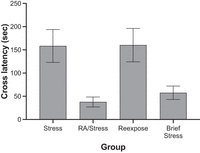
Mean (±SEM) latency (in seconds) to cross to the black side of the black–white shuttle box for both groups in experiment 2. Longer latency scores for the stress group that was stressed 48 h prior to training replicate the stress-induced impairment of extinction. Decreased latency scores for the group injected with cycloheximide immediately after stress (RA/stress) compared with the increased scores of the stress group replicate retrograde amnesia for the stress memory. Longer latencies exhibited by the group that received a brief stress exposure (re-expose) demonstrate the recovery of the forgotten stress memory. The brief stress group showing less avoidance demonstrates that a 5-min restraint stress session before training was not sufficient to impair extinction retrieval.
The results of this second experiment can also be explained using the memory integration retrieval-based model of retrograde amnesia mentioned above. Here, when cycloheximide was administered following the restraint stress, the memory was encoded in a “drug” state. Following the stress when training, extinction, and testing occurred, there was a mismatch in internal states, thus preventing the stress impairment of extinction. However, the brief re-exposure to the restraint stress before training, extinction, and testing reinstated the memory for the stress, which led to the stress-induced impairment of extinction. Thus, for the results observed here, when the amnestic is administered following restraint stress, the stress-induced impairment is abated. However, being restrained for a brief period reactivated the memory for stress, which was then re-encoded in a “nondrug” or “normal” state, allowing the memory for stress to impair extinction.
Related to the internal state-dependent explanation of the results here, Klinke et al. (2020, study 2) failed to observe stress effects on extinction in human subjects when the stress session and learning occurred in separate distinct external contexts (i.e., two different laboratories). This retrieval failure view is a possible mechanism for how the reactivated forgotten memory for stress impairs extinction learning and does not provide a physiological mechanism of how stress impacts extinction. These results of a memory for stress appearing similar to other memories, along with those presented by Klinke et al. (2020), emphasize the importance of both internal and external contextual cues for the stress-induced impairment of the extinction effect. Clearly, more research is needed to determine how stress impacts extinction learning and retrieval. Determining such mechanisms could have clinical applications for enhancing exposure-based treatments.
Acknowledgments
Partial funding of this research was provided by a Susquehanna University Committee on Faculty Scholarship grant to J.F.B.
Footnotes
-
Article is online at http://www.learnmem.org/cgi/doi/10.1101/lm.053895.123.
- Received October 16, 2023.
- Accepted December 5, 2023.
This article is distributed exclusively by Cold Spring Harbor Laboratory Press for the first 12 months after the full-issue publication date (see http://learnmem.cshlp.org/site/misc/terms.xhtml). After 12 months, it is available under a Creative Commons License (Attribution-NonCommercial 4.0 International), as described at http://creativecommons.org/licenses/by-nc/4.0/.