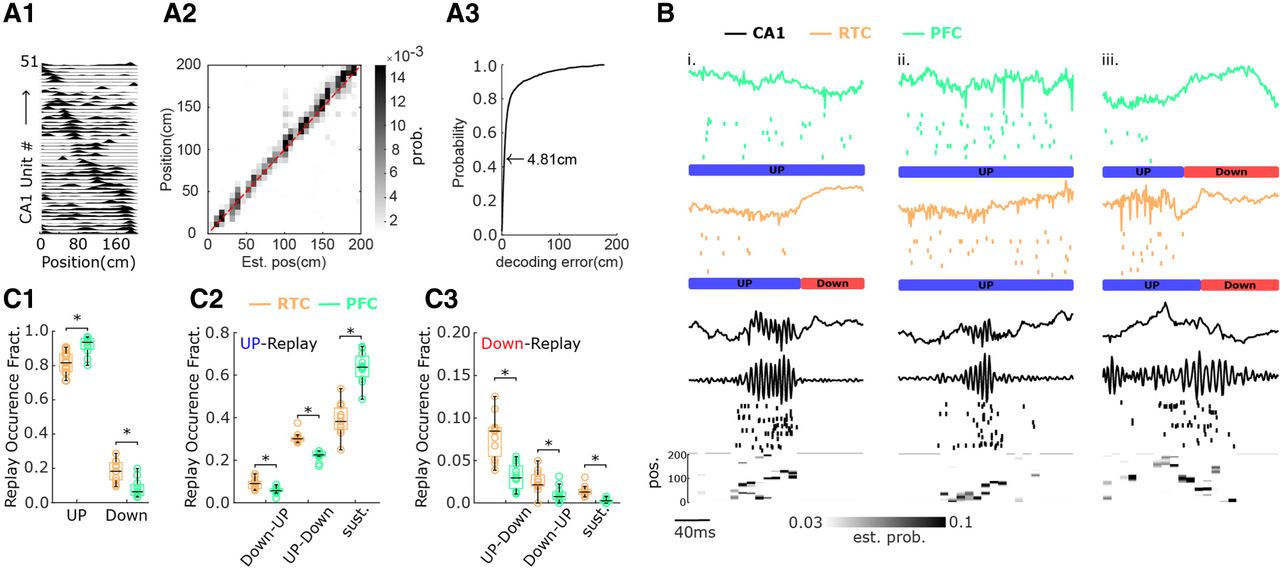
Coordination of hippocampal replays and cortical states of the RTC and PFC. (A1–A3) Bayesian decoding using place tuning units from hippocampal CA1. (A1) Firing rate of CA1 units in a linear maze. Units were ordered based on their place field. (A2) Confusion matrix showing the distribution of the actual position of a mouse and the estimated position from the decoding model. (A3) Empirical cumulative distribution function (CDF) of decoding errors. The arrow represents the median error in estimating the position for a single animal experiment. (B) Replay examples and their coordination to cortical states of the RTC and PFC. (Green) LFP and units of the PFC; (orange) the LFP and units of the RTC; (black) the LFP, filtered LFP ripples, units, and replay position reconstruction of CA1. (Panel i) An example of a replay that was coordinated with an up-to-down transition in the RTC but remained in a sustained up state in the PFC. (Panel ii) An example of a replay coordinated to sustained up states of the RTC and PFC. (Panel iii) An example of a replay coordinated to an up-to-down transition in the RTC and PFC. (C1–C3) Classification and coordination of hippocampal replays with the retrosplenial and prefrontal cortical up and down states. (C1) Fraction of replays occurring during a cortical up or down state of the RTC or PFC. (C2) Fraction of replays occurring during different classifications of the up state. States transitioned from down to up or up to down or were sustained (sust.) up states. (C3) Fraction of replays occurring during different classifications of the down state. States transitioned from up to down and down to up or were sustained down states. RTC n = 11, three mice; PFC n = 11, two mice. (*) P < 0.01 robust ANOVA with post hoc bootstrap-t.