Developmental changes in retention and generalization of nonadjacent dependencies over a period containing sleep in 18-mo-old infants
- Corresponding author: rgomez{at}arizona.edu
Abstract
Sleep promotes the stabilization of memories in adulthood, with a growing literature on the benefits of sleep for memory in infants and children. In two studies, we examined the role of sleep in the retention and generalization of nonadjacent dependencies (NADs; e.g., a-X-b/c-X-d phrases) in an artificial language. Previously, a study demonstrated that over a delay of 4 h, 15 mo olds who nap after training retain a general memory of the NAD rule instead of memory for specific NADs heard during training. In experiment 1, we designed a replication of the nap condition used in the earlier study but tested 18-mo-old infants. Infants of this age retained veridical memory for specific NADs over a delay containing sleep, providing preliminary evidence of the development of memory processes (experiment 1). In experiment 2, we tested 18 mo olds’ ability to generalize the NAD to new vocabulary, finding only infants who napped after training generalized their knowledge of the pattern to completely novel phrases. Overall, by 18 mo of age, children retain specific memories over a period containing sleep, and sleep promotes abstract memories to a greater extent than wakefulness.
A large body of literature supports the notion of sleep-dependent neural processes that stabilize and consolidate memories. In general, adults who sleep soon after learning will show better retention after a delay in comparison with individuals who stay awake for the same duration, a finding replicated with many types of learning, such as word learning (Dumay and Gaskell 2007; Tamminen et al. 2010), generalization and rule abstraction of an artificial language (Batterink et al. 2014; Batterink and Paller 2017), spatial memory and navigation (Nguyen et al. 2013), and motor-based tasks (Walker et al. 2002; Doyon et al. 2009). What mechanisms might drive this effect? Studies with rodents (for review, see Born and Wilhelm 2012) and human participants (Staresina et al. 2015) revealed synchronous activity during sleep among subcortical structures, like the hippocampus, and the neocortex. The dialogue between these regions likely supports the strengthening of long-term memory, promoting retention (Diekelmann and Born 2010; Born and Wilhelm 2012).
More specifically, results from animal studies using single-cell recordings suggest that one of the mechanisms driving sleep-dependent memory consolidation involves the hippocampus. During learning, neurons fire in specific sequences that correspond with the information being acquired. During sleep, the same neurons fire in the patterns observed during learning (Pavlides and Winson 1989; Skaggs and McNaughton 1996). Researchers refer to this phenomenon as neural replay, when patterns of activation that occurred during learning replay in the brain during subsequent sleep. Across slow-wave sleep, these bursts of activity in the hippocampus occur in sync with sleep spindles generated in the thalamus. In turn, sleep spindles generated throughout the cortex sync within the up phases of slow oscillations. Altogether, this synchronous activity assists the strengthening of cortical memory (for review, see Born and Wilhelm 2012).
While sleep promotes memory consolidation in adulthood, a much smaller set of literature examines the effects of sleep as infants and young children develop. An early study of sleep-dependent consolidation demonstrated the contributions of sleep to the generalization of grammatical language rules (Gómez et al. 2006). Gómez et al. (2006) investigated the effects of sleep on the retention of NADs by training 15-mo-old infants on an artificial language containing two NADs. In English, we have phrases like “he is jumping” and “she is playing” consisting of a nonadjacent dependency (NAD) “is” and “-ing” that remains consistent, but the rest of the vocabulary varies. In these phrases, “is” and “-ing” form a NAD. The artificial language in Gómez et al. (2006) consisted of three-word phrases in which the first word predicted the third word (e.g., pel-X-jic and vot-X-rud). Infants either slept or remained awake after learning, following their typical sleep schedule. Four hours after training, infants completed a test using the head turn preference procedure to measure infant looking times to different stimulus types (Kemler Nelson et al. 1995). The infants who stayed awake showed veridical retention, remembering the exact vocabulary making up the NAD (i.e., that pel and jic formed an NAD but pel and rud did not). These infants discriminated trials violating the NADs from training (e.g., pel-X-rud and vot-X-jic) from the trials containing NADs consistent with training (e.g., pel-X-jic and vot-X-rud). Alternatively, infants who napped retained a more abstract representation of the NAD rule: They remembered the predictive relationship between the first word and third word in each phrase but not the specific dependencies from training (Gómez et al. 2006). Furthermore, a follow-up study demonstrated that infants who did not sleep after learning did not retain their veridical representations across 24 h. On the other hand, infants who slept continued to show generalization effects, indicating that sleep promoted a long-lasting abstract representation of the NADs in 15 mo olds (Hupbach et al. 2009).
This work leaves two unanswered questions. First, does sleep contribute to veridical retention of NADs later in development? Notably, children experience developmental changes in learning of NADs over 15–18 mo. Santelmann and Jusczyk (1998) demonstrated that 18 mo olds but not 15 mo olds can discriminate legal NADs in English passages (e.g., “is running”) from illegal NADs (e.g., “can running”), suggesting that older infants are more mature in their knowledge of NADs than younger infants. Additionally, in an immediate test of learning, 15 mo olds demonstrated a familiarity effect, listening longer to trials containing NADs from training than to trials violating NADs from training, whereas older infants showed a novelty effect, the opposite pattern (Gómez and Maye 2005; see also Gómez 2002). Such outcomes are consistent with the idea that younger infants attend longer to familiar patterns after exposure to stimuli that appear more complex to them, whereas older infants may attend more to novel patterns after exposure to the same stimuli, which in their more advanced developmental state may appear simpler to them (see also Saffran and Thiessen 2003; Chambers et al. 2011). Both pre-existing knowledge (Henderson et al. 2015) and stronger encoding during learning (Baena et al. 2021) may lead to greater stabilization or consolidation across sleep in child and adult learners, respectively.
Given these outcomes, we have every reason to expect that 18 mo olds will retain a more robust representation over a delay containing sleep compared with 15-mo-old infants. If so, then 18 mo olds will discriminate between familiar and unfamiliar NADs when tested 4 h after learning, showing significantly longer looking times to one trial type versus the other.
Second, if 18 mo olds do indeed form a more robust, veridical representation over sleep, does sleep still contribute to the formation of an abstract representation? Both veridical and flexible abstract representations are important for language acquisition. As we expected 18 mo olds to demonstrate veridical retention across a delay containing sleep in experiment 1, we also wanted to measure whether 18 mo olds retain an abstract memory over sleep. If so, infants should generalize knowledge of the NAD rule to stimuli in a completely new vocabulary over a period of sleep but not over an equal period of wakefulness.
Thus, we investigated the development of sleep-dependent memory consolidation by examining the effects of sleep on veridical retention (experiment 1) and generalization (experiment 2) of nonadjacent dependencies in 18-mo-old infants. To investigate this question, we used the same stimuli and procedure as Gómez et al. (2006) but recruited 18-mo-old infants. As 18 mo olds are further along in development than 15 mo olds, we thought we might see different effects after a period containing sleep in these older infants.
In the present studies, infants listened to an artificial language containing two NADs in their homes during training. Infants in the nap conditions (experiments 1 and 2) completed training ∼1 h before their expected nap time. After training, these participants took a nap as usual. Wakefulness infants (experiment 2) completed training at a time when they were expected to be awake across the following 4 h. We tracked infants’ sleep and wakefulness by asking parents to complete a sleep log by reporting any sleep that occurred during the delay. We also placed Actiwatches on infants’ ankles for the 4-h delay in order to confirm parent-reported sleep times based on body movement data. We opted to follow infants’ natural sleep/wake cycles in order to increase the chances that they would nap or stay awake in accordance with their assigned condition. Otherwise, promoting wakefulness or sleep at an unusual time can be stressful for infants and children. The nature of our design led to differences in the amount of rest between conditions, with nap infants more rested at test. In previous research, 15 mo olds displayed an abstraction effect both when rested (Gómez et al. 2006) and when relatively unrested (Hupbach et al. 2009). Considering these findings, we did not expect the level of restfulness in our groups to impact our results.
Training stimuli in experiment 1 contained either pel-X-jic and vot-X-rud dependencies (language version G1) or pel-X-rud and vot-X-jic dependencies (language version G2). In experiment 2, infants listened to a training language containing a guf-Y-zam and a miv-Y-fop dependency. All infants came to the laboratory 4 h after training to complete the test measuring veridical memory and/or generalization using the head turn preference procedure (Kemler Nelson et al. 1995). At test, infants listened to two trial types: Half of the trials contained phrases from G1, and half contained phrases from G2. For infants in experiment 1 who heard G1 during training, we considered G1 test trials familiar and G2 test trials unfamiliar, with the opposite true for infants who heard G2 during training. All infants in experiment 2 heard the same test stimuli as those in experiment 1. Because experiment 2 infants heard a grammar containing different vocabulary during training, this manipulation allowed us to assess generalization to novel exemplars of the NAD rule (that the third and first items of each phrase formed a dependency). In experiment 2, we refer to G1 as TG1 and G2 as TG2 to reflect the fact that we presented entirely novel vocabulary during the test compared with during training, requiring infants to transfer knowledge from training to test.
Results
We found no difference based on participants’ gender or language version, so we collapsed across these variables for all analyses in experiments 1 and 2.
Experiment 1
Sleep data
Infants slept for an average of 87 min (SE = 7.87 min; range = 32–134 min) and participated in the test at an average time of 2:30 p.m. (range = 11:30 a.m.–3:30 p.m.).
Veridical memory
Figure 1 shows the average and individual looking time to familiar trials in light gray and unfamiliar trials in dark gray. The left bars in Figure 1 present data from 15 mo olds in Gómez et al. (2006), and the right bars plot 18 mo olds’ data from experiment 1. To measure change across development, we compared the results of Gómez et al. (2006) with the present data. We conducted a mixed design ANOVA, with trial type (familiar vs. unfamiliar) as a repeated measure and age (15 mo olds vs. 18 mo olds) as a between-subjects factor. We found no significant main effects of trial type or age (trial type: F(1,30) = 1.63, P = 0.211, partial η2 = 0.012; age: F(1,30) = 0.21, P = 0.65, partial η2 = 0.007) and a nonsignificant interaction of trial type and age (age × trial type: F(1,30) = 11.54, P = 0.06, partial η2 = 0.113).
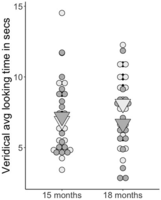
Average (triangles) and individual (dots) looking times to familiar trials (light gray) compared with unfamiliar trials (dark gray) in experiment 1. (Left) Nap data from 15 mo olds from Gómez et al. (2006). (Right) Eighteen month olds’ looking times. Targeted t-tests revealed that 18 mo olds looked significantly longer toward familiar trials, while 15 mo olds showed no difference in average looking time between trial types.
We conducted a targeted t-test to follow up on our a priori hypothesis that 18 mo olds would discriminate familiar from unfamiliar NADs at test by conducting a paired-sample, two-tailed t-test comparing 18 mo olds’ average looking time to familiar trials with average looking to unfamiliar trials. A significant difference would indicate that infants remembered the NADs present during training and discriminated them from contrasting NADs. We found a significant difference with longer average looking during familiar trials (M = 8.10 sec, SE = 0.61 sec) than during unfamiliar trials (M = 6.69 sec, SE = 0.61 sec; t(15) = 2.68, P = 0.017, d = 0.67). Thus, although we did not observe a significant interaction between age and looking time to familiar versus unfamiliar trials, 18 mo olds discriminated trial types over a period of sleep in the present study, whereas 15 mo olds did not (see Gómez et al. 2006). The P-value for the t-test for the 18 mo olds survived a Bonferroni correction to control for family-wise error rate (corrected P = 0.05/2 = 0.025). To assess the correlation between looking behavior and nap duration, we calculated a difference score by taking average looking to familiar trials and subtracting average looking to unfamiliar trials. Nap duration failed to correlate with looking time differences (r = 0.45, P = 0.093).
Generalization
Figure 2 shows the average and individual looking times to trials consistent with the first trial type and trials inconsistent with the first type in both 15 mo olds and 18 mo olds. Following Gómez et al. (2006), we assessed whether infants retained an abstract representation of the nonadjacent dependency that facilitates generalization to grammars similar to that heard during training. We compared the present data with the results of Gómez et al. (2006) in order to measure age-related change in generalization. We performed a mixed design ANOVA with trial type (first test trial type vs. inconsistent with first trial) as a repeated measure and age (15 mo vs. 18 mo) as a between-subjects factor. This revealed a significant main effect of trial type (F(1,30) = 11.95, P = 0.002, partial η2 = 0.285), no main effect of age (F(1,30) = 0.29, P = 0.59, partial η2 = 0.01), and a significant trial type × age interaction (F(1,30) = 5.402, P = 0.027, partial η2 = 0.153).
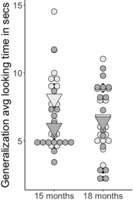
Average (triangles) and individual (dots) looking times to trials consistent with the first trial type (light gray) compared with inconsistent trials (dark gray) in experiment 1. (Left) Nap data from 15 mo olds from Gómez et al. (2006). (Right) Eighteen month olds’ looking times. An ANOVA revealed a significant age × trial type interaction, with 15 mo olds looking longer to trials consistent with the first test trial type, while 18 mo olds showed no difference in looking between trial types.
In order to conduct targeted t-tests, we compared the average looking times to the grammar heard in the first test trial with the average looking times to trials inconsistent with the first trial. If infants had nonspecific, abstract representations of the nonadjacent dependencies from the training grammar, we would observe a significant difference. We used a paired-samples, two-tailed t-test comparing 18-mo-old infants’ looking times during trials consistent with the first test trial type with looking times during inconsistent trials. We found no difference (Mfirst trial = 7.66 sec, SE = 0.55 sec; Minconsistent = 7.25 sec, SE = 0.73 sec; t(15) = 0.69, P = 0.50, d = 0.23), indicating that 18 mo olds did not generalize their knowledge of NADs to the first test trial. On the other hand, 15 mo olds from Gómez et al. (2006) demonstrated generalization to the first test trial type (t(15) = 5.15, P < 0.001, d = 1.28), with longer looking to trials consistent with the first trial type (M = 8.11 sec, SE = 0.67 sec) than to those inconsistent with the first trial (M = 5.96 sec, SE = 0.51 sec). The P-value for the t-test for the 15 mo olds survived a Bonferroni correction to control for family-wise error rate. In order to assess the correlation between looking behavior and nap duration, we calculated a difference score by taking average looking to trials consistent with the first trial type and subtracting average looking to inconsistent trials. Nap duration correlated significantly with looking time differences in 18 mo olds (r = 0.69, P = 0.004).
Experiment 2
Sleep data
In the nap condition, infants napped for an average of 89.9 min (SE = 5.91 min, range = 64–116 min) and completed the test at an average time of 3:00 p.m. (SE = 12 min; range = 1:30 p.m.–4:15 p.m.). Two infants in the wakefulness group of experiment 2 fell asleep for <17 min during the retention delay. As we define a nap as a minimum period of 30 min of sleep in all our prior research, we retained them. Including them did not alter the results in this condition. The wakefulness group napped for an average of 1.5 min (SE = 1.12 min, range = 0–17 min) and completed the test at an average time of 1:45 p.m. (SE = 34 min, range = 11:00 a.m.–5:00 p.m.). Test times for the nap and wakefulness groups did not differ significantly (Mann–Whitney U = 163.5, P = 0.179).
Generalization
Figure 3 displays 18 mo olds’ average and individual looking time to trials consistent with the first trial type and inconsistent trials with the nap group's looking time displayed at the left and the wakefulness group's at the right. We first conducted a mixed model ANOVA with trial type (first test trial type vs. inconsistent with first trial) as a repeated measure and delay type (nap vs. wakefulness) as a between-subjects factor, resulting in a main effect of trial type (F(1,30) = 5.24, P = 0.029, partial η2 = 0.149), no main effect of delay type (F(1,30) = 0.12, P = 0.729, partial η2 = 0.004), and a significant trial type × delay type interaction (F(1,30) = 4.42, P = 0.044, partial η2 = 0.128). We then conducted two two-tailed, paired-samples t-tests. The first test compared average looking time to trials consistent with the first trial type against average looking time to inconsistent trials in the nap group only. The second t-test performed the same comparison in the wakefulness group. A significant difference indicates that infants noted the NADs in the first test trial and discriminated those NADs from the contrasting grammar. The nap group looked significantly longer to trials consistent with the first test trial type (Mfirst trial = 8.04 sec, SE = 0.59 sec) than to inconsistent trials (Minconsistent = 6.44 sec, SE = 0.52 sec; t(15) = 3.99, P = 0.001, d = 0.99), surviving a Bonferroni correction and indicating that they generalized their knowledge of NADs to the grammar presented in the first test trial. The wakefulness group showed no difference in looking time between trial types (Mfirst trial = 7.53 sec, SE = 0.48 sec; Minconsistent = 7.46 sec, SE = 0.70 sec; t(15) = 0.112, P = 0.912, d = 0.028). Thus, infants in the wakefulness group did not extend their knowledge of NADs to recognize the ones present in the first test trial. In order to assess the correlation between looking behavior and nap duration, we calculated a difference score by taking average looking to trials consistent with the first trial type and subtracting average looking to inconsistent trials. Nap duration failed to correlate with looking time difference scores (r = 0.08, P = 0.85).
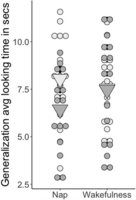
Average (triangles) and individual (dots) looking times to trials consistent with the first trial type (light gray) compared with inconsistent trials (dark gray) in experiment 2. (Left) Looking times in the nap group. (Right) Looking times in the wakefulness group. All infants in experiment 2 were 18 mo of age. An ANOVA revealed a significant delay type × trial type interaction, with infants in the nap group looking longer to trials consistent with the first test trial type, while wakefulness infants showed no difference in looking between trial types.
Discussion
Overall, in experiment 1, we provide preliminary evidence that 18-mo-old infants retained veridical representations of the NADs they learned during training across a delay of 4 h containing a nap. Importantly, research indicates that sleep consolidates contextual aspects of learned information, such as where learning took place (van der Helm et al. 2011), and adults are more successful at recalling learned information when training and testing take place in the same context (Smith and Vela 2001). All conditions in the present experiments involved a change in context between learning and test, potentially making our testing relatively more difficult than if we had trained and tested infants in the same locations. Despite the change in context, we observed successful recognition of learned NADs in experiment 1. Looking at our measure of generalization, the identity of the first trial failed to bias participants at test, providing further support for the idea that infants retain veridical representations of the NADs from training. Because infants remembered the exact NADs from training, the identity of the first test trial did not matter.
However, generalization plays an important role in the acquisition of grammar, as a language user needs to recognize and understand grammatical sentences containing novel word forms. Therefore, in experiment 2, we assessed whether 18 mo olds’ memory is flexible enough to generalize their knowledge of NADs to a grammar with completely novel vocabulary. We also asked whether sleep offers a benefit to the ability to generalize over wakefulness, finding that 18 mo olds who napped after learning generalized their knowledge of NADs to new vocabulary. Those who stayed awake after learning did not generalize.
Comparing our results with those of Gómez et al. (2006), we provide preliminary evidence for development in memory retention across sleep between 15 and 18 mo of age. Eighteen month olds were not biased by the identity of the first test trial when the testing grammars used the same vocabulary as the training grammar. Their lack of generalization in experiment 1 likely stemmed from their relatively strong veridical memory for the specific words forming NADs in their training grammar. Notably, 18 mo olds demonstrated a familiarity effect in our test of veridical memory, looking longer during familiar than unfamiliar trials. This pattern of looking behavior suggests that infants lost detail from their representation with sleep, as both 17 mo olds and 18 mo olds showed a novelty effect on immediate tests of learning (Gómez 2002; Gómez and Maye 2005, respectively). Our observed correlation between sleep duration and generalization in experiment 1 provides support for this notion, as children with longer naps showed a greater first trial effect. We may not have observed such a correlation in experiment 2 due to limited power, as we had Actiwatch data for just eight of 16 infants, though an analysis using parent-reported data for 15 of 16 infants also resulted in a nonsignificant correlation (r = 0.17, P = 0.538). Despite any loss of veridical information across sleep, 18-mo-old infants did retain a sufficient amount of detail to discriminate their training grammar from a contrasting grammar. Thus, by 18 mo of age, sleep may stabilize the veridical representations of the NADs from the training grammar to a greater extent than at 15 mo (experiment 1) while also promoting generalization (experiment 2).
Of note, Friedrich et al. (2022) reported possible evidence of multiple representations emerging in the ERP responses of 6 mo olds and 8 mo olds who slept soon after learning. In a postsleep test, infants who napped activated a distinct ERP response while listening to NAD stimuli heard during training versus NADs containing novel middle elements that tapped generalization, akin to recognizing an unheard verb in a familiar form; for example, extending knowledge of “is running” or “is jumping” to a novel verb.
We asked a similar question in experiment 2, but instead of testing generalization to NADs with different middle elements (after Friedrich et al. 2022), we tested generalization to an entirely new vocabulary, akin to generalizing from knowledge of a NAD linking “is” to “-ing” in a phrase like “is jumping” to a NAD linking “had” with the “-ed” suffix in “had talked.” This approach permitted a behavioral test of the idea that sleep may contribute both to veridical retention of newly formed NADs (reported in experiment 1) and to a truly abstract representation of the NAD relation, something that we could not determine with 15 mo olds given their lack of veridical memory after the nap.
Our findings are in contrast to those of Friedrich et al. (2022), who exposed 6- and 8-mo-old infants to a natural language containing two NADs with aXb and cXd structure. At test, infants heard four types of test phrases: (1) familiar regular phrases presented during learning (e.g., aXb), (2) irregular phrases with violations of the NAD (e.g., aXd), (3) new phrases that contained a novel medial item and followed the NAD (e.g., aYb), and (4) new irregular phrases that contained a novel medial item but violated the NAD (e.g., aYd). ERP responses measured during learning and after a retention period containing either sleep or wakefulness indicated that all infants recognized both familiar phrases and new phrases that followed the NAD rule compared with irregular phrases, regardless of whether they slept after learning. In other words, infants recognized correct NADs with novel medial items, suggesting an ability to generalize memory for the NADs across both sleep and wakefulness. Therefore, mechanisms to acquire and retain morphosyntactic rules are in place very early in development. Friedrich et al. (2022) also found that sleeping after learning promoted higher-level processing of the familiar regular phrases, potentially indicating consolidation or lexicalization of specific strings heard during leaning—processing absent in infants who remained awake after learning. It also was not present for regular NADs with novel medial items. In other words, all infants retained a general memory for the NADs, while sleeping benefitted a specific memory for the phrases heard during learning. In contrast, Gómez et al. (2006) and the present studies suggest that napping, but not wakefulness, produces a more general memory of the rule infants can apply to novel vocabulary.
Such differences in results between these studies and that of Friedrich et al. (2022) could result from variations in delays, dependent measures, stimuli, or designs for testing generalization. In both experiments 1 and 2, we tested infants 4 h after they listened to the training grammar. Friedrich et al. (2022) tested infants in the nap group an average of 72 min after learning, but in the wakefulness group an average of 36 min after learning. While their wakefulness group retained a general memory <1 h old, we do not know whether the memory would persist over the longer duration tested in the nap group in their study. Additionally, their studies relied on ERP responses for dependent variables, which are difficult to compare with the behavioral responses used here.
Differences between our stimuli and those of Friedrich et al. (2022) may more fundamentally explain our different findings. They used morphosyntactic phrases with shorter elements that may incur a smaller load on working memory than the two-syllable middle elements used by Gómez et al. (2006). Friederici et al. (2011), who used the same stimuli as Friedrich et al. (2022), reported a maximum mean duration of 530 msec for the X element and the b or d ending. Adding in the initial a and c elements, the total duration of NAD phrases could not have exceeded 750 msec, in contrast to the NAD phrases used here that lasted 2 sec. Thus, the NADs in the study by Friedrich et al. (2011, 2022) put a lighter burden on working memory that may better support NAD learning in very young infants.
Finally, in the study by Friedrich et al. (2022), generalization stimuli contained the same NADs heard during training paired with 32 novel medial items compared with the entirely novel three-element phrases used in experiment 2. Given that high variability of the medial element in aXb phrases leads to greater veridical detection of NADs, Gómez (2002) argued that infants will treat generalization phrases with new medial elements as similar enough to the phrases presented during training so that infants fail to discriminate between new and old phrases with the same NAD present. In contrast, our generalization stimuli contained completely novel phrases compared with those from training so that infants must retain an abstract representation of the NAD relationship in order to recognize it in phrases with completely novel vocabulary. In experiment 2, we observed this level of generalization only after sleep.
A number of other studies also provided evidence that sleep promotes generalization in infancy. For example, Friedrich and colleagues found that after napping, 6- to 8-mo-old infants (Friedrich et al. 2017) and 9- to 16-mo-old infants (Friedrich et al. 2015) retained recently learned object labels and could apply them to novel exemplars. The infants who stayed awake in the hours after learning did not retain the words and could not recognize new exemplars of the learned category. Similarly, Horváth et al. (2015) demonstrated that 16 mo olds who napped after exposure to object–label associations applied the learned labels to novel exemplars, while infants who stayed awake after learning did not. Along with these findings, experiment 2 of the present studies provides further evidence that napping after exposure to linguistic information promotes generalization of representations acquired during learning.
Mechanisms supporting increased specificity of retention from 15 to 18 mo
While our interaction between trial type and age was not significant in experiment 1, targeted t-tests revealed that 18 mo olds looked significantly longer to familiar trials than unfamiliar ones, while 15 mo olds did not (Gómez et al. 2006). These results provide preliminary evidence for changes in the specificity of retention from 15 to 18 mo. One possible explanation for the potential changes in memory retention with development may stem from increased strength of encoding with development. Gómez (2002) illustrated that 18 mo olds show a novelty effect immediately after listening to an artificial language containing NADs, which may reflect a more robust representation of the training stimulus that leads infants to look longer at a novel stimulus compared with 15 mo olds who demonstrate a familiarity effect immediately after learning NADs, listening longer to phrases from training (Hunter et al. 1983; Hunter and Ames 1988; Gómez and Maye 2005; see also Houston-Price and Nakai 2004). Along similar lines, 18 mo olds may have a larger processing window than 15 mo olds, allowing older infants to hold more information in working memory. Although no empirical demonstration of working memory increases between these specific ages currently exists, studies show that processing windows grow in the span of months during development (for review, see Reynolds and Romano 2016). Furthermore, Santelmann and Jusczyk (1998) found that 18 mo olds cannot recognize NADs in English when the two related elements are separated by five syllables but can when the related elements are separated by three syllables, providing evidence that the size of their processing window limits infants’ recognition of NADs, especially when many interleaving elements come between the associated items. Increases in working memory with age might allow older infants to represent an entire NAD in memory at once. Shorter working memory span, on the other hand, might allow an infant to hold only part of the NAD in mind, preventing them from forming robust representations (Santelmann and Jusczyk 1998). Therefore, age-related differences in the initial encoding of NADs could largely drive the increased specificity of retention in older infants, especially considering studies showing that strongly encoded memories consolidate to a greater degree than weakly encoded ones over sleep (for reviews, see James et al. 2017; Walker et al. 2019).
Mechanisms supporting generalization over sleep
What processes might support 18 mo olds’ generalization to novel vocabulary across sleep? Lewis and Durrant (2011) proposed that repeated reactivation of memories during sleep contributes to abstraction. Namely, when memories contain commonalities, repeated reactivation encourages strengthening of the more greatly reactivated, consistent elements than elements that correspond to only one memory. As the veridical representations of the training NADs reactivate during sleep, the system further extracts or strengthens the common general dependency between the first and third items. In this way, neural replay supports integration across multiple activations of learned NADs during sleep, with sleep after learning required for generalization. Given that 15 mo olds did not retain veridical knowledge of the NADs, different mechanisms may support generalization in that age group.
According to an alternative theory, infants might encode at two levels of representation during training, and protection from interference through sleep maintains the abstract NAD relationship (Yonelinas et al. 2019). During training, infants may separately encode positional information at anchor points (i.e., the vocabulary at the beginning and end of each phrase) while also encoding the NAD relationship between these items (the association between constituents in the first and third positions). Infants encode the exact words that occur at the beginnings and ends of phrases (Benavides-Varela and Mehler 2015) and learn the association between these specific items while also representing the existence of a general relationship between items in the first and third positions.
Finally, according to the synaptic homeostasis hypothesis, active synaptic connections become strengthened during experiences across wakefulness, with the connections used most building up the most “weight.” Then, during sleep, a global downscaling of weights occurs so that only the strongest connections remain after sleep (Tononi and Cirelli 2006). Particularly in development, sleep may also function to actively weaken unnecessary connections formed during learning while also strengthening maintained connections (Li et al. 2017). Following these ideas and as outlined by Gómez (2017) and Gómez and Edgin (2015, 2016), the specific vocabulary making up the NADs occurred in only half the phrases infants experienced during training (i.e., pel-X-jic was present in half of the phrases and vot-X-rud was present in the other half). Therefore, the vocabulary varied to a greater extent than the abstract NAD relationship, which occurred in every training phrase. This disparity may lead 15 mo olds to better maintain the abstract representation across synaptic homeostasis while forgetting individual vocabulary items due to downscaling. This may result in forgetting of the specific vocabulary instantiating the NAD relationship at 15 mo. Thus, the general NAD relationship survives downscaling but the specific vocabulary making up the NADs does not, resulting in generalization without stabilization across sleep. Eighteen month olds, on the other hand, form stronger representations during encoding because of their further development (Santelmann and Jusczyk 1998; Gómez 2002; Gómez and Maye 2005). Stronger encoding in this age group generates connections that persist after synaptic downscaling, so 18 mo olds retain both levels of representation across sleep.
Limitations
We were not able to draw conclusive statements from experiment 1 regarding the contribution of sleep to the retention of specific memory in older children, as we did not compare retention across sleep with retention across wakefulness. Considering that 15 mo olds retain veridical representations across a 4-h delay containing wakefulness (Gómez et al. 2006), we expected that 18 mo olds would also retain veridical representations over an equal period of wakefulness. Therefore, to implicate sleep in the age-related development we observed in retention, studies using polysomnography may reveal associations between specific sleep physiology (e.g., sleep spindles and slow-wave activity) and retention. In addition, comparing retention between sleep and wakefulness groups at longer delays can inform whether sleep has a long-term stabilizing effect. An increasing number of studies demonstrate the importance of naps for stabilizing memory for later nighttime sleep (Desrochers et al. 2016; Kurdziel et al. 2018; Werchan et al. 2021). Although we expect 18 mo olds to retain veridical representations across a 4-h delay containing either sleep or wakefulness, if sleep stabilizes memories by 18 mo, we predict that only infants who sleep soon after learning will demonstrate veridical retention 24 h later.
Concluding remarks
In two experiments, we provided evidence that 18 mo olds demonstrate both memory stabilization and generalization across a delay containing sleep. Our results provide preliminary evidence suggesting potential developmental changes in the role of sleep in retention, along with evidence that sleep supports generalization to a greater extent than wakefulness by 18 mo of age. Thus, these results provide new insights into the development of NAD learning in infancy.
Materials and Methods
Participants
We recruited infants between 17.5 and 18.5 mo of age to participate. After discards (see below), our final sample included data from a total of forty-eight 18-mo-old infants from monolingual English-speaking families with a term of at least 36 wk at birth, a birth weight of at least 5.5 lb, no familial history of developmental language delay, or no ear infections within 2 wk of at-home training or at the time of the laboratory visit. Each participant completed one experiment, with 16 participants in experiment 1 (mean age = 18.23 mo, range = 17.53–18.66 mo, SE = 0.07 mo). We randomly assigned the 32 infants in experiment 2 to either a nap condition (N = 16, mean age = 18.31 mo, range = 17.62–19.89 mo, SE = 0.12 mo) or a wakefulness condition (N = 16, mean age = 18.35 mo, range = 17.72–19.92 mo, SE = 0.12 mo). We conducted a two-tailed t-test to ensure that we compared infants of similar ages in experiment 2 (t(30) = −0.24; P = 0.81). We selected sample sizes of 16 participants per condition following previous research (e.g., Gómez et al. 2006).
Before scheduling, we ensured that all infants had a relatively regular nap time. We excluded an additional 22 infants in experiment 1 due to (1) parent or sibling interference during training or test (n = 3), (2) failure to participate in the test session or if the infant demonstrated excessive fussiness defined as continuous crying and/or whimpering (n = 11), (3) the infant did not nap for at least 30 min during the delay (n = 2), (4) extension of the delay between learning and test due to late arrival to the test session (n = 2), (5) experimenter error (n = 3), or (6) technical errors (n = 1). We discarded an additional three infants, as we discovered that they did not meet our requirements for participation during the course of the study for reasons including >10% exposure to a foreign language (n = 2) or a familial history of language delay (n = 1). For experiment 2, we excluded an additional five infants in the nap group not included in data analysis due to (1) parent interference during training or test (n = 1), (2) fussiness or lack of infants’ participation in the test session (n = 3), or (3) extension of the delay between learning and test due to late arrival to the test session (n = 1). We discarded an additional eight infants who did not meet our requirements for participation due to significant foreign language exposure (n = 5), possible hearing loss (n = 1), premature birth (n = 1), or a family history of speech therapy (n = 1). We excluded three infants in the wakefulness group due to (1) excessive fussiness or lack of infant participation in the test session (n = 1), (2) napping for >30 min during the delay (n = 1), or (3) technical error (n = 1). We also collected and discarded data from one infant in the wakefulness group due to foreign language exposure, as they did not meet the requirements for participation.
Materials
Training
Table 1 displays the NADs present in each language across both experiments. Experiment 1 used the stimuli from Gómez et al. (2006). In this experiment, during training, infants listened to one of two grammars, each containing two nonadjacent dependencies. Phrases in the first grammar (G1) consisted of phrases with the structure pel-X-jic and vot-X-rud, in which the first element paired consistently with the third element. The second grammar (G2) contained phrases following a contrasting pattern, pel-X-rud and vot-X-jic. Thus, the phrases from G1 violated the grammar in G2 and vice versa. In both grammars, the medial X elements drew from a bank of 24 disyllabic words. These included wadim, kicey, puser, fengle, coomo, loga, gople, taspu, hiftam, deecha, vamey, skiger, benez, gensim, feenam, laeljeen, chila, roosa, plizet, balip, malsig, suleb, nilbo, and wiffle. This level of variability in the medial item increased the salience of the more consistent items making up the NADs, supporting the acquisition of the NAD in particular (Gómez 2002). All phrases followed the same metrical cadence, with increased stress on the final syllable of the phrase regardless of grammar. Both grammars contained 48 unique phrases, each lasting ∼2 sec, with 750 msec of silence separating phrases during training. We selected the number of exposures to ensure ample time for encoding (following Gómez et al. 2006). Training lasted a total of 14 min, ending after five blocks of trials, with each block containing all 48 phrases.
The training and testing grammars used in experiments 1 and 2
In order to assess generalization to new vocabulary in experiment 2, we created a single training grammar that followed the structure of the grammars used by Gómez et al. (2006). It contained two NADs, guf-Y-zam and miv-Y-fop, and the Y items came from a novel set of 24 unique words: burkid, drakel, fraggle, fupred, gaffin, hager, harnet, hilgub, kondit, labo, lotad, mabbit, minka, nutter, plicka, pumraz, quabit, rezzit, shodo, stenga, triftan, vozlet, wahav, and zeenel. The grammar consisted of 48 different randomly ordered 2-sec phrases, separated by 750 msec of silence, altogether forming a block. Each block repeated five times with phrases in a different random order. The grammar played for ∼14 min, and all infants listened to the same grammar.
Testing
In experiment 1, half (eight) of the test trials contained phrases from one grammar (G1 or G2). The remaining half of the trials contained phrases from the other grammar. Each trial contained six phrases and lasted for a maximum of 17 sec. Critically, in experiment 1, seven of the infants heard phrases from G1 on the first trial and nine heard G2 on the first trial. In experiment 2, half of the infants in the wakefulness group heard G1 on the first trial and the other half listened to G2 on the first trial. Six participants in the nap group heard G1 first and 10 heard G2 first. Following the findings of Gómez et al. (2006), we implemented this manipulation to assess whether the grammar in the first trial influenced infants’ behavior for the remainder of the test.
In experiment 2, we used G1 and G2 test stimuli from Gómez et al. (2006), identical to the test stimuli used in experiment 1. We referred to them as transfer grammar 1 (TG1) and transfer grammar 2 (TG2) for this experiment. TG1 contained phrases that followed the pattern pel-X-jic and vot-X-rud. TG2 followed a contrasting NAD pattern: vot-X-jic and pel-X-rud. The X items drew from the same bank of 24 disyllabic words as experiment 1, different from the training grammar used in this experiment. Half (eight) of the test trials contained phrases from TG1, and the other half contained phrases from TG2. Furthermore, we counterbalanced whether infants heard TG1 or TG2 on the first test trial. Thus, all vocabulary used for test stimuli differed from that used for the training stimuli.
Procedure
Training
Training took place in the infant's home. All infants listened to the training language in a quiet room in their home accompanied by their caregiver and the researcher. Both the caregiver and researcher refrained from speaking while listening and entertained the infant silently to keep them engaged in quiet play that would not interfere with hearing the stimuli. After training, researchers provided families with a sleep log and an Actiwatch, informing them to record in the sleep log the time at which their child went down for a nap and when they woke. Parents also provided their infant's typical sleep schedule in the sleep log. The researcher placed the Actiwatch on the infant's ankle and instructed parents to press the button once when putting their child down for a nap and again when their child woke.
Testing
All infants completed the test in the laboratory. We tested infants using the head turn preference procedure (Kemler Nelson et al. 1995). In this procedure, infants sat on their caregiver's lap facing forward in a sound-attenuated booth with the caregiver wearing noise-canceling headphones. Once the infant and caregiver were situated, the researcher, also wearing noise-canceling headphones, sat in an adjacent room to observe the participant over closed-circuit television and control the experimental program. At the start of each trial, a center light affixed to the wall directly in front of the infant began blinking. Once the infant fixated on the center light, the researcher pressed a button that extinguished the center light and illuminated one of two lights on the walls to the left or right of the participant. The side light blinked until the infant turned their head 30° toward that direction, at which point the researcher pressed another button, initiating the presentation of audio stimuli through a speaker directly below the blinking light. The grammar played through the speaker until the child looked away from the light for two consecutive seconds or until the audio file ended, whichever occurred first. The center light then resumed blinking, marking the beginning of the next trial.
Data analysis
Actiwatch data
We analyzed the Actiwatch nap data and parent-reported sleep logs in order to measure time spent asleep during the delay. Actiware software determined sleep onset and sleep end based on minutes infants spent immobile, measuring the infants’ activity in 30-sec epochs. Each sleep interval began when the infant was immobile for 10 consecutive minutes, with sleep onset occurring at the beginning of that 10-min window. Similarly, sleep intervals ended at the end of the last epoch of a 10-min section in which an infant was mobile for at least one epoch. In experiment 1, we had missing Actiwatch data for two infants. Not including them, we found no significant difference between parent-reported nap times and Actiwatch nap times (Msleeplog = 104 min, SE = 11.66 min; MActiwatch = 87 min, SE = 7.86 min; t(29) = −1.19, P = 0.224). Thus, we report Actiwatch nap times for infants in experiment 1. In experiment 2, we had missing Actiwatch data for eight infants and missing parent-reported data for one infant. Not including these nine infants, we found no significant difference between parent-reported nap times and Actiwatch nap times (Msleeplog = 117 min, SE = 6.95 min; MActiwatch = 91 min, SE = 5.91 min; t(12) = −2.02, P = 0.066). Thus, in experiment 2, we report Actiwatch data and omitted infants who did not have Actiwatch data from analysis involving sleep times.
Head turn preference data
In all analyses involving looking time, we omitted trials where the infant looked for <2 sec because a single NAD phrase was ∼2 sec long. In order for an infant to hear both the first element and the last element in the first NAD of each test trial, they must have looked for at least two seconds per trial. In experiment 1, we omitted 12% of trials. In experiment 2, we omitted 20% of trials in the nap group and 18% of trials in the wakefulness group for this reason.
Acknowledgments
We thank the caregivers and infants who participated in these experiments, as well as the many undergraduate research assistants who helped with data collection. National Science Foundation grant BCS-1052887 to R.L.G. supported data collection for experiments 1 and 2.
Footnotes
-
Article is online at http://www.learnmem.org/cgi/doi/10.1101/lm.053772.123.
- Received March 27, 2023.
- Accepted July 24, 2023.
This article is distributed exclusively by Cold Spring Harbor Laboratory Press for the first 12 months after the full-issue publication date (see http://learnmem.cshlp.org/site/misc/terms.xhtml). After 12 months, it is available under a Creative Commons License (Attribution-NonCommercial 4.0 International), as described at http://creativecommons.org/licenses/by-nc/4.0/.