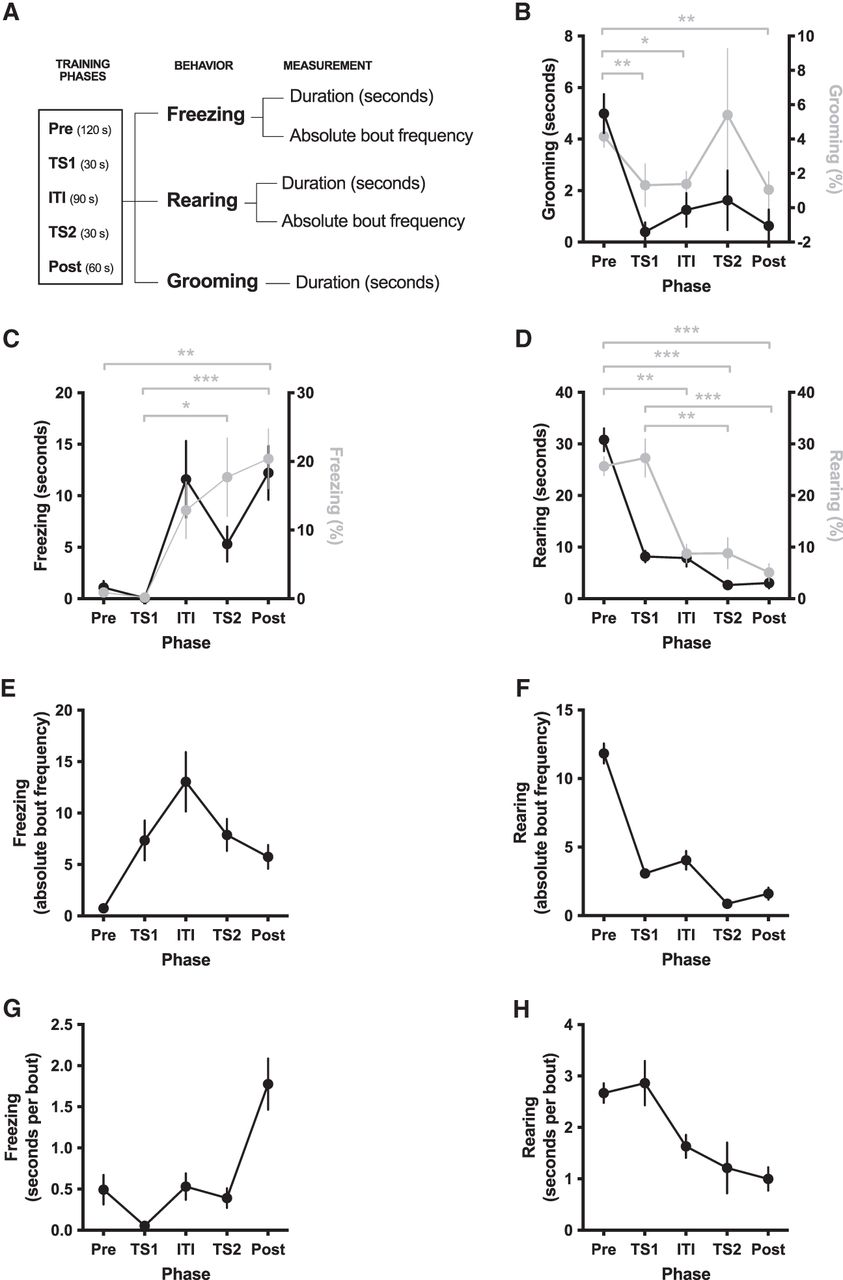
Behavioral profiles during fear memory conditioning. (A) We split the auditory fear conditioning session into five phases (“Pre”: before conditioning, “TS1”; first tone–shock presentation, “ITI”: intertrial interval, “TS2”: second tone–shock presentation, and “Post”: after conditioning) with different durations (in seconds) and measured for each phase both absolute bout frequency and time spent freezing and rearing, as well as time spent grooming. (B–H) Behavior profiles included time spent grooming (B), freezing (C), and rearing (D); absolute bout frequency of freezing (E) and rearing (F); and average bout duration of freezing (G) and rearing (H). Freezing, rearing, and grooming were recalculated as phase percentage for phase comparison (gray traces in B–D). For the latter we ran a Friedman's test with Dunn–Bonferroni multiple comparisons test as post-hoc analysis. (*) P < 0.05, (**) P < 0.01, (***) P < 0.001. All data points represent mean ± 1 SEM.