An in vitro analog of learning that food is inedible in Aplysia: decreased responses to a transmitter signaling food after pairing with transmitters signaling failed swallowing
- 1Gonda (Goldschmied) Brain Research Center, Goodman Faculty of Life Science, Bar Ilan University, Ramat Gan 52900, Israel
- 2State Key Laboratory of Pharmaceutical Biotechnology, Institute for Brain Sciences, School Life Sciences, Nanjing University, Jiangsu 210023, China
- Corresponding author: avy{at}biu.ac.il
Abstract
An in vitro analog of learning that a food is inedible provided insight into mechanisms underlying the learning. Aplysia learn to stop responding to a food when they attempt but fail to swallow it. Pairing a cholinergic agonist with an NO donor or histamine in the Aplysia cerebral ganglion produced significant decreases in fictive feeding in response to the cholinergic agonist alone. Acetylcholine (ACh) is the transmitter of chemoreceptors sensing food touching the lips. Nitric oxide (NO) and histamine (HA) signal failed attempts to swallow food. Reduced responses to the cholinergic agonist after pairing with NO or HA indicate that learning partially arises via a decreased response to ACh in the cerebral ganglion.
A single experience can cause multiple learned changes in behavior that may arise and be stored at different sites within the nervous system via different cellular mechanisms. The changes in behavior are usually expressed together but may be separable experimentally. For example, in humans, the ability to acquire a visuo–motor skill leads to separable declarative and nondeclarative memories, with declarative memory processed and initially stored in the hippocampus, and nondeclarative memories processed elsewhere (Squire 2009a,b). Despite the common occurrence, the CNS mechanisms underlying multiple learned changes remain poorly understood.
We used a learning task in an experimentally advantageous model system, Aplysia, to examine how an experience causes cellular changes at multiple neural sites to produce multiple but integrated changes in behavior. In this learning task, the animals are given a tasty food wrapped in a plastic net, making the food inedible. The animals attempt to swallow the food, but the attempts fail. The food spends progressively less time in the mouth, eliciting progressively fewer attempts to swallow, until the animals stop responding to the food (Susswein et al. 1986). The animals show both short-term and long-term memory when re-exposed to the inedible food. Memory is expressed by fewer attempts to swallow and by stopping to respond more quickly (Botzer et al. 1998).
Previous work has indicated that memory after learning is stored partially in the buccal ganglia (Levitan et al. 2012; Tam et al. 2020), which organize the motor responses to food (Nargeot and Simmers 2012), and partially in the cerebral ganglion (McManus et al. 2019), which receives chemosensory input from taste receptors sensing food and initiates feeding responses (Cropper et al. 2004). The role of the cerebral ganglion in memory formation was shown in an experiment on a reduced preparation in which the buccal and cerebral ganglia were removed from the animal but were still attached to the buccal muscles that produce feeding behaviors. Application of a cholinergic agonist onto the cerebral ganglion induced repetitive biting movements (Susswein et al. 1996), since acetylcholine (ACh) is the transmitter released by taste afferents that sense the presence of food touching the lips (Xin et al. 1995; Susswein et al. 1996). When the preparation responded to the cholinergic agonist with a bite, inedible netted food was placed within the mouth, and the preparation made repeated failed attempts to swallow the food, similar to those in an intact animal. After training, the preparation displayed short-term memory expressed by poor responses to application of the cholinergic agonist applied to the cerebral ganglion. These findings suggested that memory partially arises via a postsynaptic reduction in response to ACh released when the animals taste the food (McManus et al. 2019).
Previous work demonstrated that nitric oxide (NO) and histamine (HA) are required for learning that food is inedible. Thus, blocking either transmitter while training animals blocked both short-term and long-term memory formation (Katzoff et al. 2002, 2010). In addition, pairing either transmitter with lip stimulation alone produced long-term memory (Katzoff et al. 2006, 2010), indicating that these transmitters substitute for the failed attempts to swallow the food. In principle, these transmitters could act on either the buccal or cerebral ganglia. In the present work, we examined the possibility that NO and HA act in the cerebral ganglion. Specifically, we tested the hypothesis that NO or HA paired with a cholinergic agonist reduces the subsequent response to the agonist alone.
In a preparation with the cerebral and buccal ganglia removed from the animals but still attached to one another, we tested the response of the cholinomimetic carbamylcholine (CCh) applied to the cerebral ganglion. In some preparations, a portion of the I2 muscle remained attached to the buccal ganglia. A partition separated the two ganglia, allowing us to apply the CCh to the cerebral ganglion alone. Bouts of fictive feeding in response to the CCh application were recorded via extracellular electrodes placed on the cut ends of three buccal nerves; in some experiments, in place of recording from a nerve, one channel recorded electromyograms (EMGs) from a portion of the I2 muscle, which is active during protraction (Hurwitz et al. 1996). Recordings were always made from buccal nerve 2 (BN2) and were also variously from BN1 or BN3 or from the radula nerve (RN). Bouts of fictive feeding were recorded as coordinated activity among the three channels.
The experiment consisted of three applications of a transmitter for 10 min applied to the bath of the cerebral ganglion, separated by 0.5 h, during which the ganglion was bathed in Aplysia saline (artificial seawater [ASW]). The first and third transmitter applications consisted of 10−2 M CCh alone. During the second transmitter application, in paired experiments, CCh was applied along with either 100 µM NO donor S-nitroso-N-acetylpenicillamine (SNAP) (Fig. 1A, column 1) or 100 µM histamine (HA) (Fig. 1A, column 3). Thus, the application of CCh, which is an analog of lip stimulation with food, was paired with either the NO donor or with HA, both of which signal failed attempts to swallow food (Katzoff et al. 2006, 2010). The pairing in effect replicated chemically the pairing of exposure to food and failed attempts to swallow, which in an intact animal produces the memory that the food is inedible. Two controls tested the unpaired effects of the transmitters. In one control, either SNAP (Fig. 1A, column 2) or HA (Fig. 1A, column 4) was applied to the bath without CCh. In the other control, there was a second application of CCh alone (Fig. 1A, column 5). The number of fictive feeding bouts elicited by CCh alone in the first and third transmitter applications were counted, allowing us to determine whether the second application of the transmitters affected the response to CCh alone.
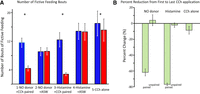
Effects of pairing histamine or NO with a cholinomimetic versus effects of histamine or NO alone. (A) Number of fictive feeding bouts during the first (blue) and last (red) exposure to CCh. Between the first and last exposures to CCh, the cerebral ganglion was exposed to either NO or HA paired with CCh, to NO or HA alone (in ASW), or to CCh alone. Significant changes are marked by an asterisk. (B) Percent change in the number of fictive feeding bouts between the first and last two exposures to CCh (for paired and unpaired exposures to NO and histamine) and to CCh alone. Standard errors are shown in both A and B.
Figure 2 shows representative examples of the recorded responses to CCh alone before and after the bout in which CCh was paired with HA (Fig. 2A), as well as before and after HA was applied unpaired with CCh (Fig. 2B). Fictive feeding bouts occurred before and after the exposure to HA. However, there was a clear reduction in the number of fictive feeding bouts elicited by CCh after pairing, but not when HA was applied unpaired with CCh.
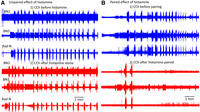
Pairing histamine with a cholinomimetic reduces the response to the cholinomimetic alone. The first (panels 1; blue) and last (panels 2; red) exposures to CCh alone are shown. (A) Between the two exposures to CCh, the cerebral ganglion was treated with HA in ASW. (B) Between the two exposures to CCh alone, the ganglion was treated with CCh paired with HA. (BN2) Buccal nerve 2, (BN3) buccal nerve 3, (Rad N) radula nerve.
Figure 1A shows the mean number of fictive feeding bouts elicited before (blue) and after (red) paired and unpaired applications of the NO donor and histamine, as well the first (blue) and third (red) applications of CCh alone. There were significant reductions in the number of fictive feeding bouts elicited after the NO donor was paired with CCh (from 11.6 ± 4.04 to 4.4 ± 2.82 [SD]; P < 0.0001, t = 7.09, df = 14) and after HA was paired with CCh (from 12.4 ± 7.88 to 2.8 ± 1.78 [SD]; P < 0.0001, t = 5.96, df = 14), but not after the NO donor (from 9.1 ± 3.81 to 9.2 ± 3.37 [SD]; P = 0.878, t = 0.157, df = 10) or HA (from 14.8 ± 7.47 to 14.6 ± 7.79 [SD]; P = 0.55, t = 0.614, df = 10) was applied alone. In addition, there was a small but significant decrease in the number of fictive feeding bouts with the repeated application of CCh alone (from 17.0 ± 9.18 to 15.1 ± 8.21 [SD]; P = 0.045, t = 2.51, df = 6; all tests were two-tailed paired t-tests).
Because the three exposures to CCh alone produced a significant reduction in the response to CCh, it was important to test whether the effects of pairing HA or NO with CCh were different from the effects of the three repetitions of CCh alone. We calculated the percent change in the number of fictive feeding bouts from the first to the last exposure to CCh alone in all five experimental conditions (Fig. 1B) and compared the percent reduction after pairing CCh with the NO donor or with HA versus the percent change on repetition of CCh alone. There were significantly larger reductions in the number of fictive feeding bouts for both pairing with the NO donor (P < 0.0001, t = 7.338, df = 20) and with HA (P < 0.0001; t = 16.84, df = 20) with respect to the reduction for repetition of CCh alone.
Our data show that pairing exposure of the cerebral ganglion to CCh with either an NO donor or HA reduces the response to CCh alone. Taste chemoreceptors use ACh as their transmitter, and these receptors synapse on cerebral ganglion neurons that initiate feeding activity (Susswein et al. 1986). In addition, NO and HA act as though they signal failed attempts to swallow food (Katzoff et al. 2002, 2010). Pairing these transmitters is the equivalent of pairing a food with failed attempts to swallow. The decrease in response to the cholinergic agonist after pairing is the equivalent of a decrease of responses to food after pairing the food with failed attempts to swallow the food. Thus, the pairing constitutes an in vitro analog of learning that food is inedible.
Previous data indicated that aspects of learning that a food is inedible are localized to the buccal ganglia as well as to the cerebral ganglion (McManus et al. 2019; Tam et al. 2020). The data presented above support the notion that the effects of NO and HA on learning that food is inedible are due to their effects within the cerebral ganglion. The data are also consistent with the idea that the component of memory within the cerebral ganglion arises as a result of a postsynaptic decrease in response to ACh. A postsynaptic decrease in response to ACh is also partially responsible for long-term memory of learning in the feeding system of a related gastropod mollusk, Pleurobranchaea (Morielli et al. 1986). However, it is still possible that a site driven polysynaptically by the CCh in either the cerebral or the buccal ganglia decreases its firing when activity is driven after the CCh is paired with NO or HA.
What neurons may release NO and HA in response to failed attempts to swallow food? We suggest that identified neuron C2 may be relevant. C2 is an unconventional mechanoafferent innervating the area just outside and inside the mouth (Weiss et al. 1986a) and would be strongly stimulated by food pressing against the mouth as animals try hard to swallow the food. C2 uses both HA and NO as its transmitters (McCaman and Weinreich 1985; Jacklet 1995). C2 produces slow, conductance-decreasing synaptic effects on its followers (Jacklet and Tieman 2004). Interestingly, preliminary evidence (G Zhang, AJ Susswein, and J Jing, unpubl.) has shown that C2 elicits fast and/or slow synaptic connections to some command-like CBIs (cerebro–buccal interneurons), which receive monosynaptic excitation from the lips (Rosen et al. 1991) and synapse on pattern generator neurons in the buccal ganglia (Hurwitz et al. 2003; Jing et al. 2004; Jing and Weiss 2005; Wu et al. 2014; Zhang et al. 2020). Postsynaptic decreases in sensitivity to ACh in CBIs are a likely mechanism by which pairing NO and HA with ACh operates.
Other than CBIs, C2 is also known to depolarize the serotonergic MCC neuron in the cerebral ganglion (Weiss et al. 1986b), which has a role in preparing the feeding system for action when Aplysia become interested in food (Weiss et al. 1978). However, the MCC is unlikely to have a role in memory after learning that food is inedible, since the animals remain aroused after learning that a food is inedible, and the latency to respond to food is unaffected after learning (Susswein et al. 1986).
Memory is also stored in part within the buccal ganglia (Levitan et al. 2012), specifically at sensorimotor connections between a cluster of mechanoafferents that innervate the interior of the mouth and motor neurons that effect feeding behaviors (Tam et al. 2020). These connections are likely to have a role in biasing feeding to rejection and release of food before animals stop responding to the food (Tam et al. 2020). NO and HA are unlikely to affect changes in behavior while animals attempt and fail to respond to the food. First, training animals while nitrergic transmission is blocked has little or no effect on patterns of feeding behaviors but blocks memory formation (Katzoff et al. 2002). Second, injecting animals with an NO donor and then training them has a minimal effect on behavior while animals learn (Briskin-Luchinsky et al. 2018). Thus, the release of NO and HA in the cerebral ganglion is likely to play a role in the decision to stop responding to food by reducing the response to lip chemoafferents rather than having a role in the changes of feeding behaviors that precede the cessation of responses to inedible food, which are likely to arise in the buccal ganglia.
In summary, by pairing transmitters signaling food with those signaling failed swallow, we have established an in vitro analog of learning that food is edible. This study suggests that the cerebral ganglion is an important site for learning, and the transmitters used for pairing could potentially act on cerebral command-like neurons to produce learning.
Acknowledgments
We thank Dr. Itay Hurwitz for comments on the manuscript. A.J.S. received funding from the U.S.-Israel Binational Science Foundation (grant no. 2017624), the Israel Science Foundation (grant no. 2396/18), and the National Institutes of Health (grant no. 1R01NS118606-01). J.J. received funding from the National Natural Science Foundation of China (grant nos. 32171011, 31861143036, 31671097, and 31371104).
Author contributions: A.J.S. and M.L. planned the experiments in response to preliminary information provided by J.J. M.L. performed the experiments. A.J.S. and M.L. analyzed the data. J.J. revised the manuscript and was key in obtaining funding. A.J.S. prepared the figures and wrote the manuscript.
Footnotes
-
Article is online at http://www.learnmem.org/cgi/doi/10.1101/lm.053867.123.
- Received August 9, 2023.
- Accepted September 13, 2023.
This article is distributed exclusively by Cold Spring Harbor Laboratory Press for the first 12 months after the full-issue publication date (see http://learnmem.cshlp.org/site/misc/terms.xhtml). After 12 months, it is available under a Creative Commons License (Attribution-NonCommercial 4.0 International), as described at http://creativecommons.org/licenses/by-nc/4.0/.