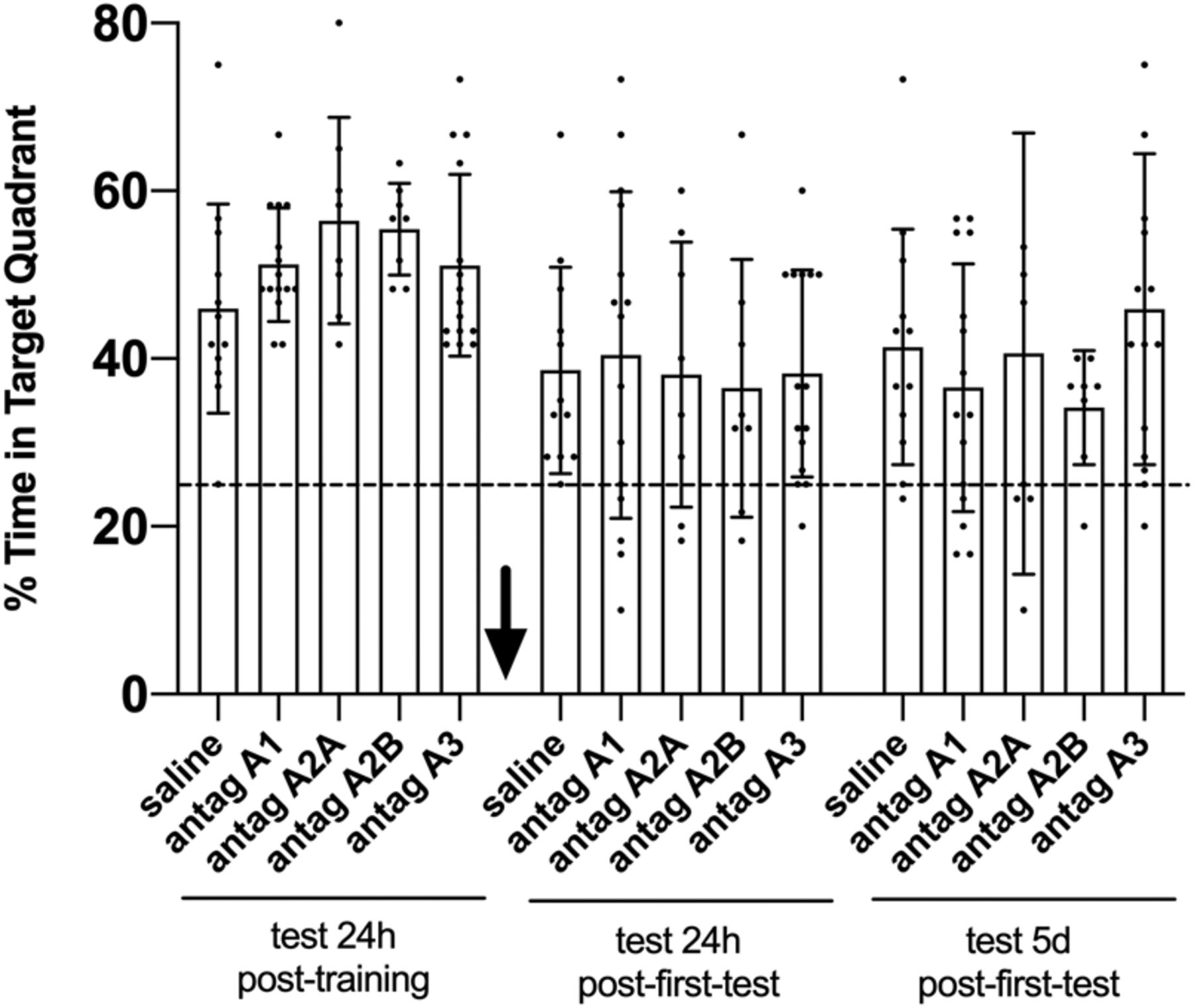
Antagonists of A1, A2A, A2B, and A3 receptors have no effect on spatial memory reconsolidation. Male Wistar rats with infusion cannulas implanted into the CA1 region of the dorsal hippocampus were trained for 5 d in the spatial version of the MWM. Twenty-four hours after the last training session, the animals were subjected to a 60-sec probe test in the absence of the escape platform. Immediately after this first test, the animals received intrahippocampal bilateral infusions (black arrow) of either saline solution (saline) or A1 (antag A1), A2A (antag A2A), A2B (antag A2B), or A3 (antag A3) receptor antagonist (50 nmol for each antagonist). Memory retention was assessed in successive 60-sec probe tests carried out either 24 h or 5 d after the first test. Data are expressed as means (±SD) of the percentage of swimming time spent in the target quadrant. (Dots) Individual value for each rat, (dashed line) theoretical mean of 25% of test time spent in the target quadrant at random. There was no difference between the respective saline groups regarding distinct drug infusion; one-way ANOVA: test 24 h after the first test, F(4,53) = 0.09668; test 5 d after the first test, F(4,53) = 0.8682; Dunnett's posttest; n = 8–15 per group.