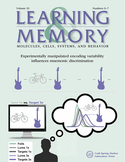
Encoding variability accounts for false recognition of noncorresponding lures on the forced-choice Mnemonic Similarity Task
- Corresponding author: leslie.rollins{at}cnu.edu
Abstract
On forced-choice tests of recognition memory, performance is best when targets are paired with novel foils (A-X), followed by corresponding lures (A-A′), and then noncorresponding lures (A-B′). The current study tested the prediction that encoding variability accounts for reduced performance on A-B′ trials. Young adults (n = 43) completed the forced-choice Mnemonic Similarity Task while eye movements were recorded. Errors on the A-B′ test format were attributable to encoding variability; incorrect A-B′ trials were associated with more fixations to the B stimulus than the A stimulus at encoding. However, encoding variability did not account for accuracy on the A-A′ test format.
Footnotes
-
Article is online at http://www.learnmem.org/cgi/doi/10.1101/lm.049593.119.
- Received March 2, 2019.
- Accepted May 14, 2019.
This article is distributed exclusively by Cold Spring Harbor Laboratory Press for the first 12 months after the full-issue publication date (see http://learnmem.cshlp.org/site/misc/terms.xhtml). After 12 months, it is available under a Creative Commons License (Attribution-NonCommercial 4.0 International), as described at http://creativecommons.org/licenses/by-nc/4.0/.