Predicting memory formation over multiple study episodes
- 1Department of Psychology, University of Cambridge, Cambridge CB2 3EB, United Kingdom
- 2School of Psychology, University of Sussex, Brighton BN1 9QH, United Kingdom
- 3School of Psychology, University of East Anglia, Norwich NR4 7T, United Kingdom
- Corresponding authors: L.Renoult{at}uea.ac.uk
Abstract
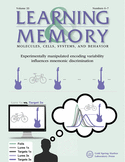
Repeated study typically improves episodic memory performance. Two different types of explanations of this phenomenon have been put forward: (1) reactivating the same representations strengthens and stabilizes memories, or (2) greater encoding variability benefits memory by promoting richer traces. The present experiment directly compared these predictions in a design with multiple repeated study episodes, allowing to dissociate memory for studied items and their context of study. Participants repeatedly encoded names of famous people four times, either in the same task, or in different tasks. During the test phase, an old/new judgment task was used to assess item memory, followed by a source memory judgment about the encoding task. Consistent with predictions from the encoding variability view, encoding stimulus in different contexts resulted in higher item memory. In contrast, consistent with the reactivation view, source memory performance was higher when participants encoded stimuli in the same task repeatedly. Taken together, our findings indicate that encoding variability benefits episodic memory, by increasing the number of items that are recalled. These benefits are however at the expenses of source recollection and memory for details, which are decreased, likely due to interference and generalization across contexts.
Footnotes
-
Article is online at http://www.learnmem.org/cgi/doi/10.1101/lm.049791.119.
- Received April 5, 2019.
- Accepted September 20, 2019.
This article is distributed exclusively by Cold Spring Harbor Laboratory Press for the first 12 months after the full-issue publication date (see http://learnmem.cshlp.org/site/misc/terms.xhtml). After 12 months, it is available under a Creative Commons License (Attribution-NonCommercial 4.0 International), as described at http://creativecommons.org/licenses/by-nc/4.0/.