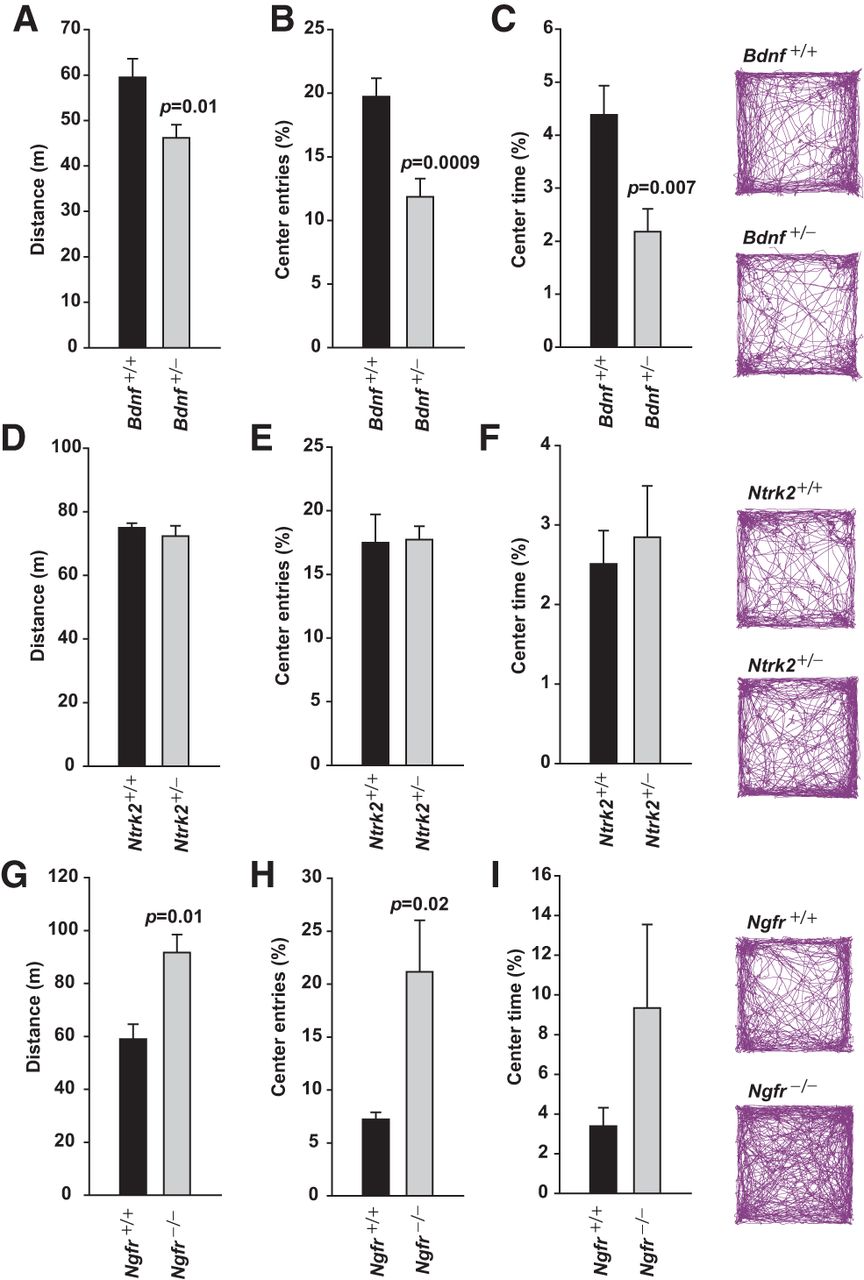
Motor activity is reduced in Bdnf+/− but increased in Ngfr−/− mice. BDNF heterozygotes and wild-type littermates (both n = 8), TrkB heterozygotes and wild-type littermates (n = 5 and n = 4, respectively), and p75NTR knockout and wild-type mice (n = 3 and n = 4, respectively) were tested in the open field test. (A–C) Anxiety-like behavior of BDNF heterozygotes illustrated by reduced (A) distance traveled (P = 0.01), (B) entries into the center of the open field relative to entries into the periphery (P = 0.0009), and (C) time spent in the center (P = 0.007). (D–F) Normal open field behavior of TrkB heterozygotes. (G–I) p75NTR knockouts are hyperactive, showing marked increase in (G) the distance traveled (P = 0.01), (H) entries into the center of the open field relative to entries into the periphery (P = 0.02), and (I) time spent in the center of the open field. Representative track plots are presented to the right.