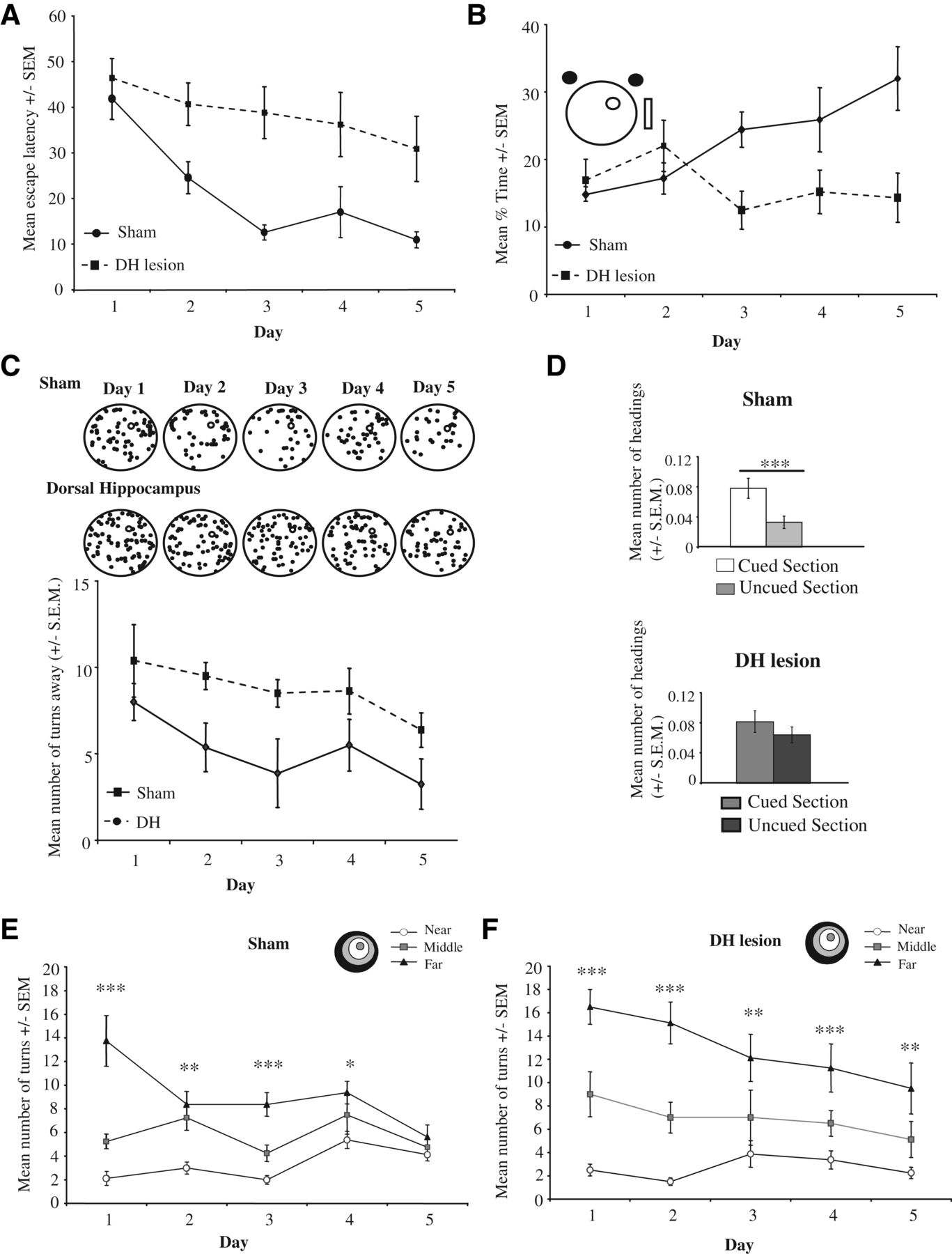
Contribution of the dorsal hippocampus to cue guidance. (A) Mean escape latency for the sham and DH lesioned animals throughout five training days (in Near condition). (B) Mean percentage time spent in direct behavior throughout training for the sham and DH animals. (C) The position of turns away from the cues throughout training for the sham and DH lesioned animals (upper), and the mean number of turns away from the cues across the 5 d for both groups (lower). (D) Mean number of direct behaviors toward either the cued (60°–240°) or uncued (240°–60°) portion of the water maze for the sham (upper) and DH lesioned (lower). (E) Mean number of turns (±SEM) in the Near, Middle, and Far zones during acquisition training in the Sham group with a reduction of turns in the Far zone and an increase of turns in the Near zone as animals learned the task. (Inset) Schematic representation of the three zones used for analysis. (F) Mean number of turns (±SEM) in the Near, Middle, and Far zones during acquisition training for the DH lesioned group.