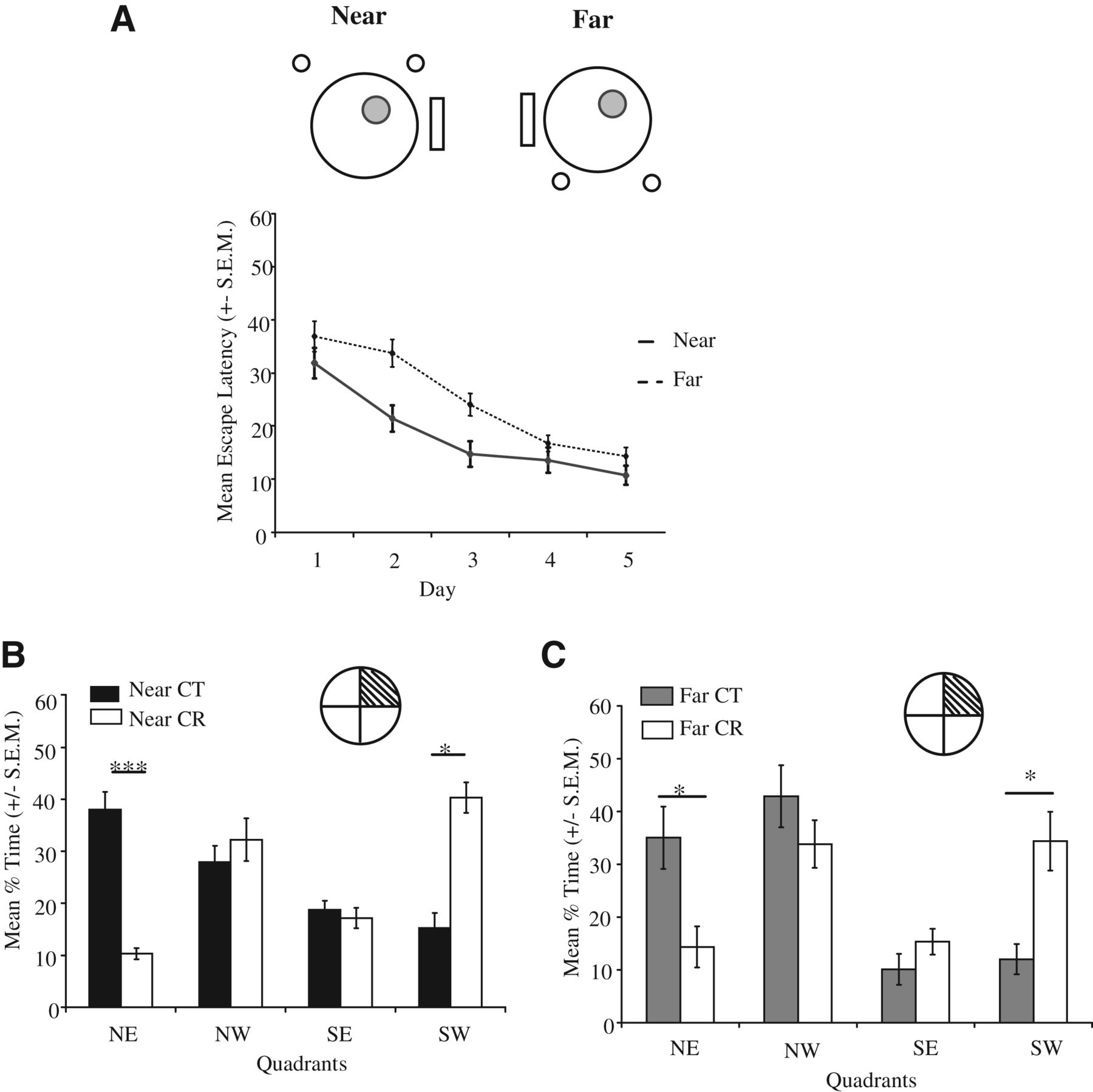
Figure 1.
Animals rely on distal cues irrespective of cue location. (A) Decrease in mean escape latency for both the Near and Far-trained groups. (B) Mean percentage time spent in each of the four quadrants of the water maze during the 60-sec retention trial for the Near-control (CT) and Near cue-rotated groups (CR). (C) Mean percentage time in each quadrant of the maze during the retention trial for the Far control (CT) and Far cue-rotated groups (CR). Note, in all conditions animals were put in at the northwest (NW) quadrant, accounting for the high percentage time spent in this quadrant.