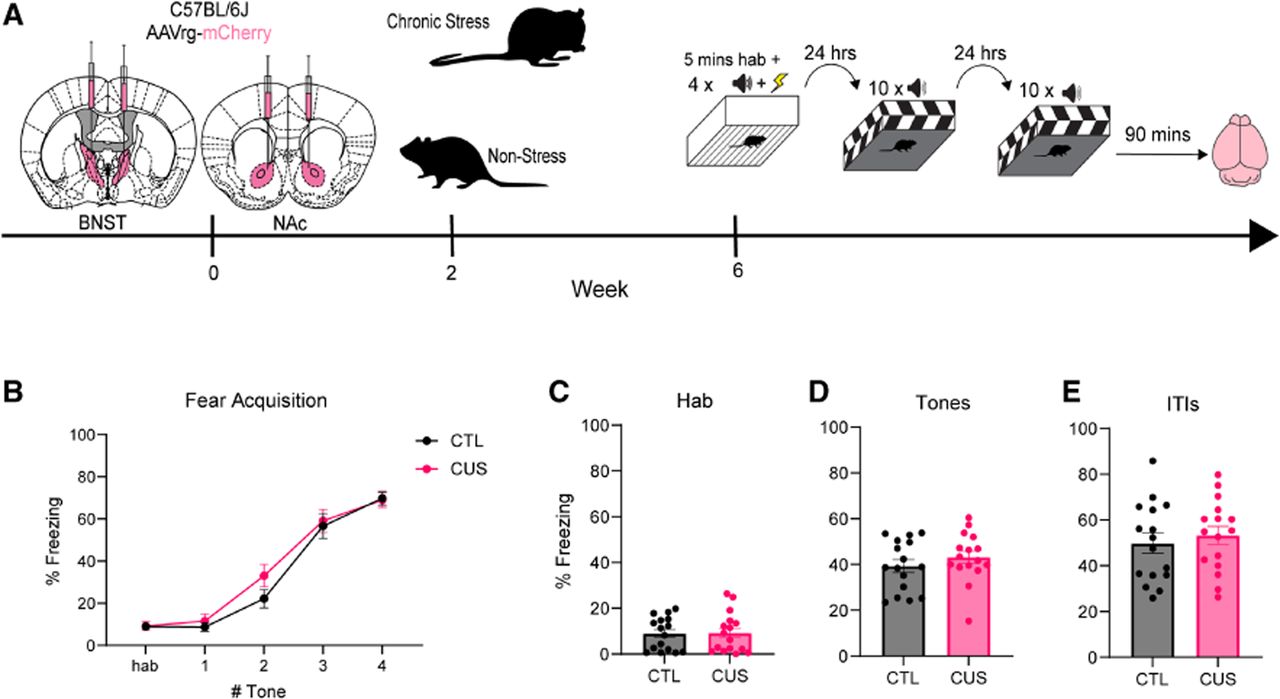
Chronic unpredictable stress does not affect fear acquisition. (A) Experimental time line of the fear conditioning paradigm. Mice (N = 32) were randomly assigned to either 4 weeks of chronic unpredictable stress (CUS) or nonstress (CTL) groups. After 4 weeks of CUS protocol, all mice underwent fear conditioning followed by 2 days of extinction protocols. N = 16 mice underwent surgeries prior to the behavioral paradigms to retrogradely label projection-specific neurons (either BNST or NAc) in the BLA. Mice were sacrificed 90 min after the final extinction session for subsequent analyses. (B) Average percent freezing (±SEM) during tone presentations on the fear acquisition day. Freezing increased with repeated tone-shock presentations but was not impacted by previous CUS exposure (two-way repeated-measures ANOVA: tones: F(2.745,82.34) = 123.7, P < 0.0001; stress: F(1,30) = 0.8169, P = 0.3733; tone × stress: F(2.745,82.34) = 0.8553, P = 0.4593). (C) Average freezing during habituation was not impacted by CUS (Mann–Whitney test, U = 125, P = 0.9260). (D) Average freezing during exposure to the tone cue did not differ between groups (unpaired t-test, t(30) = 0.9872, P = 0.3314). (E) Average freezing during intertrial intervals (ITIs) did not differ between groups (unpaired t-test, t(30) = 0.5957, P = 0.5559). Bars are plotted as mean ± SEM. (*) P < 0.05.