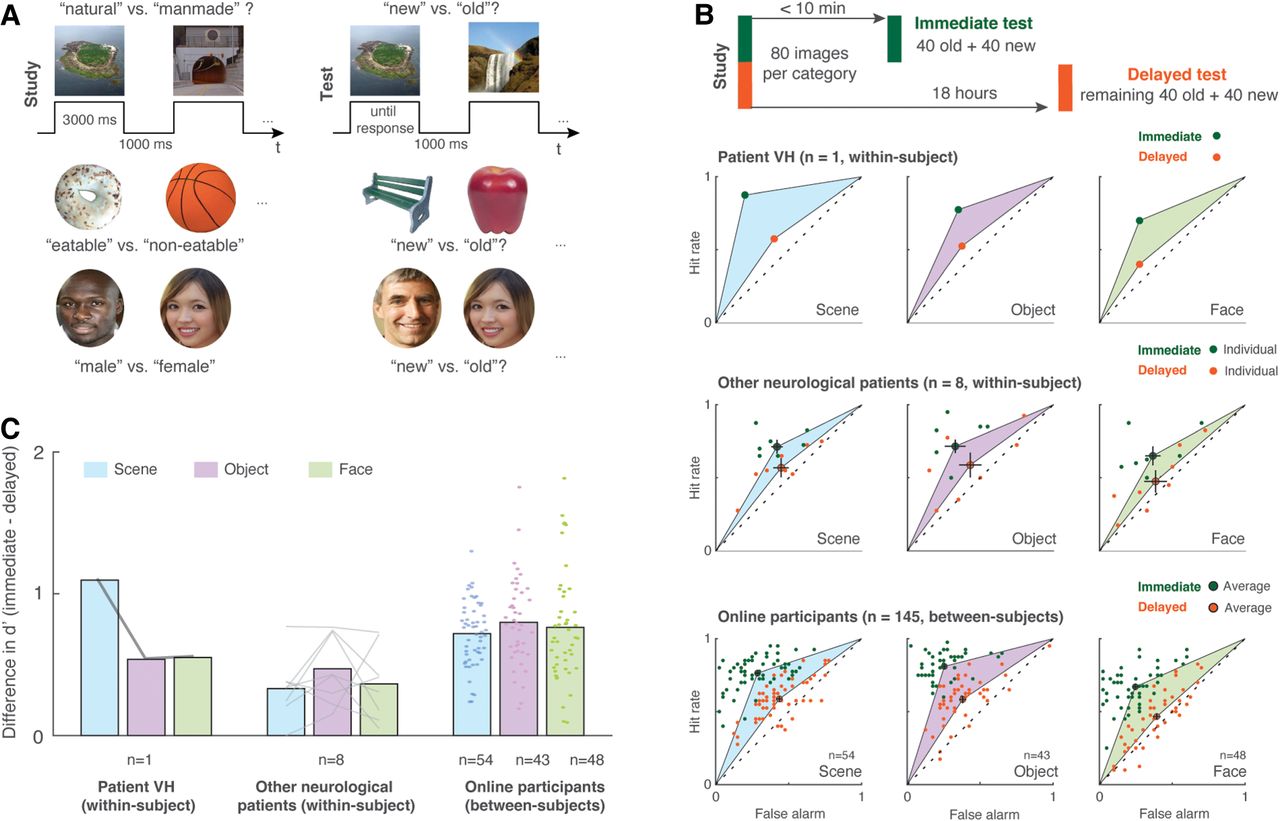
Patient VH shows greater forgetting of scene memory after an overnight delay. (A) During the 12-month follow-up, VH completed a recognition memory test using images of scenes, objects, and faces. For each category, he studied 80 unique exemplar images, during which he answered a stimulus-related question to ensure his engagement (e.g., natural vs. manmade for scenes). Afterward, half of the study images were tested immediately (green) and another half were tested after an 18 h delay (orange). Similar tests were conducted on neurological patients and online participants. (B) Each participant's performance (i.e., hit and false alarm rates, un-circled dots) is shown with averages (circled dots) and standard errors (i.e., horizontal and vertical error bars). The area between the hit rate and false alarm rate contours of the immediate and delayed tests captures the amount of forgetting between these two testing time points. (C) VH's scene memory declined significantly, while object and face memory remained stable. Other participants did not show this pattern. Each line or data point represents the result from one participant. The face photographs in this figure (also in Fig. 4) are sourced from the public domain under Creative Commons noncommercial licenses.