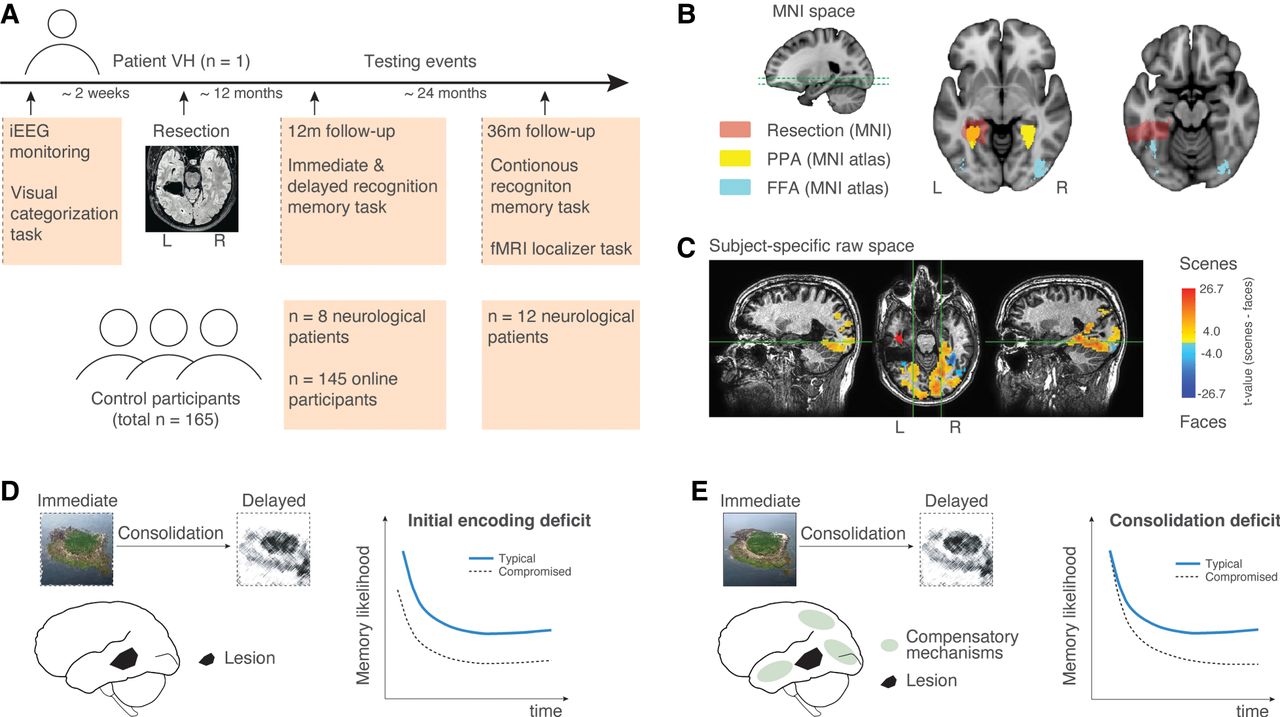
Design and predictions for the current case-control study. (A) Patient VH underwent a surgical trial for epilepsy, involving intracranial electrode implantation for seizure monitoring. VH completed a visual task during monitoring (see Fig. 2 for details). Following clinical evaluation, surgery removed posterior medial temporal lobe tissue. VH later participated in memory tasks at the 12-month (see Fig. 3) and 36-month (see Fig. 4) follow-ups using diverse visual stimuli. We tested 165 controls to assess VH's memory performance compared to other neurological patients or online participants. (B) VH's lesion (marked in pink) overlaps with the conventional PPA (marked in yellow) identified based on a probabilistic functional atlas from the previous research (Rosenke et al. 2021). In contrast, VH's lesion barely overlaps with the conventional FFA in the more posterior side (marked in teal). All regional masks are normalized to the MNI space for visualization and comparison. (C) Selectivity for scenes and faces in VH's brain following resection at 36-month follow-up revealed by fMRI. t-maps resulting from the generalized linear model contrast faces > scenes are overlaid on the anatomical volume and thresholded at t ± 4.0. Note that selectivity for scenes extends throughout the anterior parahippocampal gyrus in the intact right hemisphere, but the corresponding anterior portion is absent in the left hemisphere due to the lesion. (D) VH's lesions in PPA may lead to a generalized deficit in processing scene images during initial perception, leading to an overall reduction in subsequent memory performance. (E) Alternatively, compensatory mechanisms from other brain areas might facilitate initial encoding, while PPA damage primarily disrupts the reactivation of specific neocortical regions essential for long-term consolidation of scene memories. As such, emerging deficits might become more pronounced during the consolidation phase, potentially leaving initial encoding minimally affected.