Cover image
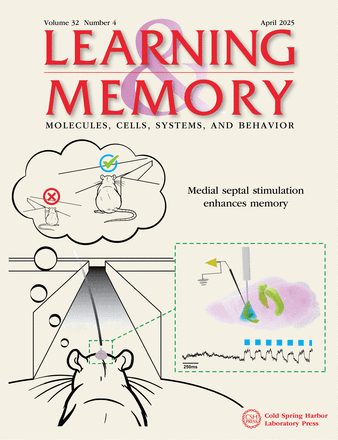
In this issue, Gemzik and Griffin (LearnMem a054075.124) investigate the role of the medial septal area (MSA) of the hippocampus in spatial working memory in rat by optogenetically stimulating MSA at theta (6 Hz) frequency during the delay period of a spatial working memory dependent delayed alternation task in a T-maze. The rat is shown waiting for the next trial to begin. The thought bubble represents the two possible upcoming goal arm choices, one that will result in reward (green check mark) and one that will result in no reward (red x). (Inset) Transparent model of a rat brain showing the MSA and hippocampus (light green). The MSA is implanted with a fiber optic and recording electrode. MSA theta stimulation (blue dashes) induces a 6 Hz oscillation in the MSA local field potential after injection of a viral vector containing the light-sensitive channel, channelrhodopsin.