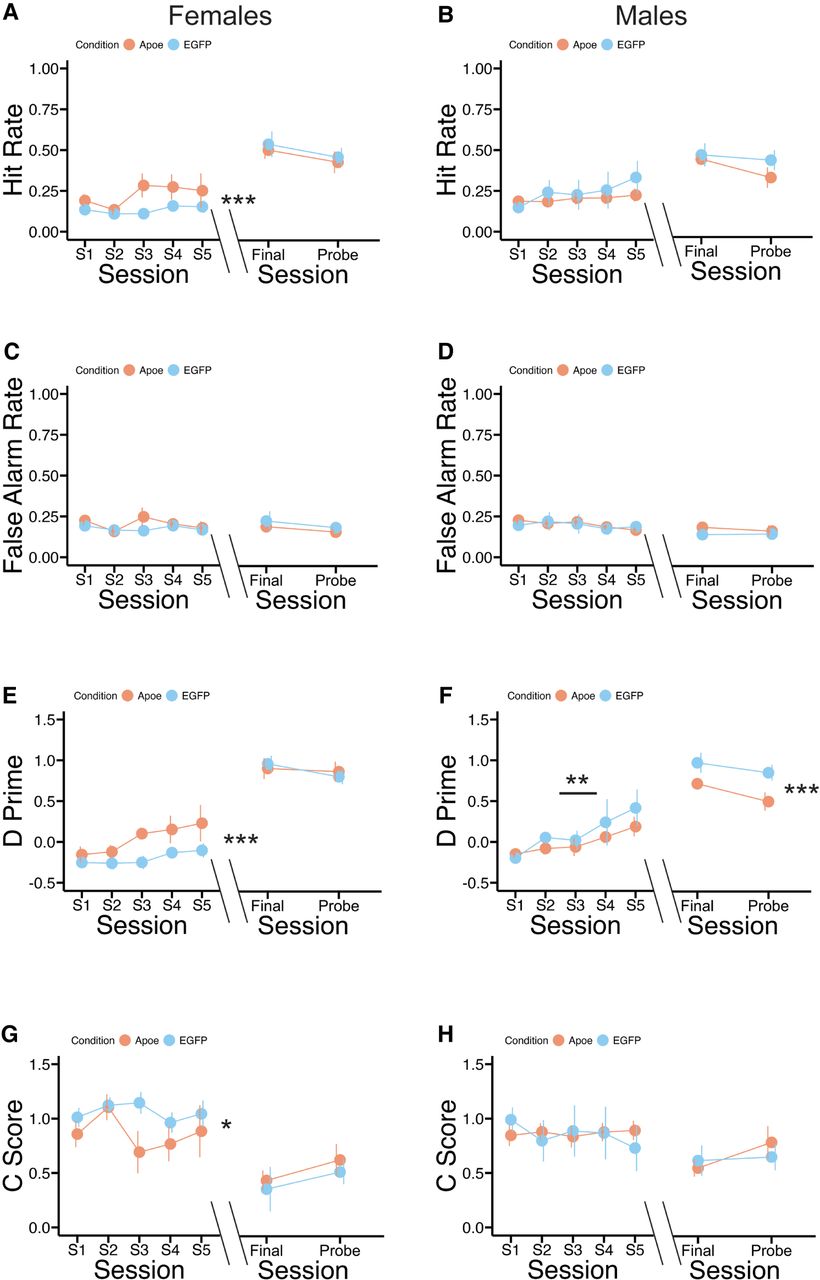
Performance metrics for rCPT learning and performance. (A) Hit rate significantly differed between groups during rCPT learning in females (F(1,1) = 7.689, P = 0.00739, main effect of group); in contrast, hit rate did not significantly differ between session or group during asymptotic stage 3 performance and the probe session in females. (B) Hit rate did not differ significantly between sessions or groups during rCPT learning or asymptotic performance in males. (C,D) False alarm rate did not differ significantly between sessions or groups during rCPT learning or asymptotic performance in females (C) or males (D). (E) D′ was significantly higher in Apoe mice compared with controls during rCPT learning in females (F(1,1) = 11.308, P = 0.00135, main effect of group), but not between the final stage 3 and probe sessions. (F) D′ significantly increased across sessions during rCPT learning in males, regardless of group (F(1,4) = 3.472, P = 0.0129, the main effect of session), but was significantly lower in Apoe mice compared to controls during the final stage 3 and probe sessions (F(1,1) = 9.881, P = 0.0044, main effect of group). (G) C score was significantly lower in Apoe mice compared to controls during rCPT learning in females, indicating a more liberal response bias (F(1,1) = 4.902, P = 0.0306, main effect of group), whereas c score did not significantly differ between groups during the final stage 3 and probe sessions in females. (H) C score did not differ significantly between sessions or groups during rCPT learning or asymptotic performance in males. Error bars represent the standard error of the mean.