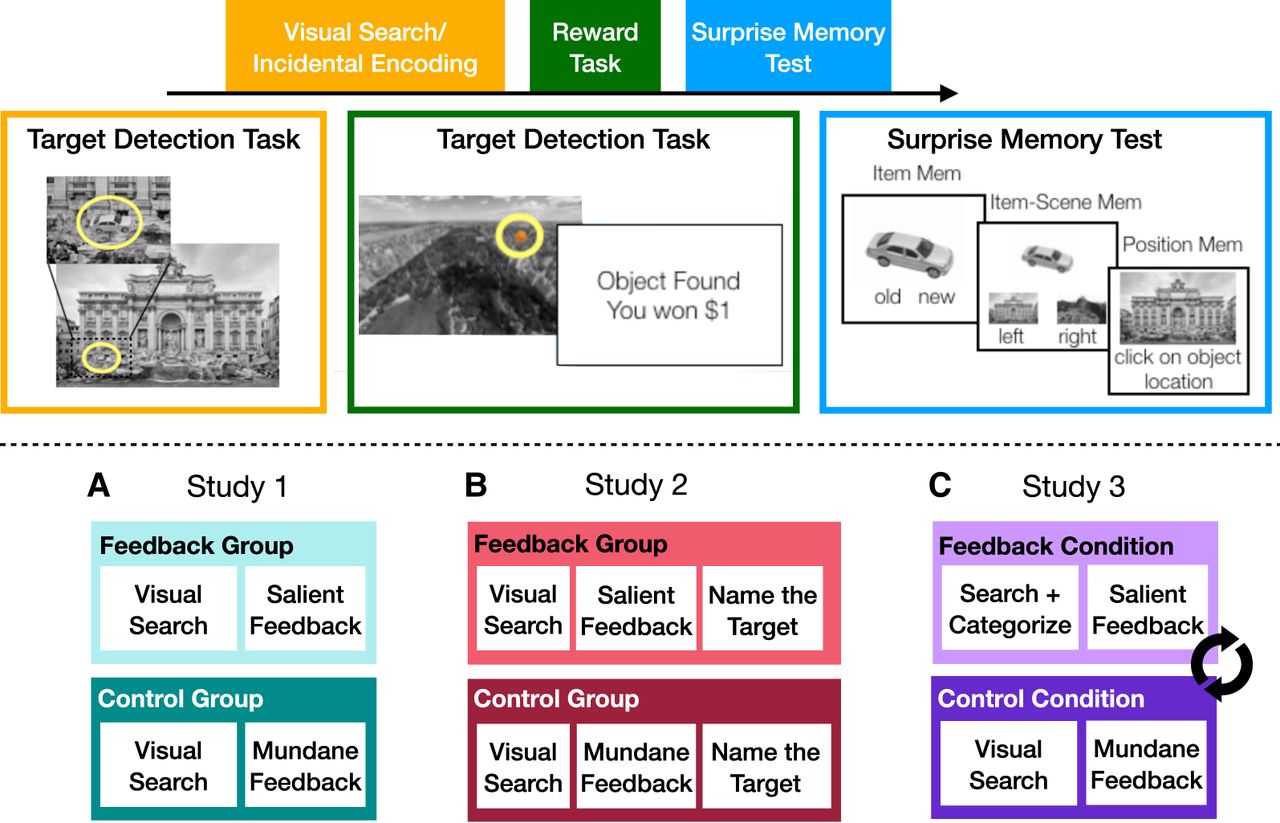
Task design. Across three experiments, participants completed a three-part study. During part 1, participants completed a “training phase” of a target detection task in which they had to visually search and find target items hidden in a complex scene. This target detection task served as an implicit encoding phase, as we later tested memory for target items and their associated contexts. In the next phase, participants completed three trials of a reward version of the task, to help with our condition manipulations in the first phase. Memory was not tested for items in this session. Finally, participants completed a surprise memory test for items, item–scene associations, and item position within the scene from the “training phase.” (A) In study 1, we used a between-subjects design, where the Feedback group was given more salient feedback on their target detection performance compared to the Control group. (B) In study 2, we modified the instructions of study 1, wherein both groups had to semantically elaborate on the target by naming the identity of the target image, although feedback was only given about visual search performance. In study 3, we used a within-subjects design where they performed a block of the Feedback and Control condition, counterbalanced across participants. (C) In study 3, we again changed the instructions such that individuals had to categorize the hidden item to indicate they found them, thus feedback was based on a combination of visual search and semantic elaboration.