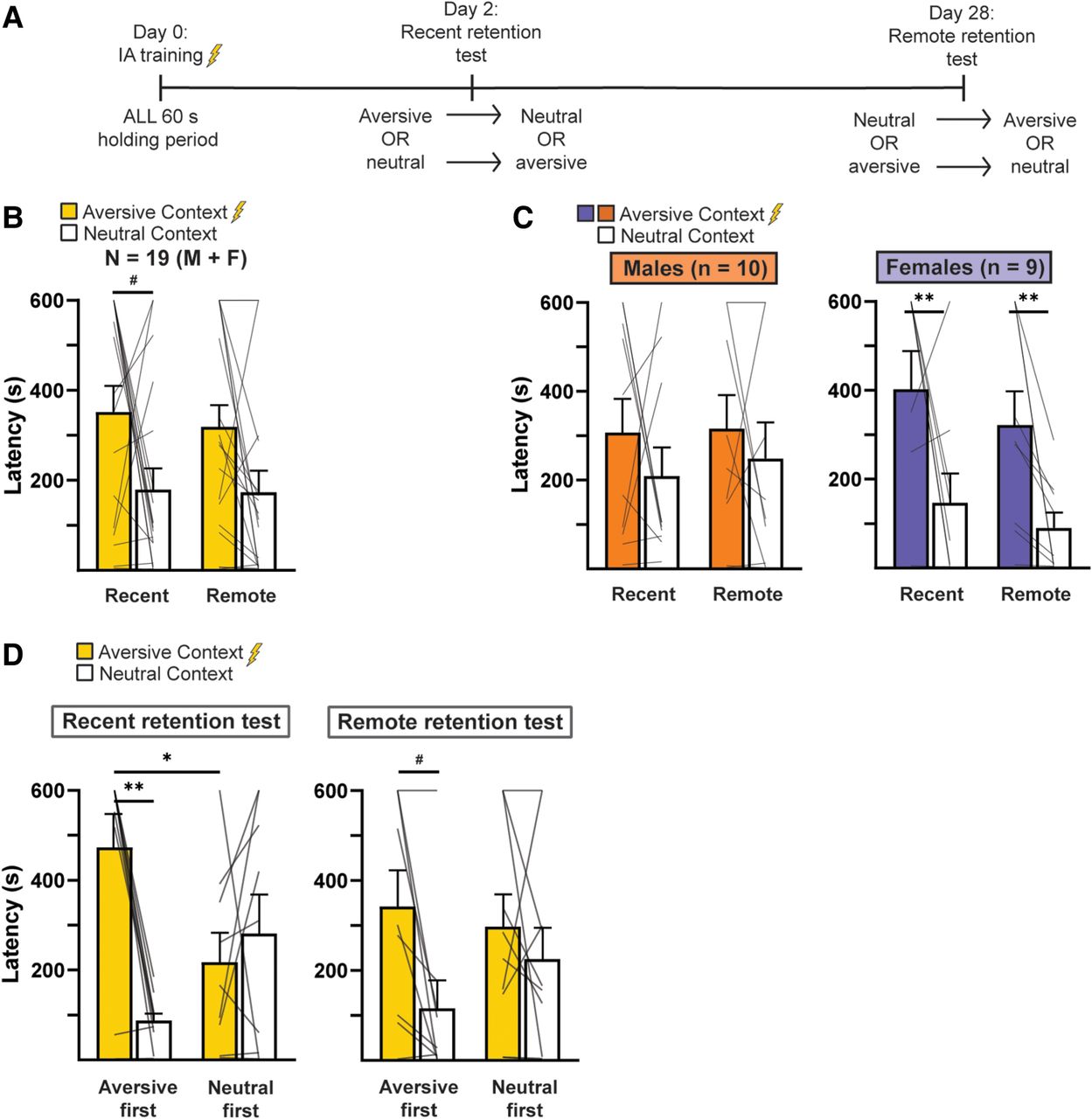
IA testing in both chambers on the same day resulted in significant testing order effects. (A) Experimental timeline. Rats underwent IA training (all with the 60 sec condition) and were then tested in each chamber on the same day at recent and remote time points. (B) Rats demonstrated a nonsignificant trend toward discrimination in the recent retention test and did not discriminate at the remote retention test. (C, left) Male rats did not discriminate at either time point. (Right) Female rats discriminated at both recent and remote time points. (D, left) At the recent retention test, rats discriminated when tested in the aversive chamber first and generalized when tested in the neutral chamber first. Additionally, rats tested in the aversive chamber first showed significantly higher aversive context latencies (i.e., memory strength) than those tested in the neutral chamber first. (Right) At the remote retention test, rats tested in the aversive chamber first showed a trend toward discrimination that was not present in rats tested in the neutral chamber first. (#) P < 0.1, (*) P < 0.05, (**) P < 0.01.