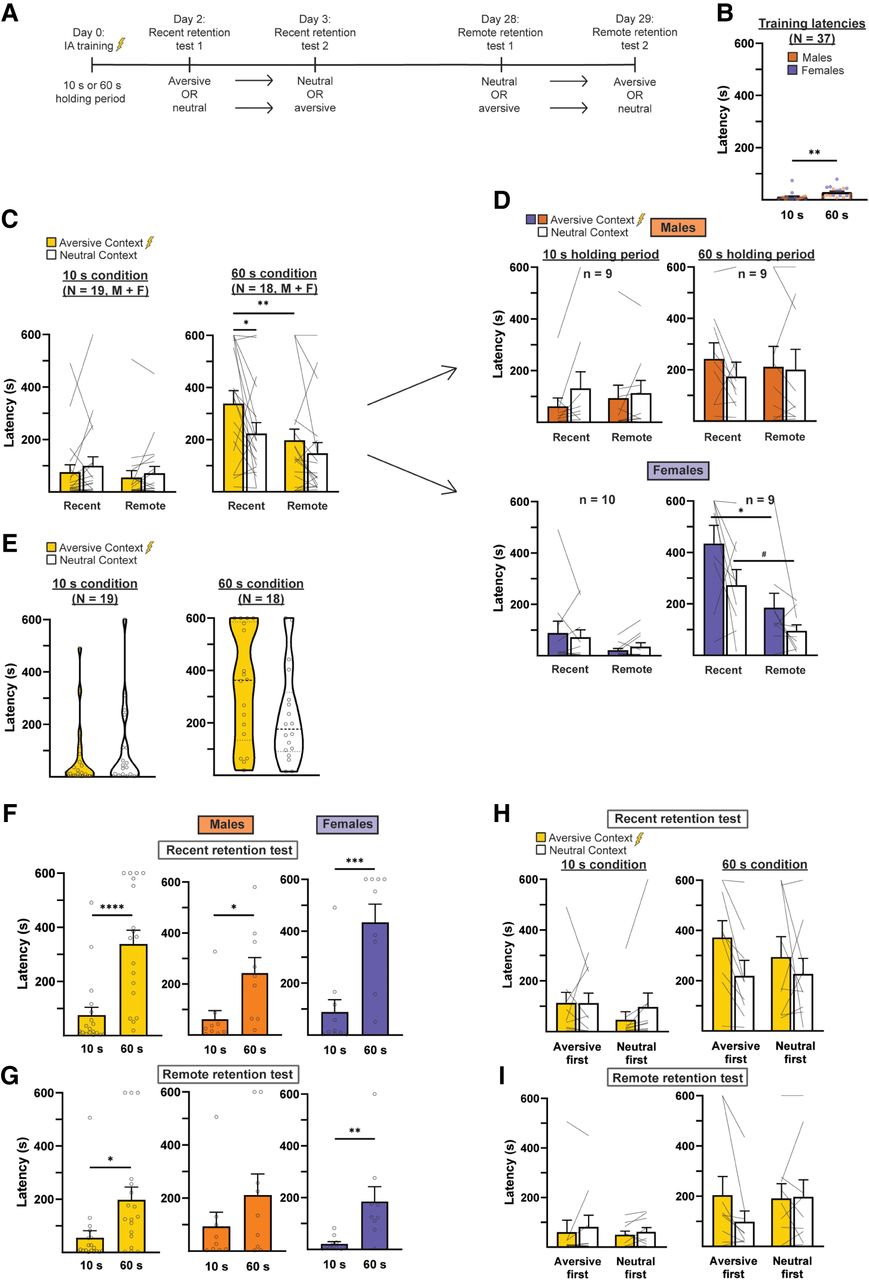
The 60 sec holding period, compared to a 10 sec holding period, increased memory strength at both recent and remote retention tests and promoted memory discrimination at the recent retention test. (A) Experimental timeline. Rats underwent IA training while being retained for either 10 or 60 sec in the lit compartment before the door was retracted. Rats were then tested at recent and remote retention tests in each chamber. (B) Rats in the 60 sec condition showed significantly longer training latencies compared to rats in the 10 sec condition. (C, left) Rats in the 10 sec condition did not discriminate at either time point. (Right) Rats in the 60 sec condition discriminated at the recent retention test and generalized at the remote retention test, with a significant reduction in aversive context latencies (i.e., memory strength) between recent and remote retention tests. (D, top left and right) Male rats in the 10 and 60 sec conditions, respectively, did not discriminate at either time point. (Bottom left and right) Female rats in either condition did not discriminate at either time point. However, female rats in the 60 sec condition displayed a significant reduction in memory strength from the recent to the remote test, as well as a trend toward a reduction in neutral context latencies from the recent to remote test. (E) Violin plots illustrating the skewness in the 10 sec condition (left) and 60 sec condition (left) at the recent retention test (i.e., same data as C, but in a different format to specifically show skew). (F, left) Rats had higher aversive context latencies (i.e., memory strength) in the 60 sec condition compared to the 10 sec condition at the recent retention test. Male (middle) and female (right) rats had higher aversive context latencies in the 60 sec condition compared to the 10 sec condition at the recent retention test. (G, left) Rats had higher aversive context latencies (i.e., memory strength) in the 60 sec condition compared to the 10 sec condition at the remote retention test. However, only female rats showed higher aversive context latencies in the 60 sec condition compared to the 10 sec condition at the remote test (right). (H) Testing order had no effect on retention latencies in either holding condition at the recent retention test. (I) Testing order had no effect on retention latencies in either holding condition at the remote retention test. (*) P < 0.05, (**) P < 0.01, (***) P < 0.001, (****) P < 0.0001.