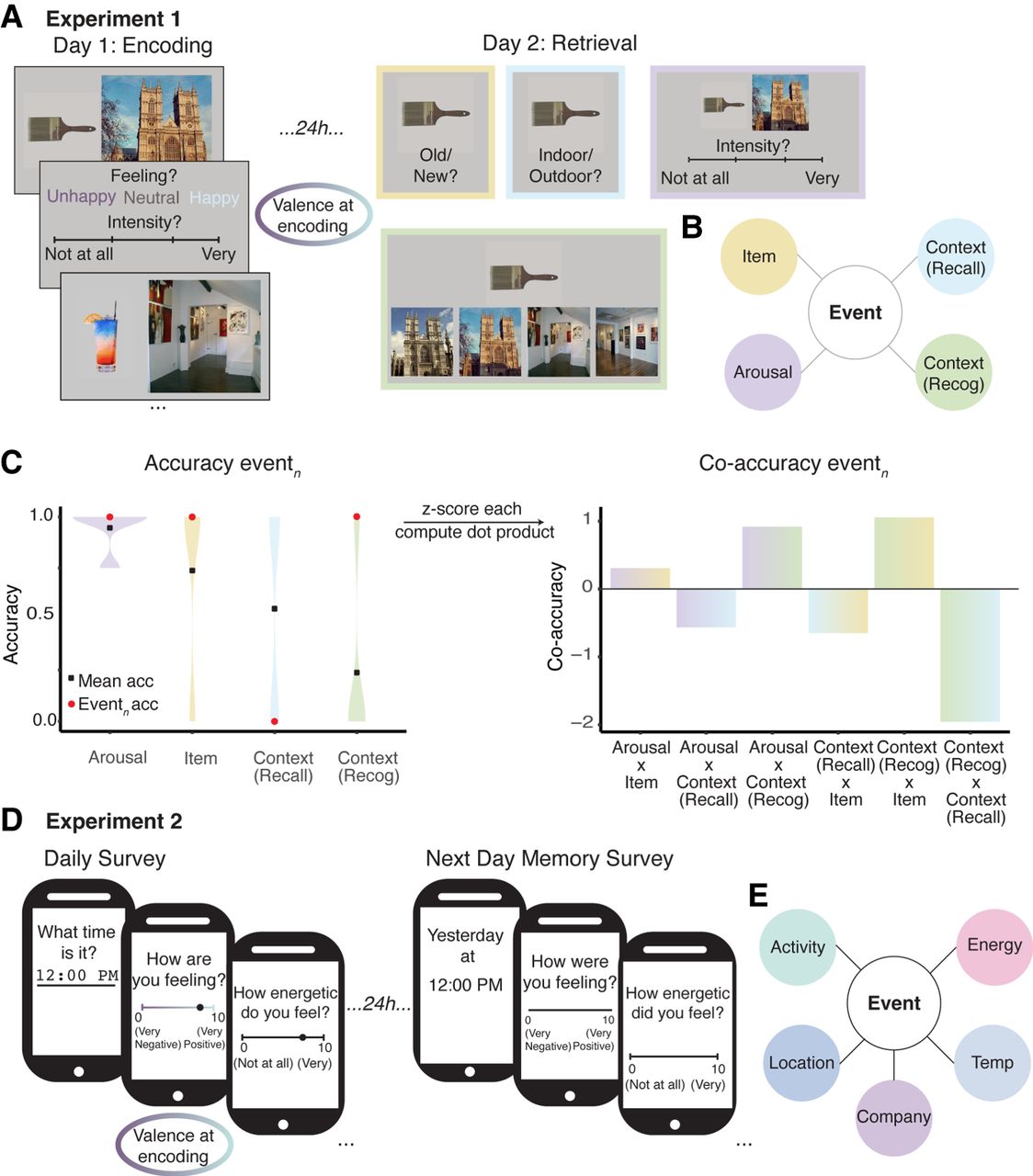
Experimental design and memory quantification. (A) In-lab memory design (Experiment 1). During encoding, participants viewed a set of 80 unique object/scene pairs. The next day, they were tested on their memory for these pairs (for exact questions, see Table 1). (B) Schematic of multifeature memory structure for Experiment 1. (C) Example of co-accuracy computation. (Left) Example distributions of a participant's accuracy scores per event feature across all trials. Squares indicate participant mean; dots indicate accuracy score on example trial. Accuracy scores, for example event n, were z-scored according to the participant's average accuracy score for the construct. (Right) We then computed the dot product per feature pair to determine element-wise co-accuracy. As shown in this example, an event could have a high co-accuracy score both when participants accurately remembered both features, and when participants forgot both. (D) Real-world memory design (Experiment 2). During encoding, participants received randomly timed prompts asking them to record the current time, their current emotional state, and aspects of their day at the current moment (for exact questions, see Table 2). The next morning, they were cued with the times from the encoding surveys and asked to remember each aspect of that event using the same questions as encoding. (E) Schematic of multifeature memory structure for Experiment 2.