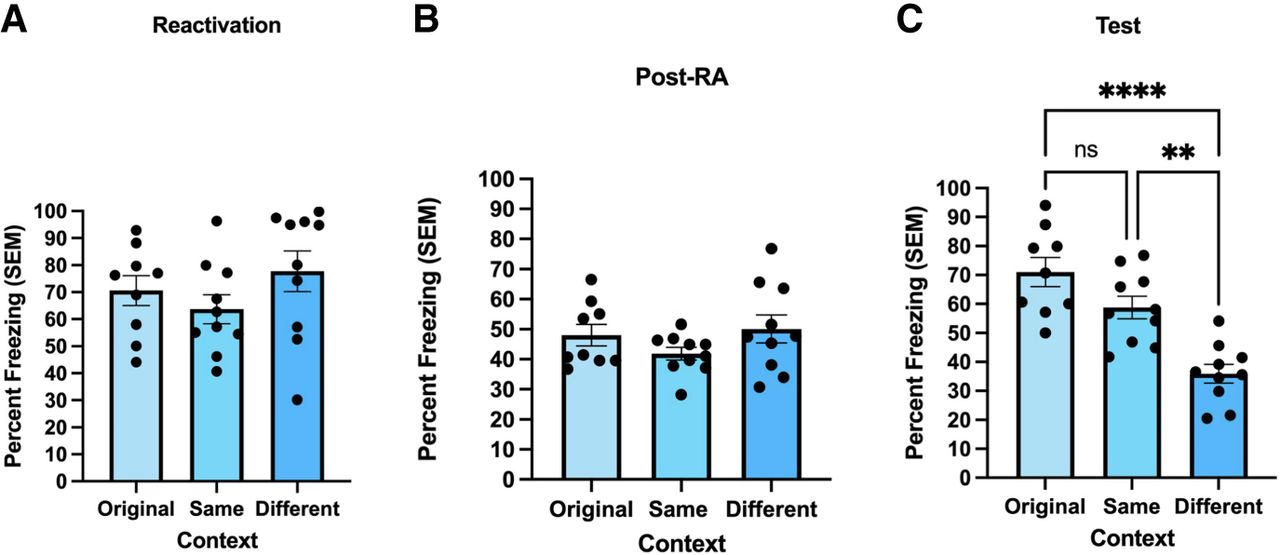
Contextual fear transfers to an alternate context when the alternate contextual information is introduced following reexposure to the training context. (A) During the reactivation session, freezing levels did not differ between the three groups. Freezing behavior was measured as percent freezing (±SEM) across a 90 sec reactivation session. (B) There were also no differences in post-reactivation (Post-RA) context freezing. Freezing behavior was measured as percent freezing (±SEM) across an 8 min post-reactivation session in the alternate contexts. (C) In the test session, rats exposed to the same alternate context as the post-RA session (Same) froze significantly more than those tested in the different alternate context (Different). Same alternate context rats also froze similarly to the rats that were tested in the original fear conditioning chamber (Original). Freezing behavior (n = 9 per group for “Original” condition and n = 10 per group for “Same” and “Different” conditions) was measured as percent freezing (±SEM) across an 8 min test session. (****) P < 0.0001, (**) P < 0.01.