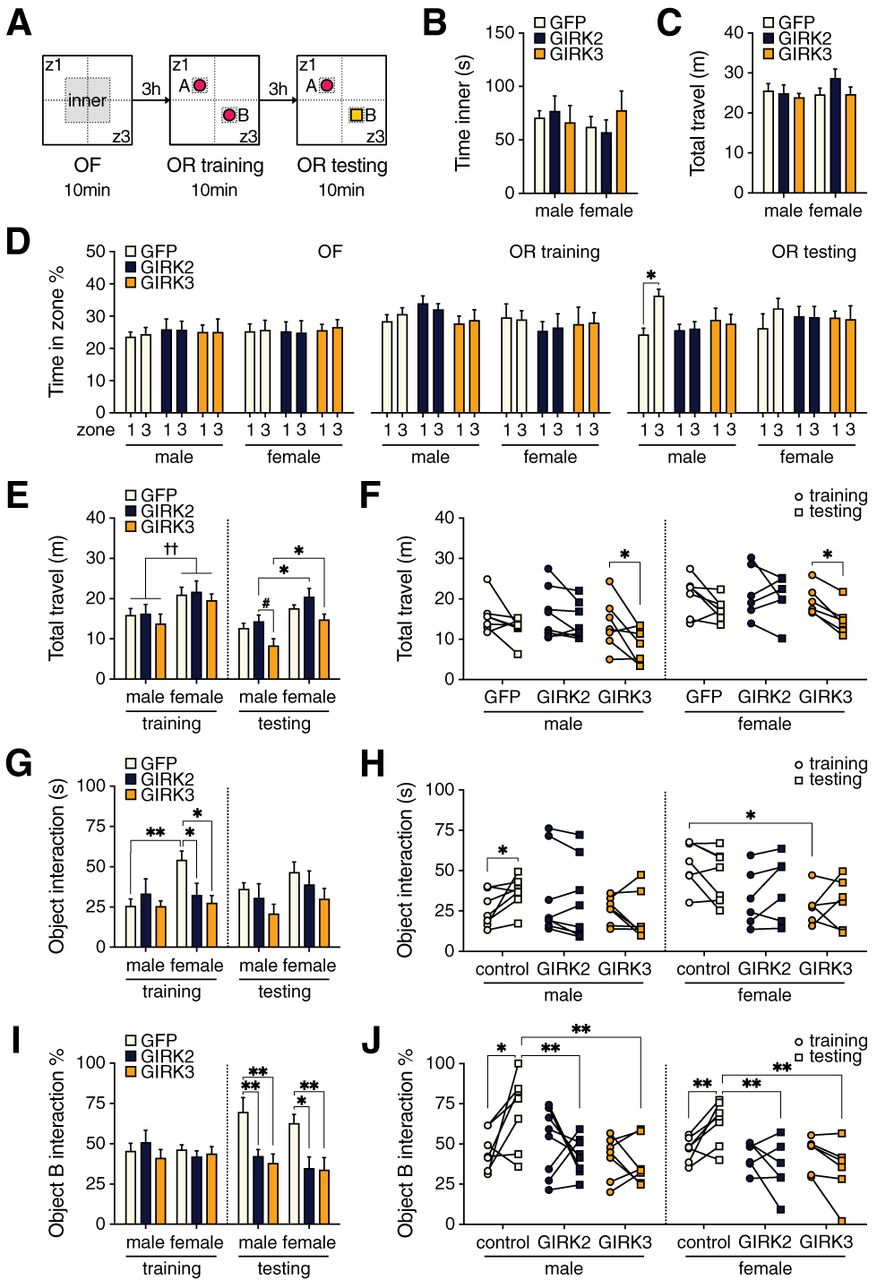
Enhancement or suppression of GIRK channel activity disrupts novel OR. (A) Depiction of OF and OR tests. Mice were placed in an OF (40 × 40 cm white plastic box) illuminated by cool white LED lights (70–90 LUX, 4000 K). Total distance traveled and time spent in the field center (20 × 20 cm) were tracked by ANY-maze software during the 10 min session. Mice were returned to their home cage for 3 h after the OF session. For OR, mice were returned to the OF which now contained two identical objects: 50 mL conical tubes filled with a pink solution and positioned diagonally with cap down at standardized positions A and B. Subjects were allowed to explore the environment during the 10 min training session. Orientation of the mouse head toward an object and within 2 cm of the object was considered as object interaction; total interaction time was recorded for each object during training, along with distance traveled. Mice were then returned to their home cage for 3 h, after which they were placed back in the OF which now contained one familiar object (point A) and one novel object, a 25 cm culture flask containing a yellow solution with cap up (point B). Total distance traveled, along with object interaction times, were measured during the 10 min testing session. The percentage of time spent interacting with the object at position B was compared across groups. Only subjects exhibiting >10 sec total object interaction times during training and testing sessions were included in E–J: 4/11 males treated with the control vector were excluded based on this criterion. (B) Time spent in the center of the OF environment during OF. (C) Total distance traveled during OF. (D) Percentage of time spent in quadrant/zone 1 and zone 3 during the OF test (left), as well as during the OR training (middle) and testing (right) sessions. Symbols (Tukey's multiple comparisons): (*) P < 0.05. (E) Total distance traveled during the OR training ([††] P < 0.01; main effect of sex) and testing sessions. Symbols (Šídák's multiple comparisons): (*) P < 0.05 (within treatment); (#) P < 0.05 (within sex). (F) Total distance traveled across OR training and testing sessions in male and female mice. Symbols (Šídák's multiple comparisons): (*) P < 0.05 (within treatment). (G) Total object interaction time during OR training (Šídák's multiple comparisons: [*] P < 0.05, [**] P < 0.01) and testing session. (H) Total object interaction time across OR sessions in male (Tukey's multiple comparisons: [*] P < 0.05) and female (Šídák's multiple comparisons: [*] P < 0.05, within session) mice. (I) Percentage of time spent interacting with the object at position B relative to total object interaction time during OR training and testing sessions. Symbols (Tukey's multiple comparisons): (*) P < 0.05, (**) P < 0.01 (within sex). (J) Percentage of time spent interacting with the object at position B across OR sessions in male (Tukey's multiple comparisons: [*] P < 0.05, [**] P < 0.01) and female (Tukey's multiple comparisons: [**] P < 0.01) mice.