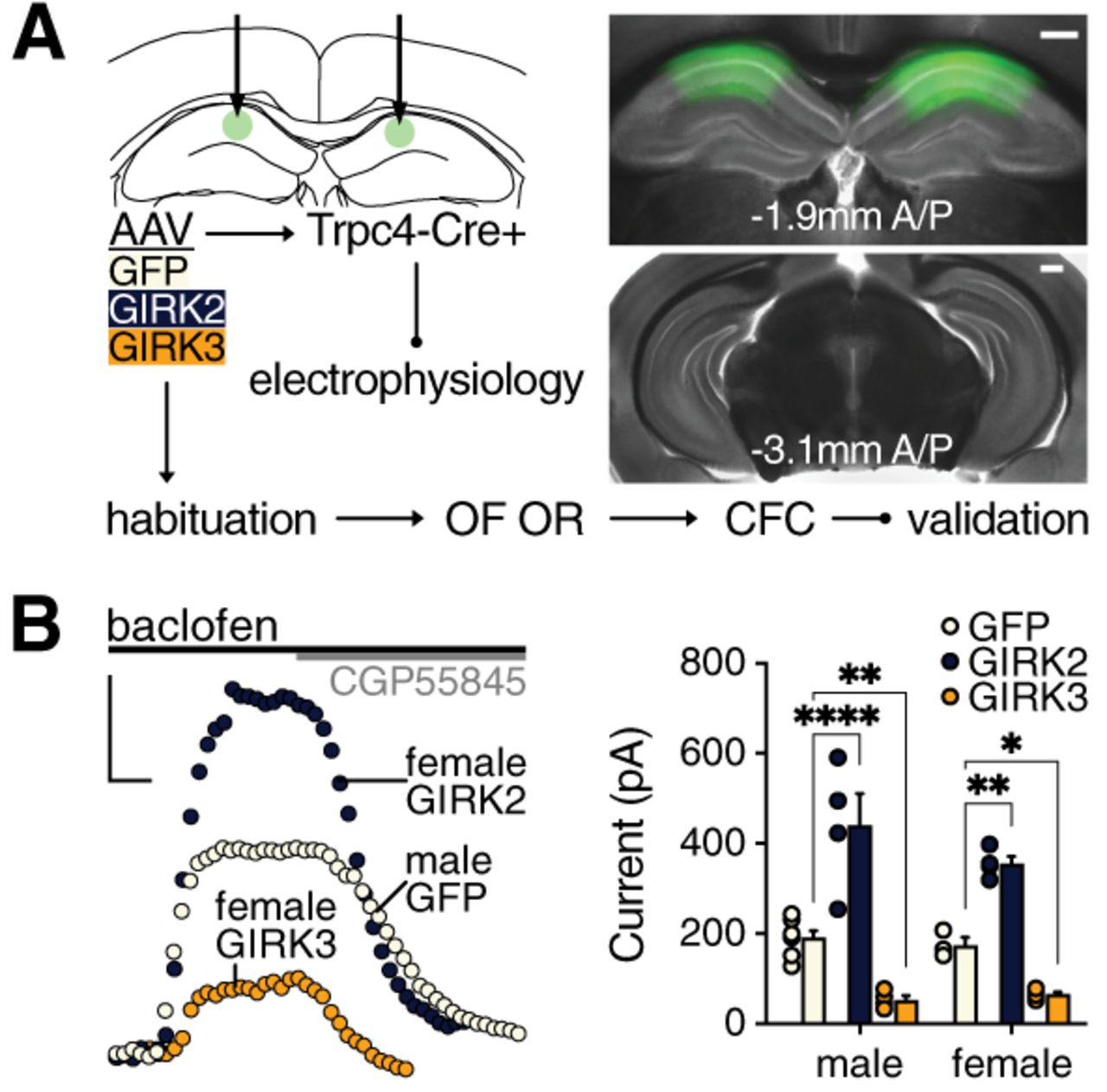
Bidirectional manipulation of GIRK channel activity in dorsal CA1 pyramidal neurons. (A) Depiction of the experimental timeline. Trpc4-Cre(+) mice received intra-dCA1 infusions of high titer (1 × 10¹² genocopies/mL) AAV8-hSyn-DIO-GFP (control), AAV8-hSyn-DIO-GIRK2-IRES-GFP, or AAV8-hSyn-DIO-GIRK3-IRES-GFP. The scope and accuracy of viral targeting were evaluated for all animals after behavioral testing (validation). Images on the right show bilateral viral-driven GFP expression in the dorsal (–1.90 mm A/P) but not ventral (−3.10 mm A/P) CA1 of a male Trpc4-Cre+ mouse injected with the GFP control vector; scale, 500 µm. Only mice showing bilateral GFP expression in the dCA1 were included in the final analysis. In total, 26 male (11 GFP/control, 8 GIRK2, and 7 GIRK3) and 19 female (7 GFP/control, 6 GIRK2, and 6 GIRK3) mice were included in the final data sets. (B) Whole-cell currents (Vhold = −60 mV) evoked by the GABABR agonist baclofen (200 µM), and their reversal by the GABABR-selective antagonist CGP55845 (2 µM), in GFP-expressing pyramidal neurons from Trpc4-Cre+ mice injected with GFP control, GIRK2, or GIRK3 vectors; scale, 100 pA/50 sec. The bar graph on the right summarizes baclofen-evoked currents in dorsal CA1 pyramidal neurons from male GFP/control (n = 7), GIRK2 (n = 4), GIRK3 (n = 4), and female GFP/control (n = 3), GIRK2 (n = 4), and GIRK3 (n = 5) viral treatment groups. Data are presented as mean ± SEM. Symbols (Dunnett's multiple comparisons): (*) P < 0.05, (**) P < 0.01, (****) P < 0.0001 (within sex).