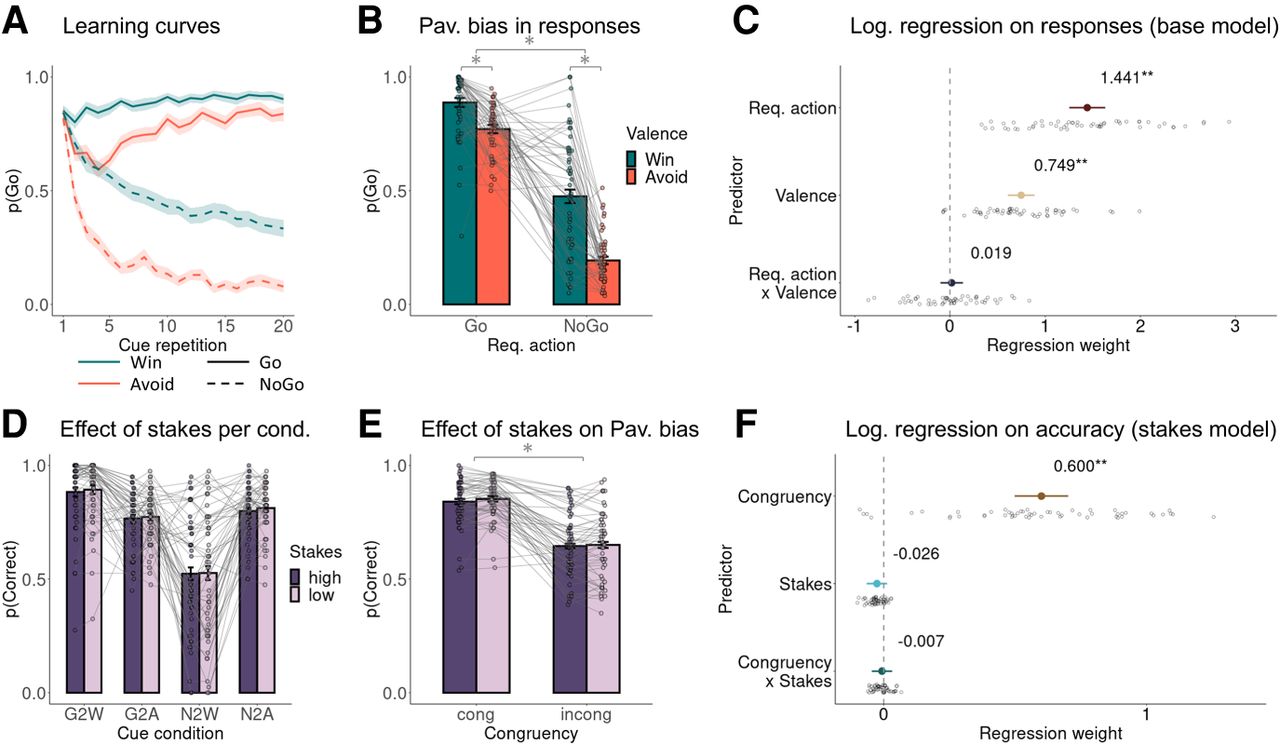
Effect on propensity of Go responses. (A) Learning curves per cue condition. (B) Proportion of Go responses per cue condition (individual dots are individual participant means). Participants show more Go responses to Go than NoGo cues (indicative of learning the task) and more Go responses to Win cues than Avoid cues (indicative of Pavlovian biases). (C) Group-level (colored dot, 95%-CI) and individual-participant (gray dots) regression coefficients from a mixed-effects logistic regression of responses on required action, cue valence, and their interaction. (D) Accuracy per cue condition and stakes condition. Accuracy is higher for congruent than incongruent cues, but there is no effect of stakes on responses for any cue condition. (E) Accuracy per valence-action congruency and stakes condition. Accuracy is higher for congruent than incongruent conditions, but this congruency effect is not modulated by stakes. (F) Group-level and individual-participant regression coefficients from a mixed-effects logistic regression of responses on congruency, stakes, and their interaction.