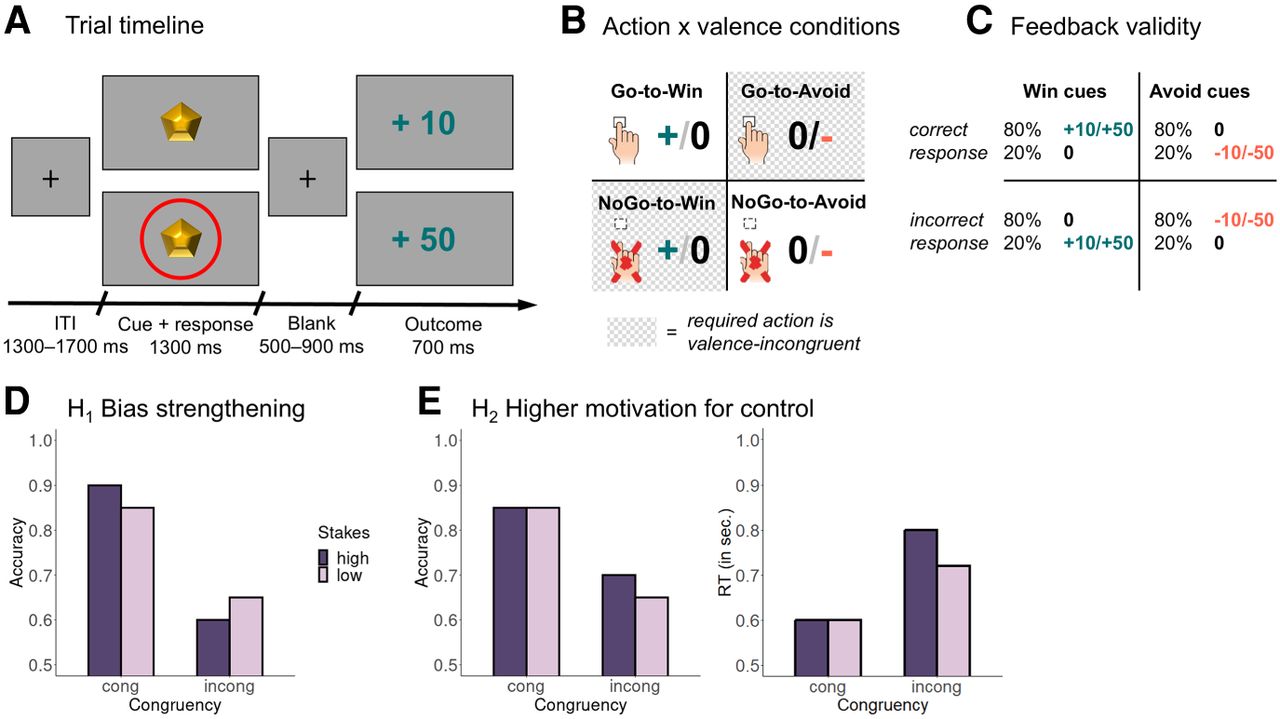
Task and behavioral predictions. (A) Time course of each trial. Participants see one of four cues (“gems”) and have to decide whether to respond to it with a button press (“Go”) or not (“NoGo”). On half of the trials, the cue is surrounded by a red circle, indicating that stakes are five times as high and points gained/lost in this trial will be multiplied with 5. After a variable interval, participants receive an outcome (increase in points, no change, or decrease in points). (B) Task conditions. Half of the cues are “Win” cues for which points can be gained (or no change in the point score occurs), while the other half are “Avoid” cues for which points can be lost (or no change in the point score occurs). Orthogonal to cue valence is the correct action required for each cue, which is either Go or NoGo. (C) Feedback given cue valence and response accuracy. For Win cues, correct responses mostly lead to an increase in points (+10 or +50, depending on whether the trial was high or low stakes), but occasionally lead to no change in score (0). For Avoid cues, correct responses mostly lead to no change in score (0), but occasionally lead to a loss of points (−10 or −50, depending on whether the trial was high or low stakes). For incorrect responses, probabilities are reversed. (D) Prediction from a “bias strengthening” hypothesis. High stakes strengthen biases, leading to higher accuracy for bias-congruent cues (for which required action and valence match), but lower accuracy for bias-incongruent cues. (E) Prediction from the “expected value of control” theory. High stakes motivate cognitive control, which inhibits biases when they are incongruent with the required action, leading to higher accuracy selectively for bias-incongruent cues (for which the bias-triggered response has to be inhibited). At the same time, cognitive control recruitment takes time, leading to slower RTs on incongruent trials, and this slowing is stronger under high stakes when more control is recruited.