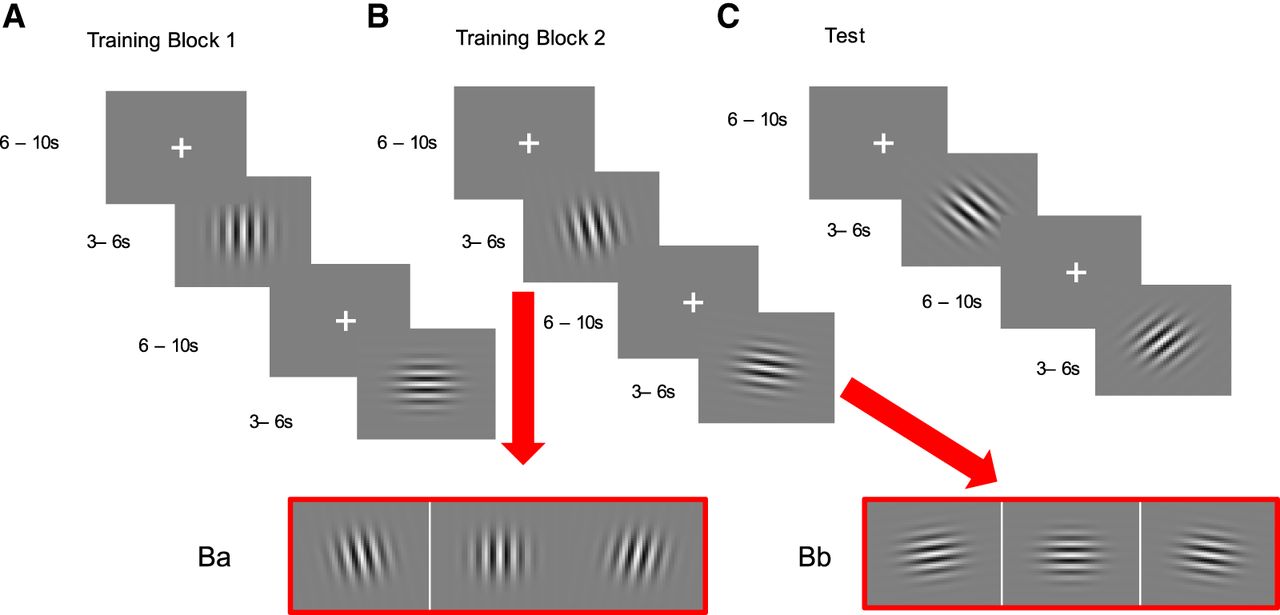
There are two phases within these experiments: training and test. Training was first started with an easy Block 1 (A) which was followed by more difficult blocks (Blocks 2–5 in Experiments 1, 3, and 5, and Blocks 2–3 in Experiment 4). This was followed by a test with novel stimuli (C), one of which was followed by the trained safety signal and the other served as a control. (A) Training Block 1. Participants were shown either a horizontal or vertical Gabor patch. One was paired with an aversive image or a loud noise (CS+), one was not (CS−), and this was counterbalanced. (B) Training Blocks 2–5, in which more stimuli were incorporated. Four new stimuli were added (Ba and Bb). Each of the new Gabor stimuli were 10° apart in orientation from the stimuli used in Training Block 1, except Experiment 5 in which Block 2 had 5° of difference. This made the “vertical” versus “horizontal” discrimination more difficult, but also facilitated the transfer of responding during the test to the new stimuli. (C) The Test Phase participants were shown new stimuli. These Gabor patches were in between the horizontal and vertical Gabor stimuli (135° and 45°). One of these produced the trained safety signal and the other one was the control.