Cover image
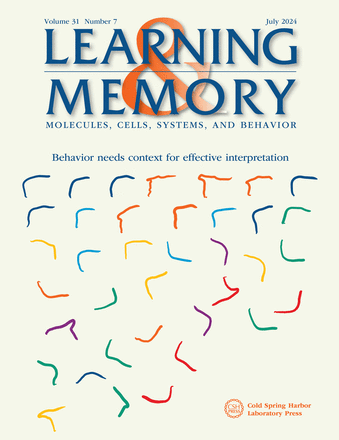
How we interpret behavior is shaped by context. Similar waves of a hand, for example, can mean “hello,” “goodbye,” or “call on me!” depending on whether you're coming, going, or sitting in a classroom. Similarly, decision-making trajectories can warp in a variety of ways as they arc toward their conclusion. As symbolized in this issue's cover image, however, searching for patterns in these routes to reward is often fraught. Do wavering paths represent indecision? Deliberation? Changes of mind? To better understand such vacillations, often called vicarious trial and error, and how they relate to flexible behavior more broadly, Miles et al. (LearnMem a053911.123) analyzed different trajectory shapes within the context of a learning and memory task. They found that vicarious trial and error tended to occur as rats learned decision-making strategies, which was also when choice accuracy and estimates of behavioral flexibility hit their peaks. These relationships were not absolute, though. Vicarious trial and error sometimes led to incorrect decisions, which was more likely to occur when rats were inflexible. Similarly, inflexible vicarious trial and error was significantly more likely to result in incorrect decisions. These observations help demonstrate that vicarious trial and error likely comes in multiple flavors, one suggestive of deliberation and another representing indecision or uncertainty. Interestingly, rhythmic neural activity in the prefrontal cortex also varied depending on the type of decision and when it occurred throughout the course of learning. Stronger increases in mid-frequency beta activity were present during vicarious trial and error, and power increased in higher frequency gamma rhythms after reward contingencies were learned. Together, these results showcase the importance of context for interpreting both neural activity and behavior. (Cover illustration by Jesse Miles.)